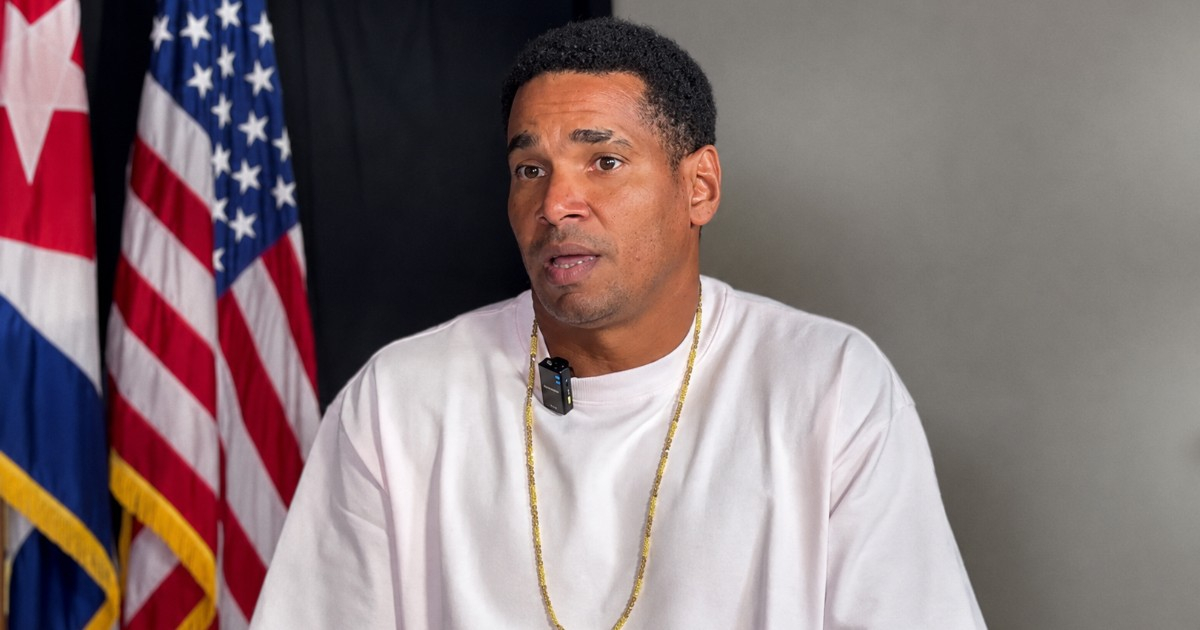
Luis Manuel Otero Alcántara revealed this Monday that the days leading up to his departure from Cuba were not days of freedom, but rather an extension of his confinement in another form. 4
After being released from the Guanajay prison on July 7, State Security moved him to a residence near Guanabo and kept him under custody while his entry into the United States was being processed.
"I was still imprisoned. They were simply taking me to another place," declared the artist and founder of the San Isidro Movement in an interview granted to Martí Noticias.
Otero Alcántara arrived in Miami this Saturday after five years of political imprisonment in Cuba, following the approval on July 17 of a humanitarian parole to allow his entry into the United States.
The application had been processed using the I-131 form submitted to the United States Citizenship and Immigration Services (USCIS) after several weeks of efforts.
Although during his stay in Guanabo he was able to say goodbye to some family and friends, Otero Alcántara claimed that all his conversations were recorded.
He stated that he still considered himself a prisoner because he remained under the surveillance and control of State Security. Various international organizations have classified this situation as "forced disappearance."
The artist recounted that the officials took those days to understand his emotional state and future plans, as well as to gauge how willing he was to negotiate.
He also stated that the authorities knew they could not keep him isolated indefinitely due to international pressure and the efforts made before international organizations.
After his transfer from Guanajay and the completion of his sentence, the United Nations Committee on Enforced Disappearances activated an Urgent Action in his favor, while Amnesty International reported that he was in a situation of enforced disappearance and demanded his immediate and unconditional release.
Otero Alcántara stated that he was aware that the images captured during those days could later be used to try to discredit him.
"I love cameras," he commented. "Using them against me depends on the perception of us, those who are building narratives," he added.
Exile as the only alternative
The founder of the San Isidro Movement stated that, since the beginning of his imprisonment, State Security made it clear to him that the only way to leave prison was to accept exile.
The artist was forced to leave Cuba permanently as a condition for regaining his freedom, despite having fully served his sentence.
Otero Alcántara explained that he chose the United States due to its proximity to Cuba and because part of his family lives there.
During the interview, the protest artist stated that painting was the main resource that helped him endure five years of incarceration. He confirmed that he continued to create works despite the isolation and that some of them were confiscated.
"If they took away all the paintings, at least 20 people had changed with the works we created in prison," he stated while explaining the impact his work had on other inmates.
When asked why the authorities allowed him to continue painting and take out a large part of his works from prison, he replied: "Because I was dying, and they didn't want me dead."
Claim for the freedom of El Osorbo
The artist dedicated part of the conversation with Martí Noticias to calling for the release of the rapper and political prisoner Maykel Castillo Pérez, known as El Osorbo, who is serving a nine-year sentence.
The musician was transferred on July 10 from Kilo 8 prison in Pinar del Río to the maximum security prison in Guanajay. His family was not informed in advance about the transfer.
Otero denounced that the Cuban regime continues to use political prisoners as bargaining chips.
Regarding Cuba's political future, he noted that he does not expect an immediate outcome, but rather the beginning of a longer process.
"I don’t believe there is an end. I believe there is a transition, and transitions lead to an evolution," he stated.
The artist also spoke about the conversations he had with other inmates regarding the possibility of a military action by the United States against the Cuban regime.
"People want something to happen. People are crazy for something to happen," he expressed.
Otero announced that he will continue to develop his work and activism from exile, with the release of political prisoners and international attention on the situation in Cuba among his priorities.
"We're going to keep working and we won't waste a minute, because a minute that we lose is one more minute of dictatorship," he concluded.
Related videos:
Filed under: