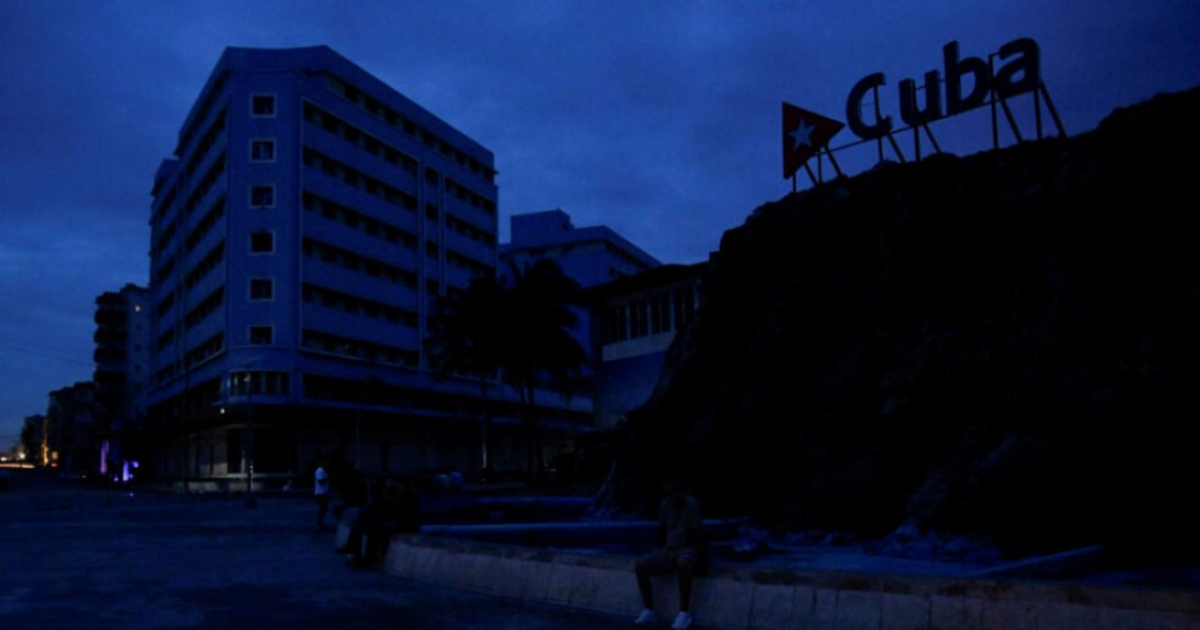
Cuba faces this Sunday, during the commemoration of the 73rd anniversary of the Moncada assault, a projected electricity deficit of 2,080 MW for peak hours, according to a news release from the Electric Union (UNE). The expected availability is only 1,150 MW compared to an estimated demand of 3,200 MW.
The day began with a new breakdown at the largest plant in the country: at 1:07 AM, UNE announced on Facebook that Unit 1 of the Antonio Guiteras Power Plant in Matanzas had gone offline from the National Electric System (SEN) "due to a leak in the economizer."
This plant has accumulated at least 17 unplanned outages so far in 2026, most of which are due to breakdowns in the boiler and the economizer, becoming the most visible symbol of the Cuban thermoelectric collapse.
On Saturday, the electrical service was affected around the clock, including the early morning hours. The highest impact reached 1,883 MW at 9:40 PM, affecting all provinces in the country.
In addition to the "Guiteras," the following units are experiencing issues: unit 6 of the Máximo Gómez thermoelectric plant (Mariel), unit 6 of the Diez de Octubre thermoelectric plant (Nuevitas), unit 2 of the Lidio Ramón Pérez thermoelectric plant (Felton), and unit 3 of the Antonio Maceo thermoelectric plant (Renté).
Unit 3 of the Ernesto Guevara de la Serna thermoelectric plant in Santa Cruz, as well as Units 5 and 6 of the "Antonio Maceo" in Renté, and Unit 5 of the "Diez de Octubre" in Nuevitas are currently under maintenance.
Distributed generation does not offer relief either: 106 power plants are out of service due to a lack of fuel, along with the Patana de Regla, the Patana de Melones, the Central Fuel in Mariel, and the Central Fuel in Moa.
The 54 photovoltaic solar parks generated 5,258 MW/hour on Saturday, with a maximum output of 876 MW, a contribution that is insufficient to offset the thermal collapse.
The political context adds a particular dimension to this Sunday's energy crisis. On the eve of July 26, Havana received electricity unusually consistently, which activists and citizens interpreted as a maneuver by the regime to demobilize protests on a politically sensitive date.
On Wednesday, the Assembly of the Cuban Resistance called for a national pot-banging event that took place in multiple neighborhoods of Havana, including Lawton, San Agustín, La Coronela, La Lisa, Centro Habana, and San Miguel del Padrón.
On Saturday, dozens of uniformed police officers were deployed in El Diezmero, San Miguel del Padrón municipality.
July 2026 has been the most critical month of the year for the SEN: on July 8, the largest historical deficit was recorded, reaching 2,341 MW, and the system completely collapsed on July 6, 10, and 14, leaving approximately 9.6 million people without electricity during each incident.
The projected deficit for this July 26—the date on which the regime celebrates its most emblematic anniversary with the central event in Pinar del Río—edges dangerously close to that historical record, while millions of Cubans are facing prolonged blackouts during the work hiatus decreed by the government itself.
Related videos:
Filed under: