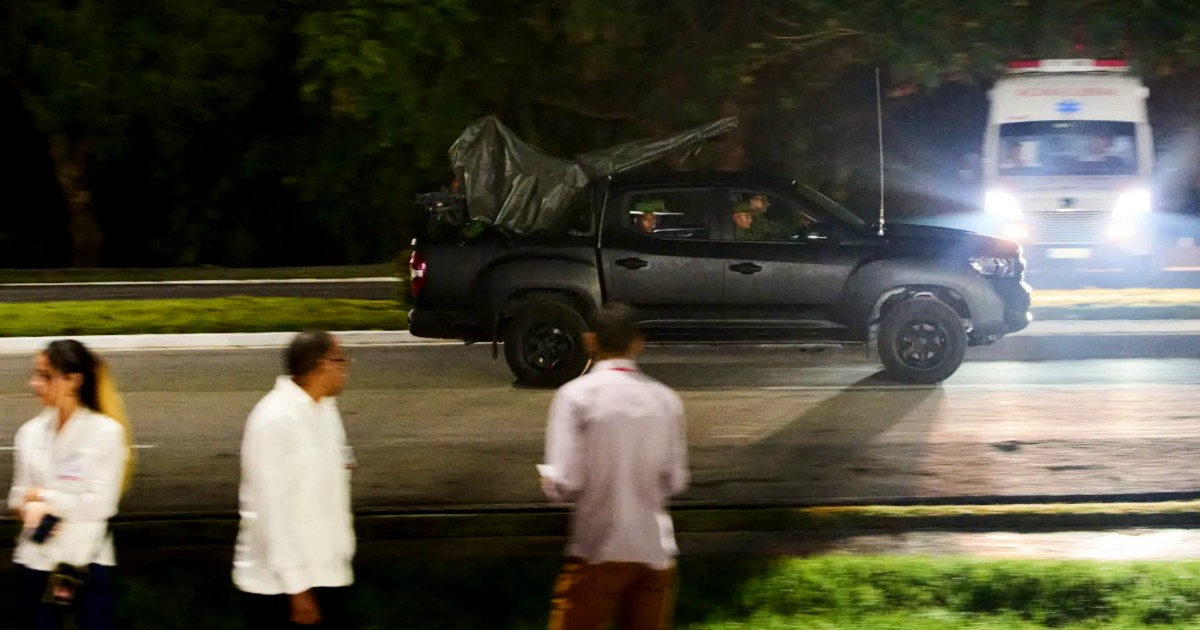
Cuban citizens captured and spread images of anti-aircraft equipment deployed on the streets of Pinar del Río last Sunday during the central event commemorating the anniversary of the assault on the Moncada, where Miguel Díaz-Canel and other high-ranking figures of the regime presided over the celebration.
The photographs, posted on social media by journalists Mario J. Pentón and Daniel Benítez, show dark pickup trucks —at least one from the brand MAXUS, manufactured in China— carrying weaponry concealed under military tarps in their rear beds and operated by uniformed personnel driving along roads in the province.
Pentón pointed out that the deployment was in response to the need to "reinforce Díaz-Canel's security during the July 26 event," and questioned the spending on military equipment while the country's energy infrastructure is collapsing: "I suppose that if there was money to buy military vehicles and drones, there should have been funds to repair the thermal power plants, right?".
On his part, Benítez was more straightforward in his interpretation of the deployment: «And the dictatorship says there is no fear while they bring out anti-aircraft weapons just in case... Remember that all of this is happening while they tell you there is no fuel».
The presidential security operation takes place within a context of sustained escalating tensions between Cuba and the United States throughout 2026. The Trump administration has deployed aircraft carriers in the Caribbean—including the USS Nimitz, which arrived on May 20 as part of Operation Southern Seas 2026—and has imposed more than 240 new sanctions on the island.
In parallel, U.S. intelligence aircraft have accumulated over 150 hours of aerial surveillance around Cuba since February 4, with routes that frequently skirt the western edge of the island.
Pinar del Río, the province closest to Florida, holds special strategic importance in this context: an RC-135V Rivet Joint spy plane flew over the northern coast of Cuba in February and turned north precisely at the height of that province, and a MQ-4C Triton drone from the U.S. Navy conducted a reconnaissance flight around Cuba in April, flying over areas near Pinar del Río.
The regime has responded with periodic military exercises: in May, it conducted live-fire drills with Soviet-made S-125 missiles, and in June, it carried out air raid drills in five provinces during National Defense Day.
The event on Sunday in Pinar del Río —the first time the province hosted the central celebration since 2001— was also marked by the absence of Raúl Castro, who broke a tradition of at least three decades by not attending the event in person.
Díaz-Canel read a handwritten message signed by Castro without the government providing any public explanation for his absence, adding an additional political dimension to a day already filled with signs.
Pentón summarized the paradox of the moment with a question: "Is this a sign that fear is starting to be felt within the longest-standing tyranny on the continent?"
Related videos:
Filed under: