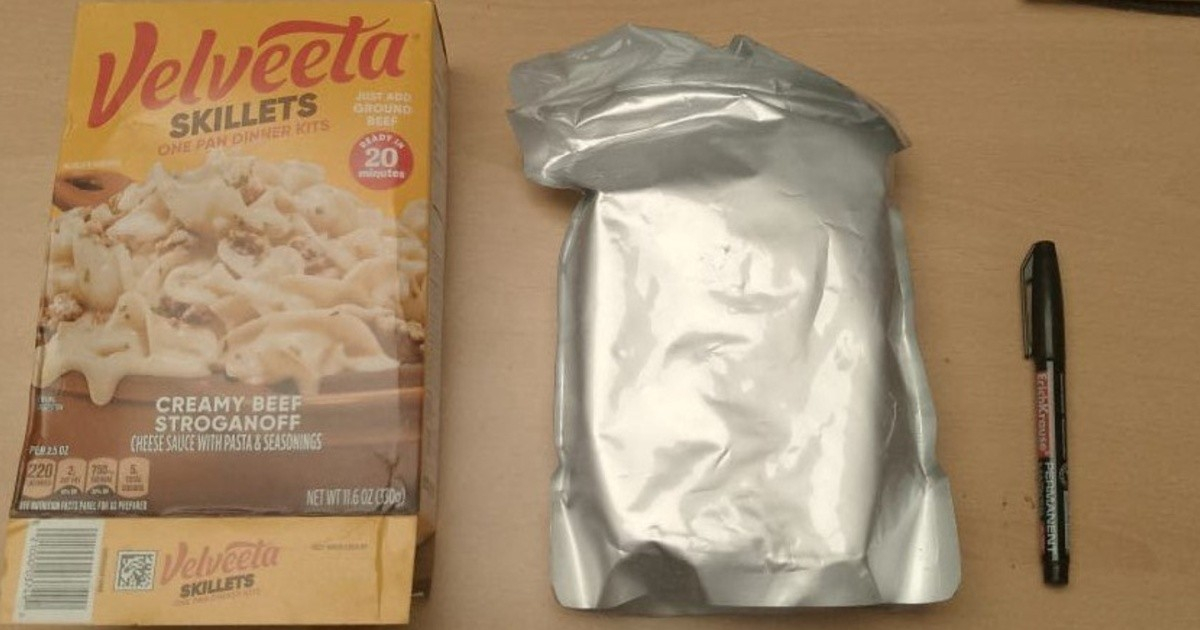
The Cuban Customs intercepted a new shipment of synthetic cannabinoids from the United States this Friday, disguised in a box of the food product Velveeta Skillets —a creamy pasta mix— that arrived in the country by air.
The discovery was announced by Wiliam Pérez González, the first deputy chief of the General Customs of the Republic, through his official account on X: "Another shipment from the U.S. with hidden synthetic cannabinoids was detected in a food box; the package arrived by air and the drug was in cream form. The anti-drug agency continues its investigation into the case as a demonstration of the collaborative efforts with Cuba’s Customs."
The substance was hidden in cream form inside a silver metallic bag included in the box, which at first glance appeared to be one of the ingredients of the culinary kit.
The images published by the official show the box of Velveeta Skillets next to the bag with the drugs, as well as a detection dog—equipped with a harness—inspecting the package.
Este decomiso es el más reciente de una serie de operativos que revelan un patrón consolidado: el uso de cajas de alimentos de marcas estadounidenses reconocidas para introducir cannabinoides sintéticos en la isla aprovechando el flujo de remesas de alimentos desde la comunidad cubana en EE.UU.
On Saturday, July 18, Customs detected a "chemical" hidden in two boxes of food from the U.S., one of which was a Pillsbury brownie mix.
In April, 19 leaves soaked with synthetic cannabinoids were found inside a box of Cocoa Puffs cereal sent from the U.S., with an estimated capacity for 22,800 doses. In March 2025, the drug was discovered hidden in disposable diapers.
Synthetic cannabinoids —known in Cuba as "el químico" or "papelillo"— are between 50 and 100 times more potent than marijuana and can cause seizures, psychosis, organ failure, and death.
At least 40 variants are circulating in Cuba out of a total of 245 identified worldwide.
The health impact is alarming. According to data from Dr. Tania Adriana Peón Valdés, head of Mental Health and Addictions in Havana, cited by the AP agency, medical emergencies due to the use of these substances in the capital increased from 467 cases in 2024 to 886 in 2025. The age of first use is between 13 and 14 years old.
Since May 2025, a more lethal version of the "chemical" has been circulating in Cuba that may contain fentanyl, formaldehyde, benzodiazepines, phenobarbital, and veterinary anesthetics.
In response, in April 2026 the Decree-Law 108 "On Customs" and Decree 134 came into effect, which classify drug importation as a "very serious" offense, subject to confiscation and fines of up to three times the value of the goods.
The José Martí International Airport in Havana accounts for 77% of the detected drug trafficking cases at Cuban borders, and the areas with the highest incidence of synthetic cannabinoid consumption are Holguín and Havana.
Related videos:
Filed under: