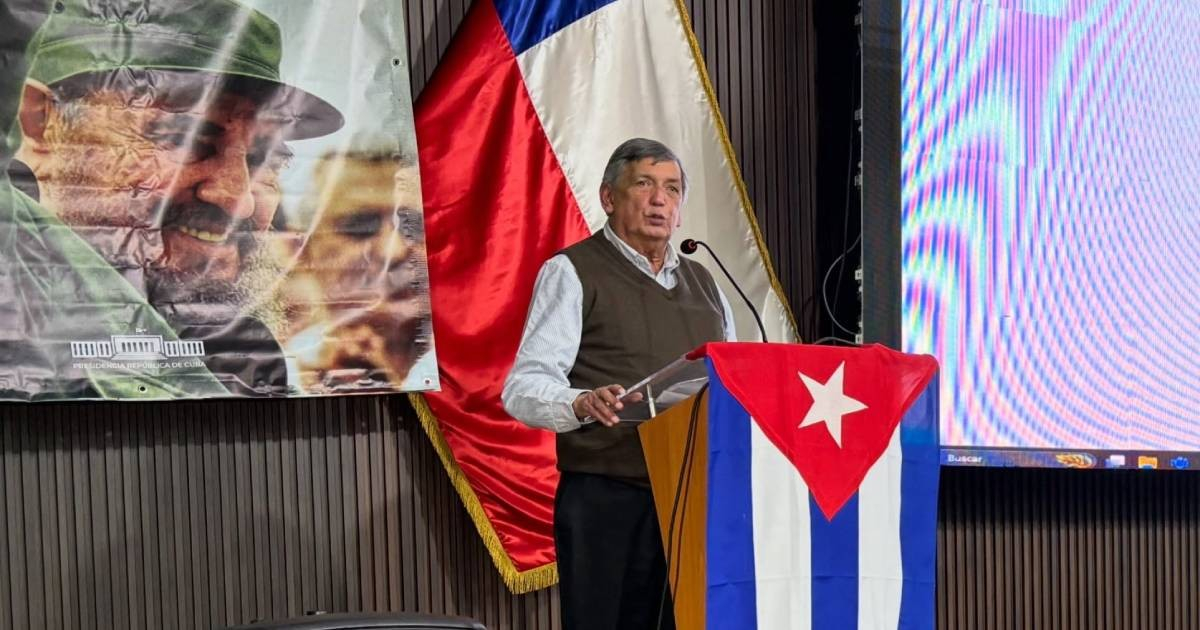
The president of the Communist Party (PC) of Chile, Lautaro Carmona, stated this Sunday that Cuba "is a democratic system, from a historical point of view," in an interview with El Mercurio, just days before traveling to Havana to participate in an international meeting dedicated to Fidel Castro.
Carmona and the party's general secretary, Bárbara Figueroa, will attend the I International Colloquium "Fidel: Legacy and Future," scheduled for August 10 to 13, as part of the activities organized to commemorate the centenary of the Cuban dictator's birth, reported T13.
During the interview, the leader defended the political system of the island and justified the existence of a single party by appealing to the history of Cuban independence. "Why is there a one-party system? That comes from the time of Martí, when the Cuban people had to establish an organization to drive out the Spaniards," he stated.
He also placed Fidel Castro among the key figures of the international communist movement. "Fidel is a very, very important reference for the communist movement of the 20th century; there is Lenin and there is Fidel as two major icons, along with Mao and Ho Chi Minh," he stated.
The statements contrast with the position expressed during the 2025 Chilean presidential campaign by then-Communist Party candidate Jeannette Jara, who acknowledged that “Cuba is not a democracy.”
When asked about that difference in opinion, Carmona responded that his party's historical stance does not depend on electoral considerations. "The opinion held by the Communist Party as a historical viewpoint is not adaptable for the sake of winning or losing a vote," he noted.
His statements provoked criticism from various political sectors in Chile.
Former deputy Pepe Auth questioned on social media how Carmona can praise Fidel Castro, Lenin, Mao Zedong, and Ho Chi Minh "as if nothing had happened in the last fifty years. As if they were unaware of the cruelty of the dictatorships inspired by them."
From the right-wing opposition, UDI lawmakers described the trip to Cuba as "unacceptable," while Congressman Cristóbal Urruticoechea from the Libertarian National Party stated that Fidel Castro led a dictatorship whose consequences continue to affect the Cuban people.
For her part, Bárbara Figueroa rejected the criticisms and argued that there is a "double standard," stating that such questioning only arises when leftist leaders participate in international activities.
Carmona's statements also contrast with the assessments of international organizations regarding the Cuban political system. In its report Freedom in the World 2026, Freedom House gave Cuba a score of 9 out of 100, with zero points in political rights, and it remained classified as a "Not Free" country.
The Cuban Constitution of 2019 establishes the Communist Party of Cuba as the "highest leading political force of society and the State," without legal recognition for opposition parties.
This is not the first time Carmona has defended the Cuban regime. In January of this year, he publicly questioned then Chilean president Gabriel Boric after Boric labeled Cuba a dictatorship. That same month, Carmona visited Havana and met with Miguel Díaz-Canel and other high-ranking officials, who conveyed to him that Cuba is going through “the most complex moment in Cuba's history since the Revolution, including the invasion at Playa Girón”.
In April 2026, the General Comptroller of Chile questioned the University of Chile for allowing its facilities for a event in which Carmona participated and a tribute was paid to Cuban military personnel who died during the operation that captured Nicolás Maduro.
The Chilean Communist Party currently operates from the opposition following the assumption of ultraconservative José Antonio Kast in March 2026, a government that has taken an openly hostile stance towards the Cuban regime and which in June 2026 declared that it would support a possible U.S. intervention on the island.
Related videos:
Filed under: