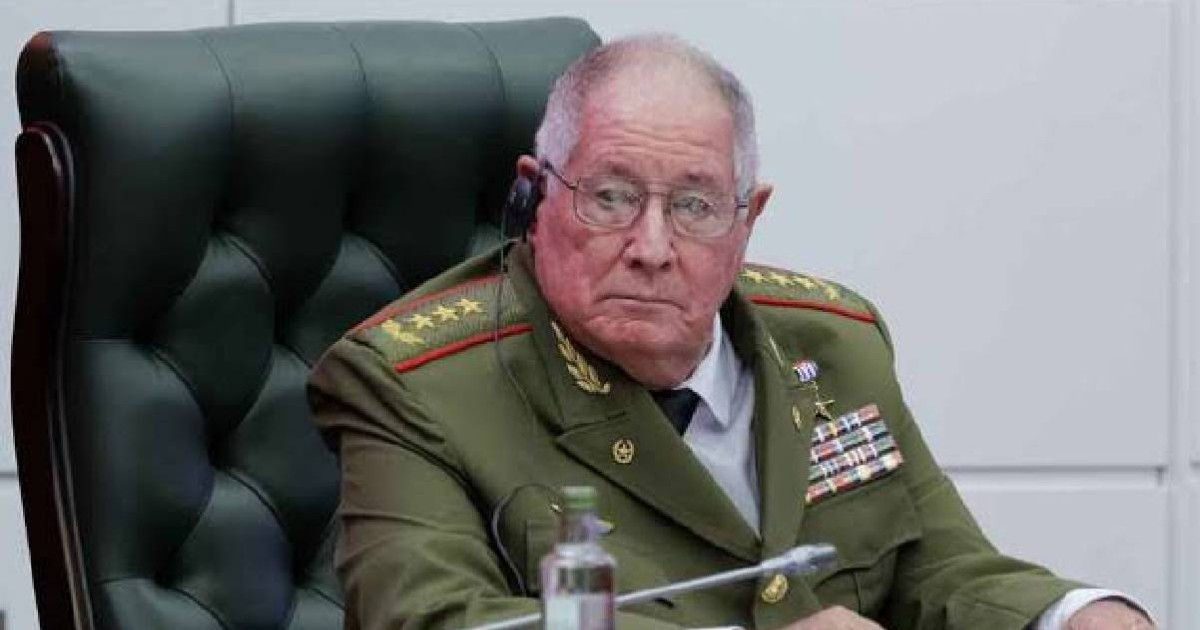
The State Department sanctioned this Thursday general Álvaro Victoriano López Miera, Cuban Minister of the FAR, marking his third designation by the United States in five years, each with a different legal basis and objective.
That agency also designated five Cuban entities and another seven individuals under Executive Order 14404, directly targeting the network that manages the purchase of foreign weapons for the Ministry of Revolutionary Armed Forces (MINFAR).
Alongside the Minister of the FAR, Roberto Legrá Sotolongo was also appointed as the Chief of the General Staff and First Deputy Minister of MINFAR, noted for his involvement in the acquisition of weapon systems from Russia.
Legrá was also already carrying a prior sanction from the Department of the Treasury, imposed on August 19, 2021, under the Global Magnitsky Act.
The measures announced this Thursday are broad economic and financial sanctions, quite different from the visa restrictions that the State Department itself imposed in July 2025 under Section 7031(c) of the Appropriations Act, which prohibited their entry into U.S. territory along with their immediate family members.
This time, the justification is not internal repression but its role in the regime's military cooperation with Russia and China.
As a result of the designation under EO 14404, all property and interests in property of López Miera under U.S. jurisdiction are blocked, and U.S. citizens and companies are prohibited from engaging in any transactions with him.
Six other officials from MINFAR have been added to the list: José Antonio Remón Rodríguez, head of the Foreign Relations Directorate; Óscar Enrique Biosca Gallego, responsible for the Economic Directorate; Mónica Milián Gómez, military attaché of Cuba in Russia; Waldo Pérez Cortés, military attaché in China; Roberto Jesús Viciana Mousset, general director of the Military Industry Union (UIM) and Brigadier General of the FAR; and Heriberto Sánchez Alleyne, general director of Tecnoimport.
The five sanctioned entities make up the core of the Cuban military supply chain: Tecnoimport and Tecnotex, both subsidiaries of the military conglomerate GAESA; the Military Industry Union; the Yuri Gagarin Military Industrial Company, dedicated to the maintenance of Russian aircraft; and Duna S.A.
The official bulletin from the State Department indicates that Tecnotex, in addition to its connection with the repair of Russian helicopters, has previously maintained cooperation with North Korea.
The Secretary of State Marco Rubio justified the measures with a statement in which he labeled the Cuban regime as a state sponsor of terrorism.
"The Trump administration will continue to use all the tools at our disposal to address the national security threats posed by the Cuban communist regime and to promote economic and political reforms that will give the Cuban people a better future," he stated.
Rubio also warned third parties: "Foreign banks and other companies that provide services to these sanctioned individuals or hold funds on their behalf must cease those activities immediately," at the risk of facing secondary sanctions.
The appointments announced this Thursday are part of a sustained escalation of sanctions against the Cuban regime that began in May 2026, and follow the report "Cuba: The Capital of 21st Century Communism," published by the Department of State on July 20, which documents Havana's military alliances with Moscow and Beijing, including the presence of Russian intelligence facilities on the island and allegations that as many as 5,000 Cuban military personnel may have fought in Ukraine integrated into Russian forces.
The first sanction against López Miera dates back to July 22, 2021, when the Treasury Department designated him under the Global Magnitsky Act for his responsibility in the repression of the protests of July 11 of that year.
Related videos:
Filed under: