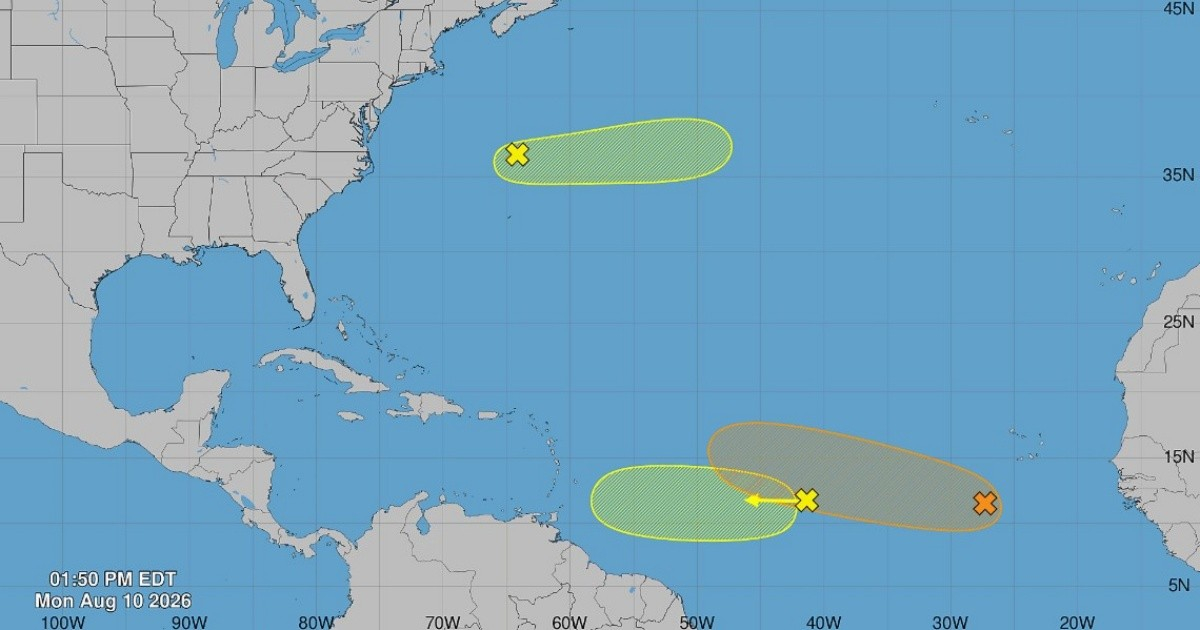
The National Hurricane Center (NHC) raised this Monday the probability to 60% that the most active tropical system under surveillance in the Atlantic will organize into a tropical depression during the second half of this week, according to the tropical outlook bulletin issued at 2:00 p.m. Eastern Time.
The figure confirms a steady increase: on Sunday morning the probability was 40%, it rose to 50% by the afternoon, and this Monday it reached 60%. On Saturday, it barely touched 30%.
It is expected to become a tropical depression by the middle of the week as it moves toward the Caribbean.
The main system: low pressure southwest of Cape Verde
The most closely monitored disturbance is an area of low pressure located several hundred miles southwest of the Cape Verde islands, generating disorganized rain and thunderstorms as it slowly moves westward.
The NHC expects that a tropical wave soon to emerge off the western coast of Africa will merge with that low pressure system in a couple of days, enhancing the conditions for its organization.
The agency, based in Miami, was explicit:
"It is forecasted that environmental conditions will be more favorable for development by mid-week, and a tropical depression could form during the second half of this week as the system moves west to west-northwest across the central tropical Atlantic."
The probability of formation in the next 48 hours remains low, at 20%. However, the seven-day outlook - at 60% is what is drawing the attention of specialists.
Two additional systems under surveillance
In addition to the main system, the NHC is monitoring two other disturbances with lower potential.
The second is due to disorganized showers associated with a tropical wave located approximately halfway between West Africa and the Lesser Antilles, with a 10% probability of formation in both 48 hours and seven days.
The NHC warned that "upper-level winds are expected to become less conducive for development by the end of the week as the system approaches the Lesser Antilles."
The third disturbance is a low-pressure trough north of Bermuda, also with a 10% probability in both time frames, whose chances of organization would end after Wednesday as it reaches cooler waters.
What path could I follow?
For now, there is no specific path toward the Caribbean nor any confirmed threat to Cuba or other islands.
The National Meteorological Service in San Juan indicated on Sunday that the models positioned the path of the wave to the northwest of Puerto Rico, without ruling out the possibility of bringing moisture and some rain to the island.
The system would move west or west-northwest across the central tropical Atlantic, a direction that in the coming days could bring it closer to the Antilles arch.
Calm season, but the peak is approaching
This activity takes place within the context of an exceptionally calm 2026 hurricane season: only two named storms have formed -Arthur and Bertha- and neither reached hurricane status.
The main factor is El Niño, which increases vertical wind shear over the Atlantic and hampers the organization of cyclones.
NOAA updated its seasonal forecast on August 7, maintaining an expectation of between seven and 13 named storms, with a 75% probability that the season will be below normal.
Nonetheless, the NHC itself has warned that "August often marks an increase in cyclonic activity," and that the climatological peak of the Atlantic season occurs around September 10.
For Cuba, the Institute of Meteorology (INSMET) estimated in May 2026 a 40% probability that at least one hurricane will affect the island during the season, and a 75% probability that at least one tropical storm will impact it, in a context of high vulnerability marked by power outages, food shortages, and a water crisis.
Related videos:
Filed under: