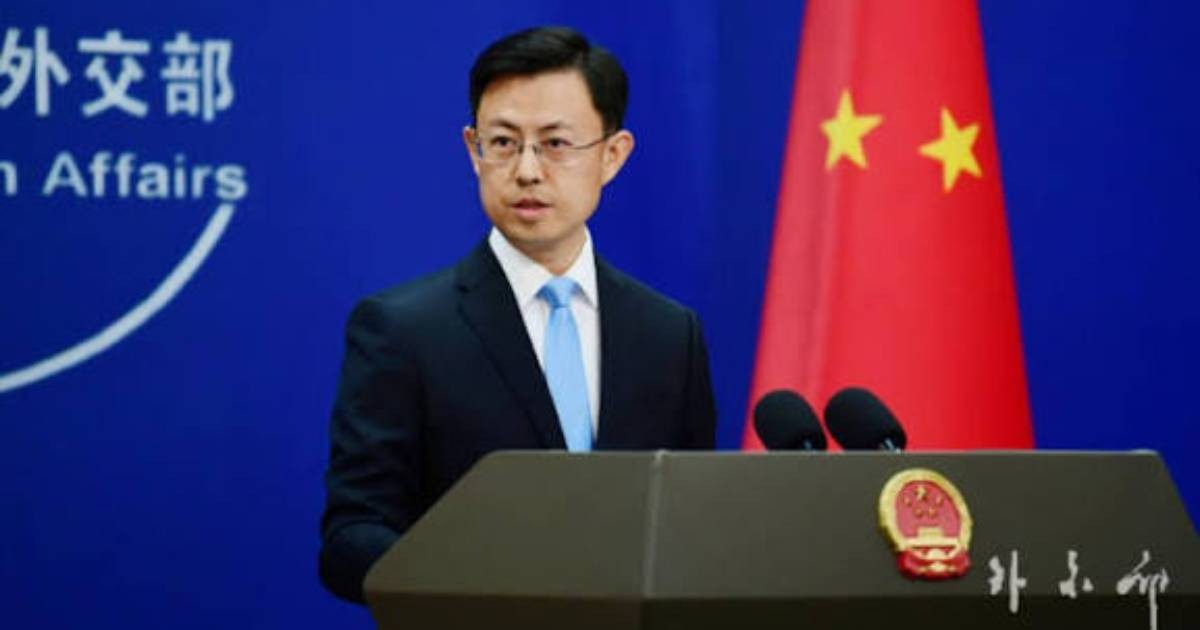
The spokesperson for the Chinese Ministry of Foreign Affairs, Guo Jiakun, demanded on Monday that Washington lift the sanctions against Cuba "as soon as possible" and accused the United States of "blaming others," in a direct response to the new measures imposed by the Donald Trump administration against companies and officials linked to the military apparatus of the Cuban regime.
The statements were made during the usual press conference of the Chinese Foreign Ministry, after a journalist from Prensa Latina inquired about Beijing's position regarding the sanctions announced on August 6 against five entities and eight individuals connected to the Cuban military apparatus and its ties with China and Russia.
"China has repeatedly expressed its stance on this matter. We urge the U.S. to lift the sanctions and blockade against Cuba as soon as possible and to stop blaming others," affirmed Guo, according to a tweet from the Chinese ambassador in Havana, Hua Xin.
The spokesperson also defended the relations between Beijing and Havana in the face of Washington's scrutiny.
"The cooperation between China and Cuba is legitimate and transparent, and China will continue to firmly support Cuba in defending its national sovereignty and opposing foreign interference," he assured.
Beijing's response comes after the State Department announced last Wednesday a new round of sanctions under Executive Order 14404, signed by President Donald Trump on May 1, 2026.
The provision expanded Washington's ability to sanction individuals and entities that support the security apparatus of the Cuban regime and its military relationships with foreign powers.
Among the eight individuals designated are the Minister of the Revolutionary Armed Forces, Álvaro López Miera, and the Chief of Staff, Roberto Legrá Sotolongo, who has also been sanctioned due to his connections with Moscow and Beijing.
Among the Cuban entities affected by the measures are Tecnoimport, Duna S.A., the Military Industry Union, and the Yuri Gagarin Military Industrial Company. Washington specifically accused Duna S.A. of facilitating the entry of military materials from China and Russia into Cuba.
Beijing's reaction, however, was not limited to the diplomatic arena.
A day after the announcement of the sanctions, Ambassador Hua Xin reported the , at a time when the island continues to face a deep energy crisis characterized by prolonged blackouts and the deterioration of the National Electric System.
China's economic support for the Cuban government has remained consistent throughout 2026. At the beginning of the year, Beijing announced an assistance package of 80 million dollars and 60,000 tons of rice. Later, the amount of rice committed increased to 90,000 tons, according to statements from Hua Xin himself.
This is not the first occasion that the Chinese Foreign Ministry has publicly defended Havana against the measures taken by Washington.
Between January and August 2026, Beijing has consistently rejected the U.S. sanctions policy and has practically repeated the same argument: that its cooperation with Cuba is "legitimate and transparent" and that it will continue to "strongly" support the Cuban government against what it perceives as foreign interference.
The stance also highlights the growing clash between Washington and Beijing over China's presence in Cuba, a matter that has gained greater significance within the Trump administration's policy toward the island.
U.S. pressure has progressively intensified throughout the year. The military business conglomerate GAESA was designated in May; the Ministry of the Armed Revolutionary Forces in June; and the Ministry of Tourism in July. Now, sanctions have also been imposed on entities and officials linked to Cuba's military cooperation with foreign powers.
Washington has specifically identified the ties between Havana and Beijing and Moscow as one of its primary security concerns. The United States ambassador has directly linked the .
Related videos:
Filed under: