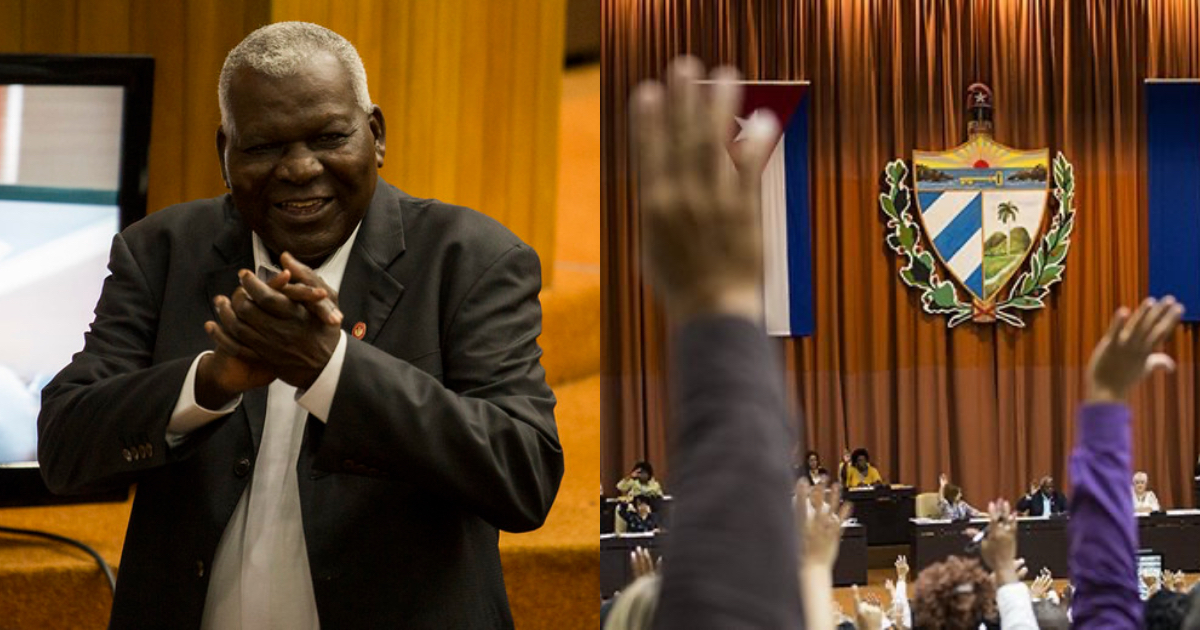
If instead of years of dogma and populism, Cubans had learned about the origin and functioning of modern parliaments, the Castro regime could not present the National Assembly of People's Power —filled with empty slogans, lacking political pluralism and genuine oversight capacity over the Executive— as the think tank tasked with saving the nation from the greatest economic, political, and social crisis Cuba has faced since 1959. These and other thoughts accompany me as I rock in my Ikea armchair in Madrid. It's not my grandmother's chair, but it helps keep me connected to my Cuban identity.
Unfortunately, Cubans born after the revolutionary tragedy have not been educated to understand the importance of the legislative power; perhaps that's why we overlook what happens in the Assembly. Indifference finds strong allies in scarcity, unsanitary conditions, and the collapse of the National Electric System, which keeps us busy day and night just trying to survive, without understanding, at times, that today surviving also means being involved.
History has shown that, in free societies, the Parliament is the place where democratically elected officials from various political groups act as public servants, aware of their responsibilities, and enact laws to find solutions to citizens' issues. Among its functions, the oversight of public spending incurred by the Executive Branch and the control of its implementation stand out. After all, the funds available to the State are not its own but ours: the result of the taxes collected from the work we perform.
In summary, the Parliament should be one of the centers of real power in a nation: the space where the issues raised by civil society are acknowledged and the laws aimed at addressing them are approved, while holding the party in power accountable for the measures taken and the resources used.
Our Parliament, on the other hand, betrays that mission by denying our precarious existence to uphold the ideas of the Executive, which it should be questioning and controlling. The analyses put forward and their spokespersons attempt to replace the debate intrinsic to the political spaces of fully functioning democracies with a kind of bait aimed at convincing the West of a freedom that does not exist on the Island.
The fragility of its power as an institution does not stem from a lack of understanding of its functions, but rather from the absence of a fundamental principle of pluralistic formation. Since it is not composed of politicians from different ideological currents, there are no substantial contradictions in how the law is proposed or executed among its deputies. No one refutes or questions opposing opinions; instead, they intervene to corroborate previous assertions and demonstrate trust in the same political actors who have led the country into extreme misery.
As the stage comes to life, social media is flooded with comments that share a common denominator: the lack of courage among Cuban deputies to confront ministers or heads of commissions who poorly execute their duties. However, my impression diverges from this simplistic evaluation: do they lack courage, or do they lack political will and the interest to defend the people? That is perhaps the key question we should ask ourselves.
After all, in Cuba, parliamentarians are not elected directly by us, but rather appointed through a process controlled by the top echelons of the Castro regime, to which they respond with unanimous voice and vote.
The session unfolds like others of its kind in this legislature: the president of the Assembly reads, without intonation, even the commas of the prepared speech. As I shift my chair more quickly, my anxiety gets the better of me just as I hear a female member of parliament caution about the role of social media and hold it accountable for the inevitable rift between the State and its citizens.
My exclamations out loud catch everyone's attention at home. I forget that I'm 9,000 kilometers away and get indignant as if I were sitting in my grandmother's armchair in Havana.
I attempt to explain my outburst as I tell my husband about the intervention of this representative from Holguín, who avoids deeply sensitive and socially relevant topics, such as the increase in infant mortality to 9 out of every thousand live births or the rising aging population without a replacement labor rate. Instead, she dedicates her time to convincing us of the negative impact of social media on the image of party leaders. She doesn't question the results of economic centralization or the lack of individual freedoms as factors in the sustained decline of a country that is suffering amid collapsing hospitals and massive waves of migration.
The contempt with which he speaks of Cubans willing to speak out is, precisely, a reflection of the lasting damage that limits our freedom of expression. He does not understand, or does not want to understand, that people turn to social media to expose what is being attempted to be hidden from those chairs. They seek refuge online because Cuban institutions are in ruins and there is no mechanism, organization, or administration capable of active listening and providing appropriate solutions. They turn to social media despite repression and political persecution because they have chosen between dying in silence and dying while speaking out, and they have made the choice to perish while pointing a finger at the source of so much grievance.
I inevitably compare it to my new reality and it doesn't take long for me to reflect on this unjustified reaction towards other spaces of critical thought where individuals are free. In the Cuban landscape, for years, there has been no analysis of who or what produces the crisis, but rather of who or what denounces it.
His episode of forced denial reminds me of another, equally or even more embarrassing, that occurred just a year earlier: the former Minister of Labor and Social Security, sitting before more than 175 Cubans gathered in the Assembly, assured that Cuba had no citizens living on the streets, but rather opportunists who, avoiding tax laws, disguised themselves as beggars and flooded our cities.
It speaks of the same Cuba where, to survive, the elderly depend on young people who one day took unknown paths, and from here we even guarantee surgical materials for emergency surgeries. The same Cuba where a doctor's salary barely covers the cost of a dozen eggs or two bottles of oil. The same Cuba where you can never aspire to own a home or a means of transportation. The same Cuba where more and more teenagers turn to drugs to escape from a sad but undeniable reality.
Can anyone believe that in that Cuba there are no needy, hungry, and barefoot people begging in the streets for a piece of bread to put in their mouths? There are such people in Paris and Madrid. How could there not be any in Cuba?
Denying: the hallmark quality for being appointed. Denying misery to avoid recognizing that communism has failed wherever it has been applied. Denying precariousness, the lack of hygiene, and the absence of compassion in order to also deny assistance and help. Denying the source of the problem so that changes remain aesthetic rather than profound.
It is the same formula applied to different cases: denying the existence of beggars takes the workload off the shoulders of deputies, who will not have to find mechanisms for care and security; denying access to networks allows for control over a complaint that transcends our community and becomes a headline of interest anywhere in the world.
This unfounded criticism of social media, I believe, is a precursor to a new prohibition. As if we were children, they justify the countless restrictions imposed with rhetoric filled with false protection and apparent well-being.
Prohibiting the networks would not be a law that would surprise me. After all, we haven't always had them. We would simply be returning to a recent past in which we were restricted from reading literary texts contrary to the system, receiving radio signals from critical spaces, and even communicating via cell phones and their corresponding mobile data services, precisely to keep us blind to the developments in the world and limit our access to knowledge.
Last year's ETECSA rate hike had the same objective through a different means: I do not explicitly prohibit you from using data to read independent news, but I indirectly ensure that you cannot access it due to a lack of financial resources.
Contrary to expectations, people pay for the most expensive data plan on the planet and continue to seek refuge in that virtual world that embodies the freedom denied to us. Now that they have tasted it, they cannot give it up. Even though freedom may resemble an old phone with poor signal, it is an addictive elixir that makes it impossible to live without sipping from its waters.
Just when my deepest thoughts pull me away from the debate, I come back to reality and respond. This has been the pattern all these years: laws emerge that restrict individual freedom, the economy declines, and emigration increases; the northern neighbor is blamed for the Cuban drama; to ease internal pressure, sanctions signed in Havana are lifted, not in Washington; and just when it seems there will be a real opening, the initial ban is reinstated.
Twelve years of my life listening to teachers say that the socialist revolution changes everything that needs to be changed, only to ultimately understand that the famous Marxist law of materialist dialectics consists of making constant changes that lead to the same blind path of economic centralization and political imposition.
In this instance, there are updates. The dictatorship, desperate due to the internal crisis and external pressure, has escalated to a new level and proudly presents the economic measures package that has been kept under wraps for nearly 15 years.
If someone were to ask me for a title for the government program read by Prime Minister Marrero, I would gladly call it: From the benevolent and all-powerful socialism to the unprecedented construction of 21st-century feudalism.
In the words of its deputies, this is a unique model that does not imitate the Asian one but is inspired by its results; a market economy that is not capitalism but is based on development through the privatization of the means of production; a system where everything can change except for those who have governed for almost 70 years and who are now implementing this new experiment, the heir to the Guidelines, the Order, and the Reorganization. In summary, they have recreated a drawer pamphlet that will ultimately prove that no economic change without real political transformations can save a nation from total collapse.
How can a market economy be sustained where private property is not respected, production and prices are intervened and regulated, and there is no real law to protect entrepreneurs because the law itself is subordinate to the power of the dictator and his inner circle?
Who would invest in a nation that does not provide legal security against potential lawsuits and publicly acknowledges its determination not to pay debts with foreign investment funds?
How can one believe that they will respect property rights when they do not respect basic human rights?
Those are the questions that true representatives of the Cuban people should be asking, concerned about their hardships and without commitments to any interests other than those of their constituents.
But we won't see anything about that in the Assembly. What we do see clearly is the waste of resources allocated to those who, when discussing the economy, applaud any measure, even though there are contradictions among them.
The credit credibility that Cuba needs to attract investors from all over the world, both Cuban and foreign, has been buried by the irrational decisions of the Castro regime and the blind support of legislators who lacked the courage or the will to stop this frenzy of market intervention, without any studies to back their short-, medium-, and long-term outcomes.
It is not in this type of plenary where our solutions lie, I conclude. My indignation prevents me from sitting still. I dress as a mambisa, a redeemer, and an uncompromising individual, and I repeat endlessly: Cuba has only one way out, and it is called freedom. Freedom to create, to think, to criticize, to believe, to choose, and to express. As long as the seats are filled with fearful loyalists rather than with free thinkers, we will have the same Assembly of praises and zero debates that have led us to the current crisis.
Related videos:
Filed under:
Opinion article: Las declaraciones y opiniones expresadas en este artículo son de exclusiva responsabilidad de su autor y no representan necesariamente el punto de vista de CiberCuba.