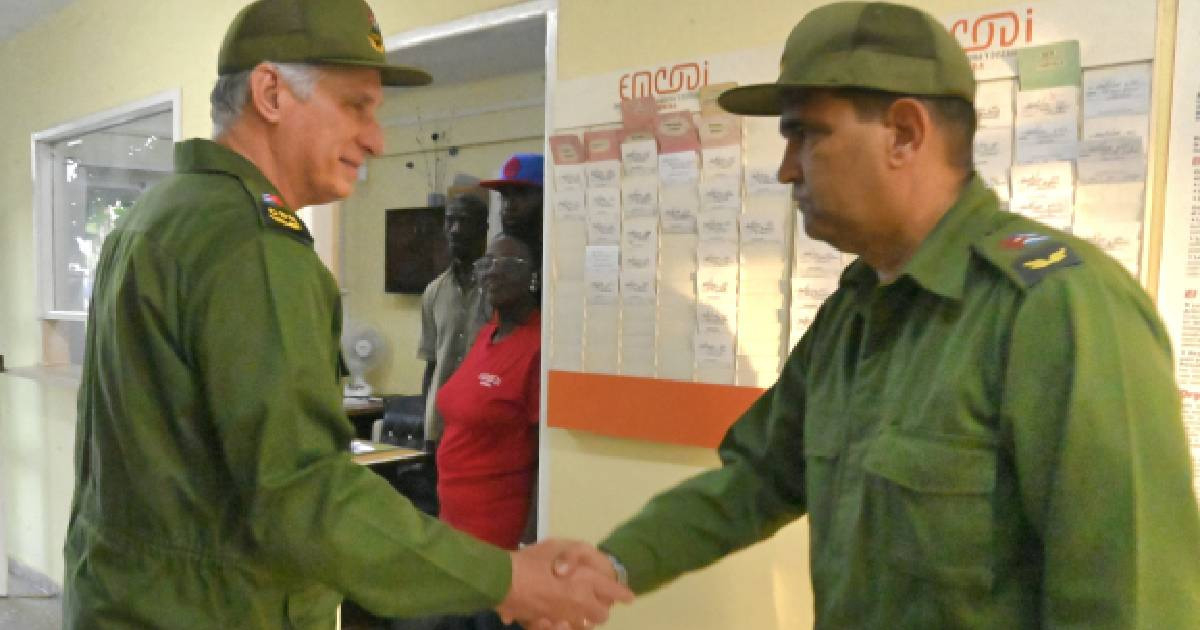
The leader Miguel Díaz-Canel visited the "Roble-Chibás" Defense Zone in the Havana municipality of Guanabacoa this Friday, where he urged the use of local resources to address issues affecting the residents of the municipality, in the context of National Defense Day
According to the official site of the Cuban Presidency, Díaz-Canel called for an analysis of the productive and social possibilities of the 176 transformations approved by the government in June, including greater municipal autonomy, the removal of the limit on workers per private enterprise, and the decentralization of prices.
During the meeting, the same issues affecting the region were identified as priorities, including power outages, the accumulation of solid waste, and difficulties with water supply.
Additionally, the president of the National Defense Council, in his capacity as president of the Republic, emphasized that "the task of defense is a fundamental responsibility for the country," while mentioning other priorities for work in a Defense Zone "such as plans to protect the population, the completion of the Production and Defense Brigades, and tasks that, he said, relate to the daily life of the population," the source highlighted.
Accompanying the leader were Esteban Lazo Hernández, president of the National Assembly of People's Power and the Council of State; the Secretary of Organization of the Central Committee of the Communist Party, Roberto Morales Ojeda; the minister of the Revolutionary Armed Forces (FAR), army general Álvaro López Miera; army general and minister of the Interior, Lázaro Alberto Álvarez Casas; and division general and secretary of the Council of Ministers, José Amado Ricardo Guerra.
On Thursday, the state company Aguas de La Habana reported on a new breakdown in the Gato System that left Los Camilos, Regla Zona Baja, Casa Blanca, and areas of Guanabacoa without water supply, without specifying a date for the restoration of service.
The presidential visit took place after several episodes of social tension in the municipality. Days earlier, three women stayed until 3:30 in the morning to prevent workers from the Electric Company from removing the transformer from their block.
In July, protests involving pots and pans were also recorded in the neighborhoods of D'Beche, Nalón, and Loma de la Pela, driven by power outages lasting over 33 hours. At the end of that month, a graffiti appeared with the phrase "Down with the dictatorship" at the Barreras agromarket.
The visit is part of a tour that started at the end of June across the 15 municipalities of Havana to review the operation of the Defense Zones.
A slide released by Canal Caribe on July 17 placed these structures within the context of a strategy to coordinate responses to a potential increase in social conflict.
While the Government insists on taking advantage of the "local potential," nearly 500,000 residents of Havana lack regular access to potable water, according to the information provided. At the national level, the figure rises to 2.7 million people.
Related videos:
Filed under: