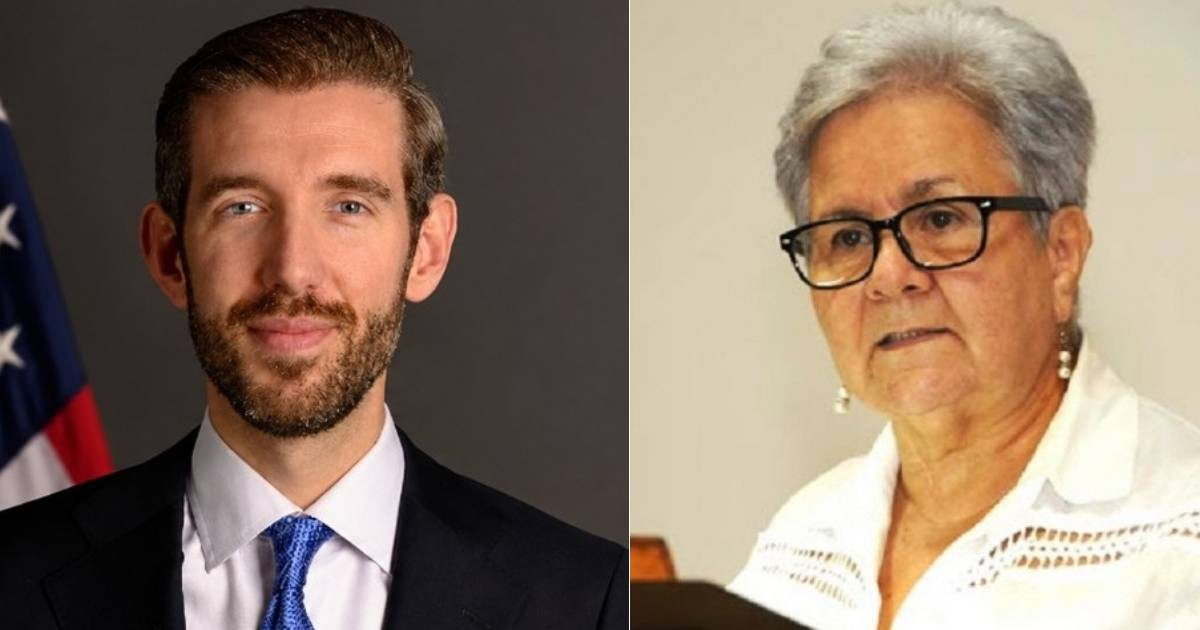
Juan Pablo Segura, newly appointed Undersecretary of State for Western Hemisphere Affairs, once again scrutinized the financial opacity of GAESA by recalling the case of Cuba's former Comptroller General, Gladys Bejerano, who publicly acknowledged in 2024 that the agency responsible for auditing state accounts did not audit the powerful business conglomerate of the Armed Forces.
In a post on Wednesday from the official account on X @WHAAsstSecty, Segura also linked Bejerano's departure from the General Comptroller's Office to those statements, an interpretation that contrasts with the version provided at the time by the Cuban authorities.
“The former vice president of the State Council and general auditor of Cuba for 14 years was dismissed by the Cuban regime for publicly stating the truth, that the State had no jurisdiction to audit GAESA. This is just one of the many ways in which GAESA has looted 18 billion dollars from the Cuban people's funds,” he wrote.
The message was accompanied by a graphic featuring partially redacted financial documents and a phrase summarizing Washington's accusation: "GAESA: EVEN CUBA'S MAIN AUDITING ENTITY COULD NOT AUDIT THEM."
The confession that exposed GAESA's shield
Bejerano was at the helm of the General Comptroller's Office of the Republic from its creation in 2009 until July 2024, and during part of that period, he also held the vice presidency of the Council of State.
In May 2024, during an interview with the agency EFE regarding the corruption case involving the then-former Minister of Economy Alejandro Gil, Bejerano acknowledged that GAESA was beyond the scope of the audits conducted by the Comptroller's Office.
The official then justified that situation by arguing that the military conglomerate had "superior discipline and organization."
The statement was particularly significant because it came from the highest authority of the agency responsible for overseeing public resource management, and it confirmed that one of the largest business networks in the country was not subject to its inspections.
Just two months later, the National Assembly replaced Bejerano with Mirian Marbán González. The Cuban authorities presented the change as part of a "natural process of renewal of leadership."
No public evidence has been presented to demonstrate that those statements were the direct cause of their dismissal, but the close timing between the two events once again places the episode at the center of criticism regarding the secrecy surrounding the finances of the military conglomerate.
The millions of GAESA beyond public scrutiny
The statement takes on greater significance following the leak of internal financial documents from GAESA, which revealed part of the volume of resources managed by the conglomerate.
The figure of 18 billion dollars mentioned by Segura refers to an investigation published by the Miami Herald in August 2025 based on 22 leaked internal financial documents.
According to those records, in March 2024, the companies within the conglomerate —including Gaviota, TRD Caribe, CIMEX, and Almacenes Universales— had accumulated nearly 17.8 billion dollars in current assets. Of that amount, about 14.467 billion dollars were deposited in bank accounts.
The documents provided a previously unknown picture of the extent of the resources controlled by GAESA, while the Cuban economy was experiencing a deep crisis marked by blackouts, shortages of food and medicine, and the deterioration of essential public services.
A structure also protected by legislation
The lack of oversight over military companies is not solely dependent on internal practices.
The Law 158/2022 of the General Comptroller of the Republic, published in the Official Gazette in February 2023, modified the framework under which institutions linked to armed structures can be monitored.
The regulations removed previous references to the oversight of those organizations and placed their control under specific mechanisms supervised by the presidency, reinforcing criticisms about the lack of public and independent auditing of GAESA.
The conglomerate controls strategic sectors of the Cuban economy, particularly activities related to tourism, retail, remittances, logistics, and real estate operations, but its financial statements are not regularly published for public knowledge.
Washington increases pressure on GAESA
The publication is one of the first high-profile statements about Cuba from Segura since he took office on August 14, following confirmation by the Senate.
Your message is part of the Washington offensive against GAESA, which the Donald Trump administration identifies as one of the economic pillars of the Cuban military power.
In May, Secretary of State Marco Rubio announced direct sanctions against the conglomerate and its CEO, Ania Guillermina Lastres Morera. Subsequently, Washington increased pressure on foreign companies that maintain business relations with entities linked to GAESA.
At the beginning of August, the State Department once again directed attention to the money managed by the conglomerate and publicly questioned why GAESA does not use its funds to meet the basic needs of Cubans.
The question carries particular weight amid a crisis in which millions of people are suffering from prolonged blackouts and facing difficulties in accessing food, medicine, and other essential products.
Segura's message now brings back a contradiction that Bejerano's own statements exposed in 2024: for years, the highest authority responsible for auditing the resources of the Cuban state acknowledged that it could not oversee one of the conglomerates that concentrates a substantial part of the country's economic activity.
Related videos:
Filed under: