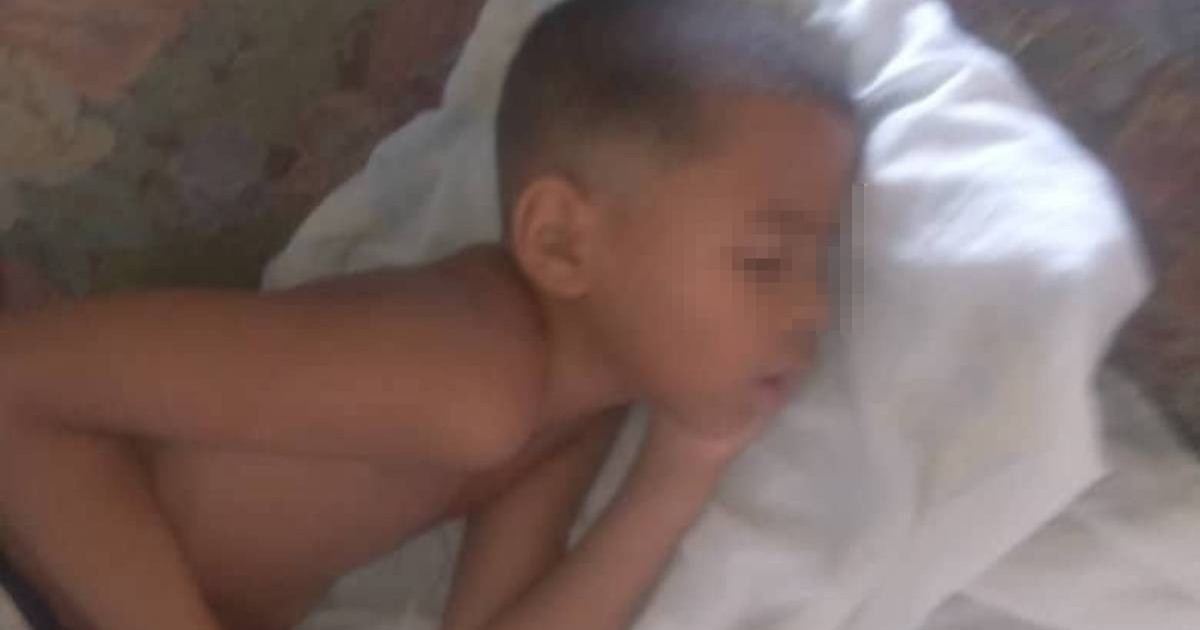
A Cuban mother identified as Ivisleivi Castellano Puig publicly reported that her seven-year-old son, Cristian Michel Roldán Castellano, has been experiencing a fever for five days and started to bleed from the nose without receiving timely emergency care, according to a report shared on Facebook by the Movimiento Democracia (MD) and the Movimiento Opositores por una Nueva República (MONR).
According to the mother's account, in the first few days, she took the child to a clinic where he was initially diagnosed with a cold and then a viral infection.
On the fourth day of fever, the child began to show signs of nosebleed and was transferred to the hospital.
The mother reports that, despite the child arriving bleeding, the staff did not take his vital signs immediately nor provide the attention she deemed urgent.
Another obstacle emerged: they were informed that the laboratory was not operational due to a lack of reagents, which hindered the ability to conduct basic clinical tests.
Finally, the minor was evaluated and referred to the Hospital Las Católicas with suspected hemorrhagic dengue, although the signatories of the complaint clarify that this diagnosis has not been confirmed.
"The one thing we do denounce is the anguish of a mother who has had to seek care for her son as he experiences prolonged fever and nosebleeds," states the text signed by José Díaz Silva and Ramón Saúl Sánchez, leaders of MONR and MD respectively.
The case is set against the backdrop of a serious health crisis affecting Cuba, with an active outbreak of dengue that has been ongoing since 2025. In July 2026, Villa Clara confirmed the simultaneous circulation of the DENV-2 and DENV-4 serotypes, a combination deemed especially dangerous as it accelerates the progression towards severe forms of the disease.
The shortage of laboratory reagents —which hinders the ability to perform blood counts, hematocrits, and platelet counts, essential tests for monitoring dengue— has been documented in multiple Cuban hospitals during 2025 and 2026, exacerbated by power outages and the energy crisis.
According to a report by Infobae, the shortage of fuel and reagents has forced hospitals across the island to cut essential blood tests.
Children are the most vulnerable group. By the end of 2025, the Pan American Health Organization recorded 81,909 infections of dengue and chikungunya in Cuba and 65 associated deaths, with more than half of the deceased being minors.
In December of that year, children represented 65% of the severe cases of arbovirosis in the country.
This is not the first case to cause alarm. In July 2025, a two-year-old child died in Camagüey due to alleged medical negligence related to hemorrhagic dengue, in a hospital where there were no specialists or clinical analyses available.
Months later, a mother reported that there was only one pediatrician for the entire pediatric hospital during an outbreak of arbovirosis in that same province.
The report on Cristian Michel concludes with a question that encapsulates the desperation of many Cuban families: "How many more children need to fall ill before dignified and timely medical care is ensured?"
Related videos:
Filed under: