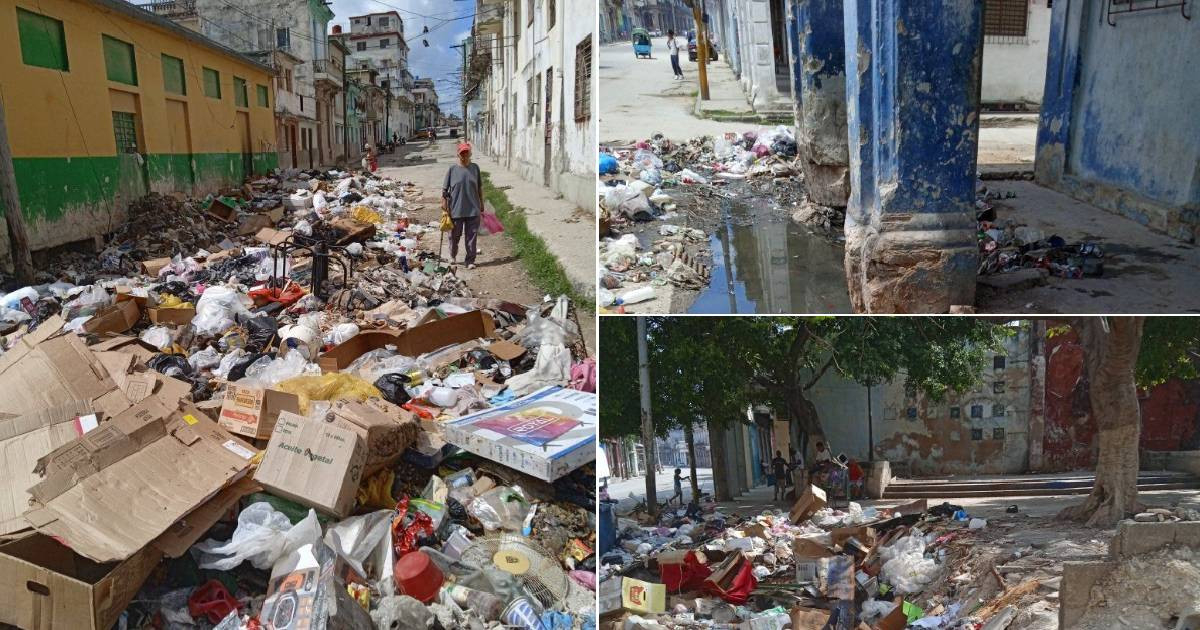
A historian from the University of Havana who works within the official Cuban system published a text on Facebook this Friday that depicts daily life on the island as a catalogue of failures and deprivations, culminating in a devastating statement: “Normalcy does not rise above the condition of being a downright mess.”
Fabio Fernández Batista, a professor in the Department of Cuban History at the University of Havana and a member of the National Committee of the Union of Historians of Cuba, wrote the text —titled "Under the Light of the Moon and with the Complicity of an Unexpected Breeze"— without the shelter of anonymity or the distance of exile, but from within the cultural apparatus of the Cuban State.
The academic outlines in his publication a typology of today's Cubans: those who emigrated convinced that the future lay outside, those who remain waiting for the first opportunity to leave, and those who — like him — have chosen to stay. Regarding the latter, he writes without romanticism: "The country that exists right now is unbearable, a warehouse of suffering."
The description of that everyday reality is meticulous and uncompromising. "One has to live without electricity, without water, without gas [...] one has to juggle a hundred different tasks just to have these basic services appear in life, and often the result is nothing but failure," he writes. Precarity, he adds, can only be mitigated if one manages to find some recreational plan or work project that allows for a moment of forgetfulness—"even if just for a little while"—from the garbage in the corner, the "meager and uncomfortable" transportation, the rampant inflation, the elderly person lying in a dirty doorway, and the shirtless, shoeless children begging for alms.
These details reflect a verifiable reality. The garbage collection fleet in Havana operates with less than half of its trucks available, leaving thousands of cubic meters of waste uncollected each day. Power outages in Cuba extend for more than 20 consecutive hours in most provinces, and the National Electric System has accumulated seven nationwide outages by early August.
This energy crisis is compounded by a wage gap that makes survival nearly impossible. The minimum wage was set at 3,210 pesos as of July 1, while covering the basic needs of a person is estimated to require 96,060 pesos per month—around thirty times more—of which more than 70,000 is solely for food.
Fernández Batista does not shy away from the political dimension of what he describes: "The list of the guilty is already made. The scorn is worth spreading here and there, although no serious person can deny that the apostles of the promised freedom have been working for several months to make everything that was already bad—terribly bad—worse."
It is not the first time that the historian has used social media to portray the crisis. At the end of July, he published the text "Zombie Apocalypse," which received widespread attention, in which he described Havana with dusty streets and black water, garbage burning on the corners, and long lines for bread. In that text, he pointed out a revealing fact about the public mood: "No one is talking about Trump, Rubio, or the blockade."
The text this Friday concludes with a bitter irony that encapsulates the exhaustion of those who have chosen not to leave: "If we do not perish, the survivors of these hard years deserve a medal or rather a small piece of heaven —with running water and gas, of course— because there is no doubt that this course in stoicism is quite intense."
Related videos:
Filed under: