"If Trump sends in the Army, everyone will hit the streets." The phrase was said by a 33-year-old Cuban to British journalist James Bloodworth during a tour of Havana.
He said it half in jest and quickly clarified that Trump was "crazy." However, Bloodworth understood that what mattered was not to take those words as a literal plea for military intervention, but rather to question what level of desperation drives someone living in Cuba to contemplate such a scenario out loud.
The level of frustration is such that some are willing to consider almost anything that brings the possibility of change, he wrote.
It has been just over three months since Bloodworth published In Cuba, Socialism Has Morphed Into A Racket, a chronicle of his time on the island that is now even more revealing than it was in May. Not so much because it uncovers poverty, blackouts, or shortages—realities that Cubans know all too well—but because it describes something harder to measure: the exhaustion of waiting.
That sentiment is increasingly recognized in the street language as well as in the reactions of Cubans to news about the crisis: “How long will this last?”, “it’s about time”, “they should leave”, “stop talking so much and do something”. Different expressions that ultimately reflect a shared loss of patience.
In June, after more than 36 hours without electricity in a neighborhood between La Lisa and Marianao, a woman expressed herself in front of a camera without resorting to political abstractions: «We are already tired of so much hunger, so much misery, and so much darkness». She asked how much longer they would have to live like this and ultimately demanded that those in power leave.
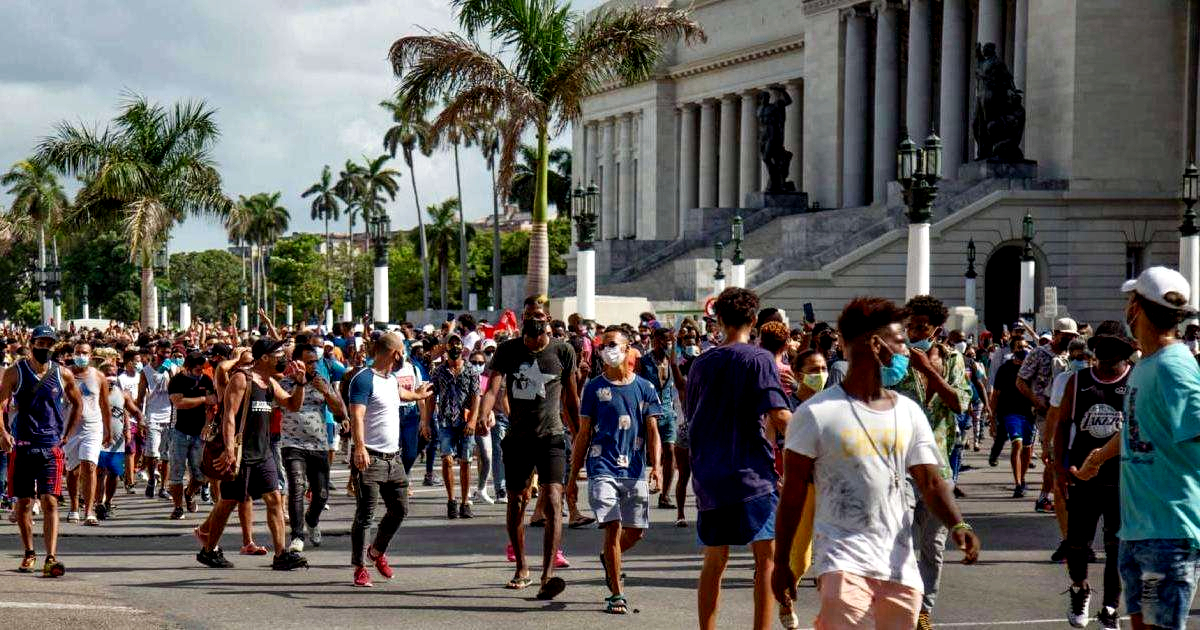
In July, there were women blocking the Calzada de Diez de Octubre after prolonged power outages, food going to waste, and children unable to sleep in their homes due to the heat. In Guanabacoa, there was a pot-banging protest after five days without electricity.
And August has not brought the relief that has been announced so many times.
At the beginning of the month, ten thermal power units were out of service, and the electricity deficit reached extraordinary levels, with days where many Cubans endured outages of over 20 hours. In Camagüey, while some communities reported endless blackouts, provincial authorities celebrated a cantata for the centenary of the dictator Fidel Castro.
That contrast would have fit perfectly in the Cuba described by Bloodworth.
In Havana, the journalist came across a nearly empty state bakery and a line of people waiting for bread that might not arrive. Across the street, a black SUV sat in front of a hotel primarily catering to foreigners, offering imported whisky and air conditioning.
Walking through the city, he met Antonio Rodríguez, a 60-year-old university History professor who also had to work as a tour guide. He earned about 9,000 pesos a month in his state job and confessed that, despite working two jobs, he only ate once a day.
They are not merely snapshots of poverty. For Bloodworth, they reveal a much deeper contradiction.
Cuba continues to officially present itself as a besieged socialist society, but the journalist argues that socialism, in any recognizable sense of the word, "has already fallen in Havana".
What you observe in its place is a post-ideological system led by a bureaucratic-military elite that continues to speak the language of the so-called "revolution" long after that promise has lost its substance.
The red flag, Bloodworth says, continues to wave. Power and money, however, flow through different channels.
At the center of that contradiction lies GAESA, the business conglomerate linked to the Armed Forces that controls vast sectors of tourism, retail, real estate, and foreign currency operations.
While millions of Cubans are waiting to see when the power will come back on or how much a pound of rice has increased in price, that military structure manages hotels, stores, businesses, and resources in hard currency.
Bloodworth cites analyses based on leaked financial information indicating that GAESA operates with extraordinary opacity and accumulates resources that do not end up funding the crumbling infrastructure and public services surrounding the Cubans.
There is one of the most uncomfortable images from your article: not that of a country where everyone is equally poor due to the failure of an old socialist utopia, but rather of a society divided in two.
On one side are those who have dollars, who can access certain businesses or navigate the privileged sectors of the economy. On the other side are those who earn in pesos and count their money every day just to eat.
The distance between both worlds has continued to grow.
The official year-on-year inflation reached 20.70% in July. Food and non-alcoholic beverages once again were the main drivers of price increases. A Cuban woman demonstrated this week some of the prices she found among the cheapest: rice at 330 pesos, sugar at 550, powdered milk at 1,700, one liter of oil at 3,650, and a package of chicken at 6,800.
These figures take on a different dimension when compared to salaries.
Another Cuban demonstrated in early August how 100 dollars, which were then converted to about 65,000 pesos, quickly disappeared while trying to stock the refrigerator. She spent 36,000 pesos on a purchase of basic goods that, as she explained, would not even cover the food needs for the entire month.
The dollar itself allows us to gauge how much the situation has deteriorated since Bloodworth's visit.
When he published his chronicle on May 13, he noted that the US dollar had reached 545 CUP in the informal market and used information from CiberCuba as a reference. This week, the dollar has stayed above 660 pesos, while the euro hovers around 750.
But reducing the issue to inflation, the dollar, or even power outages would be to scratch the surface of what Bloodworth is trying to convey.
His argument is that behind this precariousness, a power structure survives with specific interests in maintaining the system. An elite that continues to invoke socialism and the "revolution" in speeches, slogans, and political acts while controlling a significant portion of the sectors capable of generating foreign currency and remains shielded from the material conditions that the majority of Cubans endure.
Hence, the title chosen by Bloodworth is deliberately provocative: for him, Cuban socialism has transformed into a racket, an English term that in this context refers to an organized business for the benefit of those who control it.
Its description leans more towards that of an oligarchic structure than the egalitarian society still claimed by official propaganda: new or semi-empty hotels while resources are lacking in hospitals; stores stocked for those with foreign currency while state salaries lose value; a powerful military corporation managing businesses while the State claims it lacks resources to meet basic needs.
And in light of all this, a population that continues to be asked for resilience.
Perhaps that is why another observation from Bloodworth is so significant. During his conversations in Havana, many people began by clarifying that "they were not political." Then, when they felt they could speak securely, they talked at length about the country. They started in a low voice and ended up sharing much more than they initially seemed willing to disclose.
Three months later, a part of that exhaustion no longer needs to speak sotto voce.
It appears in a woman who asks "how much longer" after 36 hours without electricity; in neighbors who bring pots into the street; in those who respond with disbelief to another recovery plan from the Electric Union; and in the hundreds of comments that accompany each new official promise with variations of the same demand: that something finally happens.
It does not mean that all Cubans think alike, nor that the comment about a U.S. intervention can be extended to the entire society. Bloodworth himself found differing positions and people who viewed that possibility with skepticism, despite the fact that, in early May, 60.9% of the participants in the #EncuestaCuba supported a direct military intervention by the United States.
What is significant is something else.
When a man can imagine as desirable even a scenario that he immediately recognizes as extreme; when others openly ask how much longer they have to endure hunger and darkness; when official promises provoke more derision than hope, the problem for those in power ceases to be merely economic.
It is also a crisis of credibility.
Bloodworth concludes his article with a devastating assertion: the "Cuban revolution," understood as a project capable of providing society with a vision for the future, has long since come to an end. What remains, he argues, is a military elite that invokes that tradition while clinging to its privileges.
His old slogan was "Socialism or death." Bloodworth suggests another to describe the Cuba he found: "privilege or hunger".
And perhaps that is precisely where the testimony collected in May connects best with the discontent currently affecting the island. The question is no longer just how long a Cuban can endure without electricity, how much rice can increase in price, or how high the dollar can rise.
It's about how long a system can hold up when more and more citizens seem to have stopped expecting anything from it.
Related videos:
Filed under: