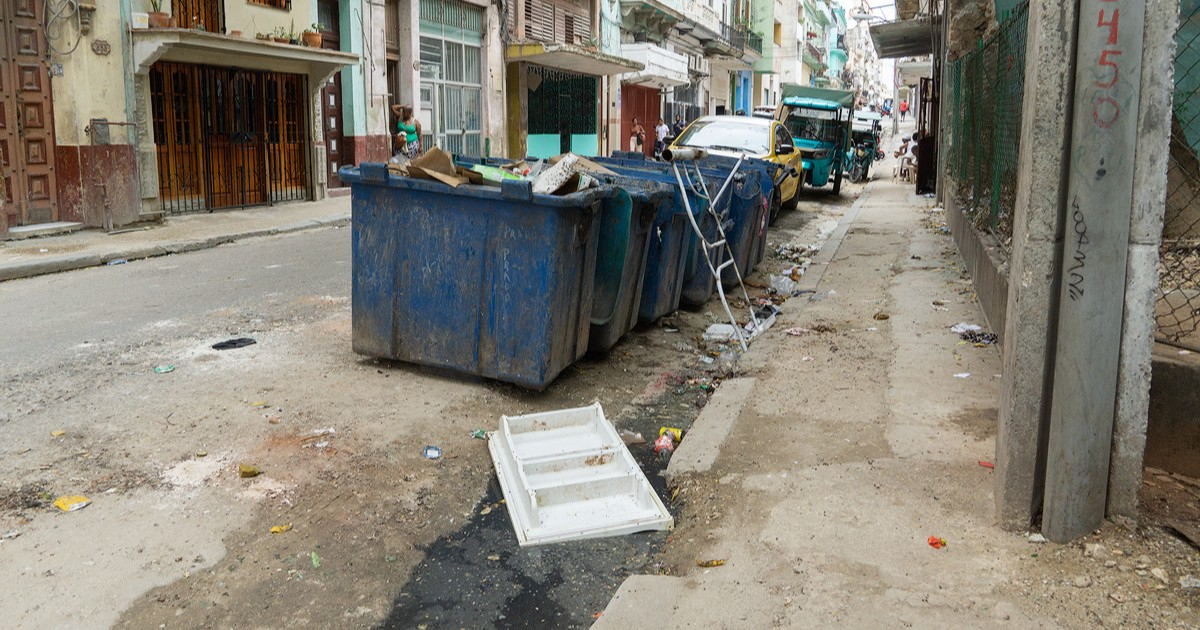
The historian Fabio Fernández Batista, a professor in the Department of History of Cuba at the University of Havana and a member of the National Committee of the Union of Historians of Cuba, published a text titled "Zombie Apocalypse" on Facebook this Friday, in which he depicts with unusual vividness the everyday reality of a Cuban city—presumably Havana—amidst a crisis.
Fernández Batista is neither a dissident nor an outspoken opponent, but an academic working within the official system. This gives his words a particular symbolic weight: when someone in his position describes Cuba as a "zombie apocalypse," the image is hard to ignore.
"The city is aflame. The sun beats down on the streets where dust and sewage coexist. Trash is everywhere, and in some corners, it smolders slowly, releasing the haunting smell of decay," wrote the historian.
The text describes the effort required to secure transportation to cross the city: a ride in a private car that, according to the historian, can cost almost an entire minimum wage. As of early July 2026, this minimum wage is set at 3,210 pesos, while meeting the basic needs of a person is estimated to require 96,060 pesos per month, about 14 times the average state salary.
"It's time to find a car to cross the city. The journey will be long, almost equivalent to a minimum wage. The fellow adventurers crowd together, and a shared cry emerges: how much longer will this last?" Fernández Batista recounted.
In that journey, the historian describes what he sees before crossing the tunnel: “a line waiting for bread, time to see an elderly man digging through the trash, time to see a child sacrificed at the altar of street vending.”
Once inside the vehicle, the conversation among the passengers revolves around power outages and the lack of water. The historian highlights a revealing detail: "No one is talking about Trump, Rubio, or the embargo." The population, in their direct experience, does not attribute their suffering to the U.S. embargo, but rather to the reality they face every day.
That detail contrasts with the official rhetoric of the regime, which systematically blames the embargo for all the country's ills. Foreign Minister Bruno Rodríguez went as far as to dismiss the existence of a humanitarian crisis in Cuba, although he acknowledged that the population suffers from "severe deprivations."
The text of Fernández Batista is part of a wave of public denunciations from Cuban intellectuals and writers. The writer from Holguín, José Poveda Cruz, published on July 26 that a sack of coal costs 2,500 pesos and rice and beans cost 400 pesos per pound, while the minimum pension of 4,000 pesos is equivalent to between seven and nine dollars. “Tonight, the blackout will return. The darkness, as punctual as an exemplary official, will invade the house,” wrote Poveda Cruz.
The backdrop of all these complaints is the energy crisis affecting Cuba: in July 2026, blackouts are averaging over 20 consecutive hours, with some areas experiencing more than 72 hours without electricity and Matanzas reaching 87 hours. Cuba has recorded at least five total collapses of the National Electric System so far this year, three of which occurred this month.
The accumulation of garbage described by the historian has a concrete explanation: less than half of the 106 garbage trucks in Havana have been operating in 2026. The heartbreaking testimony of Cubans who say they are living like animals is echoed on social media with a frequency that is no longer surprising, yet it continues to be deeply impactful.
In March 2026, , marked by the accumulated fatigue of the population, poor perception of government management, and bureaucratic inefficiency. His new publication suggests that, since then, the situation has not improved; rather, it has worsened.
Related videos:
Filed under: