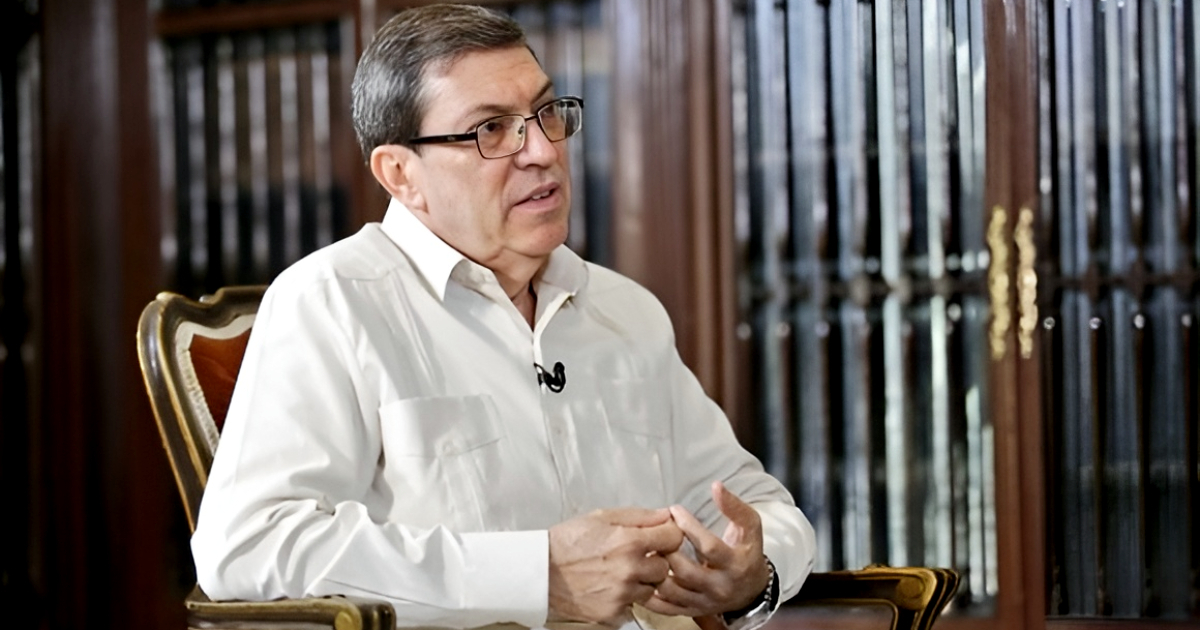
Cuban Foreign Minister Bruno Rodríguez Parrilla reacted harshly this Tuesday to the extension of the U.S. embargo against Cuba, describing it as a "genocidal policy that has been maintained against our people for over six decades" in a statement released by the Cuban Foreign Ministry on its social media.
The regime's reaction comes days after Donald Trump signed Presidential Determination No. 2026-21 on August 20, extending the authorities of the Trading with the Enemy Act against Cuba until September 14, 2027.
The measure was published in the Federal Register on Monday, August 24, with the formal justification that its continuation responds to the "national interest" of the United States.
Rodríguez Parrilla did not simply reject the measure; he presented it as a statement of intent from Washington. "The renewal of the so-called Trading with the Enemy Act until September 2027 is not a minor administrative act, but rather a confirmation that Washington persists in its goal of suffocating an entire nation," the minister wrote on his X account.
The chancellor also framed the extension within the context of the Trump administration's foreign policy towards the Island: "This extension comes at the cruelest moment of the U.S. offensive against Cuba in recent years."
The extension is, in fact, an annual procedure that all presidents have carried out: the previous extension was signed by Trump himself in August 2025, and before that, Joe Biden did the same in September 2024.
The definitive removal of the embargo requires action from Congress, as stipulated in the Helms-Burton Act of 1996; the president can only extend or modify the annual authorities under the Trading with the Enemy Act, which dates back to 1917.
The Cuban regime has been turning the embargo into the central argument for explaining its economic and social crisis for decades.
However, independent analysts point out that the downfall is largely due to the structural inefficiencies of over six decades of the communist model. The Prime Minister Manuel Marrero Cruz himself acknowledged in July 2025 that “not all of Cuba's problems are due to the blockade”.
This is not the first time in 2026 that Rodríguez Parrilla has used the term "genocidal" to refer to Washington's sanctions.
In July, the chancellor as a "clear manifestation of the criminal and genocidal intent" of the United States.
In January 2026, the MINREX itself had declared an "international emergency" resulting from executive orders by Trump regarding the supply of oil to Cuba, and Trump also signed a new executive order against the dictatorship on May 1, 2026.
In the multilateral arena, the UN General Assembly approved in October 2025 —for the 33rd consecutive time since 1992— a non-binding resolution calling for an end to the embargo, with 165 votes in favor and only seven against, including the vote from the United States. In July 2026, the UN also authorized an urgent debate on the issue with 136 votes in favor.
Rodríguez Parrilla concluded his statement with the slogan that the regime has turned into a common refrain: “#CubaIsNotAThreat, the blockade is.”
Related videos:
Filed under: