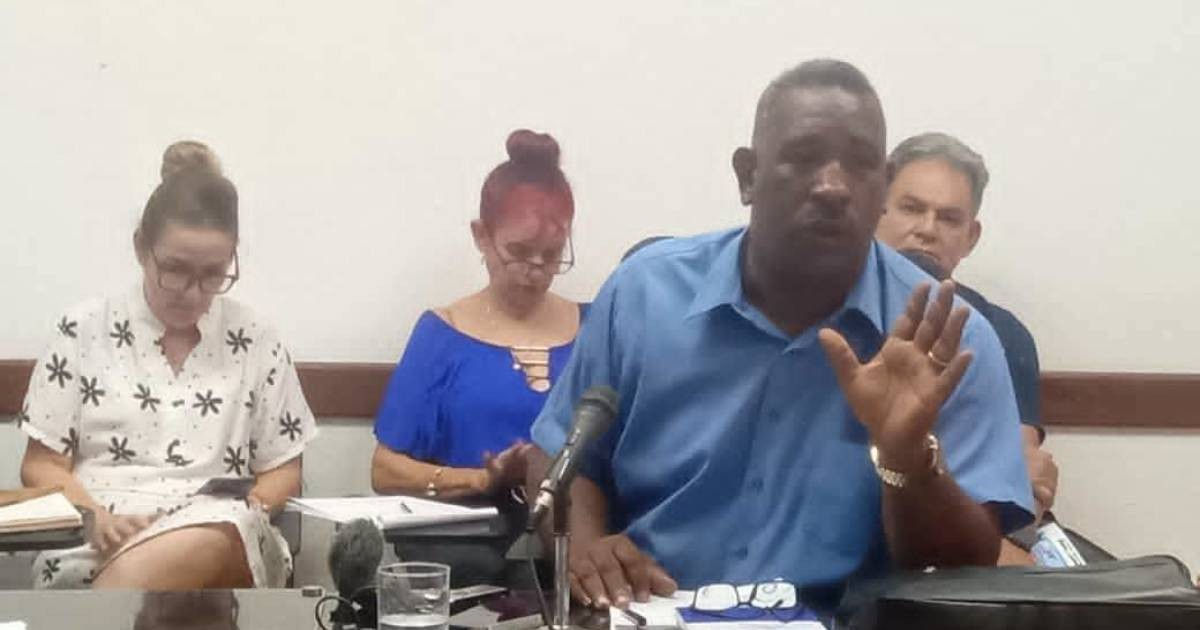
Walter Simón Noris, first secretary of the Communist Party of Cuba (PCC) in Camagüey, unleashed a wave of criticism and mockery on social media after stating that starting the school year on September 1 is a "blow to imperialism."
“Nobody can imagine the blow we are delivering to Imperialism in the political sphere by starting classes on September 1 in #Camagüey,” wrote the leader on his Facebook profile.
Noris also stated that "all the resources available in the province will be at the disposal of the school year" to ensure educational quality.
The phrase provoked numerous responses that contrasted the political discourse with the conditions under which many children will begin classes.
"All the resources they mention, in other words, NOTHING," one user scoffed. Another commented, "On the first day of school, the children probably won't have a glass of milk and a piece of bread for breakfast. When they arrive at school, it's most likely they won't have electricity."
Critics also highlighted the power outages, the lack of water, issues with uniforms, and the high costs that many families face when buying shoes, backpacks, and school supplies.
"In Nuevitas, they still haven't distributed the school uniforms. What do we do? Should we call on imperialism to make a donation, since that's all the rage? Almost everything is coming from there," questioned another internet user.
A course that begins in the midst of a crisis
The controversy arises just days before the start of a school year marked by serious shortages. The Cuban education system faces a deficit of at least 24,000 teachers, which is equivalent to 12.5% of the necessary positions.
Difficulties with school uniforms also persist. For the start of the academic year, between 2.2 and 2.3 million pieces were produced, compared to the 3.6 million needed.
This is compounded by the food crisis. According to data from the World Food Programme, 48.5% of Cuban children aged six to eleven do not receive meals or snacks at school.
Power outages and the lack of fuel will also impact classes. The previous academic year had to end early in many centers, and for the new term, universities will begin with hybrid or distance learning formats.
The situation has even led Cuban mothers to announce that they will not send their children to school if there are no minimum conditions of electricity, water, food, and rest.
One of the comments on Noris's post summed up the contrast her phrase created: "When children can sleep comfortably, when they can eat without limitations, when parents can buy them shoes, backpacks, and supplies without depending on 'imperialism', then you can speak with superiority."
The controversy once again puts under scrutiny an official rhetoric that presents everyday actions as political victories against the United States, while families face increasing difficulties in meeting the most basic needs of their children.
Related videos:
Filed under: