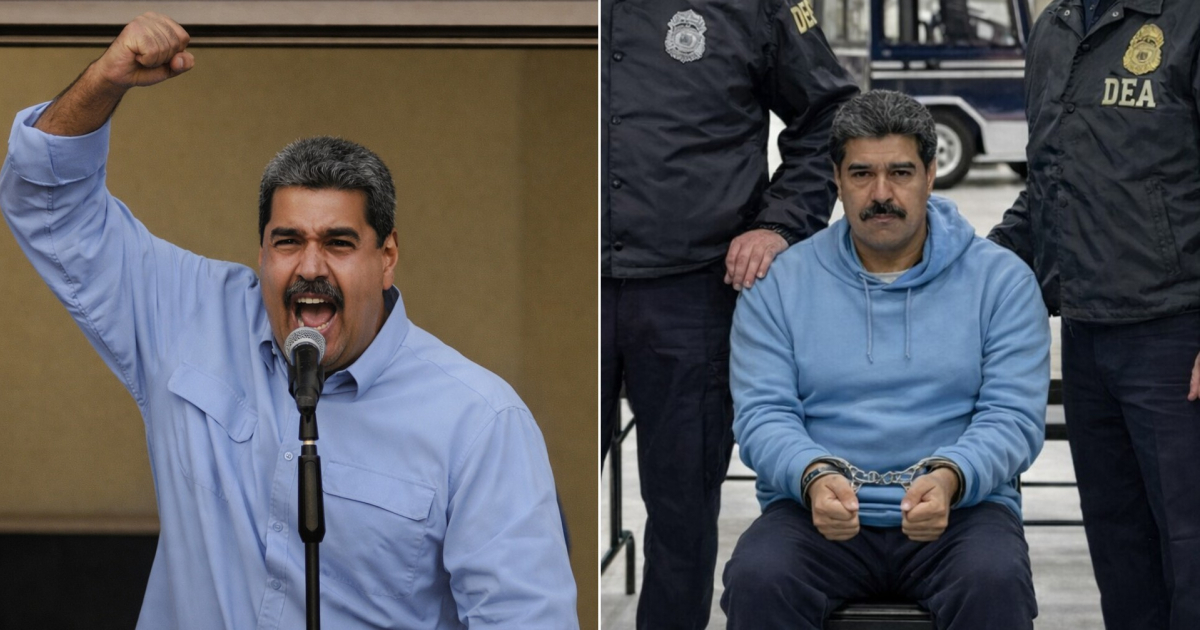
The capture of Nicolás Maduro by U.S. forces on January 3, 2026 has resulted, in just eight months, in one of the most profound geopolitical changes in Latin America since the end of the Cold War. Maduro and his wife, Cilia Flores, were transferred to the United States to face federal charges, while Delcy Rodríguez took on the interim presidency. The international legality of the U.S. operation remains highly controversial; however, despite this debate, its strategic consequences are already visible.
The main result can be summarized as follows: Venezuela has ceased to function as the principal political, economic, and strategic support for the Cuban regime, Russia, China, and Iran in the Caribbean and South America. At the same time, the United States has regained influence over Caracas that it has not had for more than two decades.
The Castro-communist regime, the most harmed
For the Cuban regime, Maduro's loss has been particularly serious because the Cuban-Venezuelan alliance was not merely diplomatic. For over twenty years, Venezuela supplied subsidized oil to Cuba and received Cuban doctors and other services in return, while Cuban military personnel were heavily involved in sensitive areas of Venezuelan security.
Havana itself acknowledged what it had denied for years: 32 members of the Armed Forces and the Ministry of the Interior of Cuba died during the U.S. operation on January 3 in Venezuela. Several were involved in the protection of dictator Maduro.
The economic consequences were even greater. Venezuela had been, in 2025, the main oil supplier to Cuba, providing approximately 26,500 barrels daily, about a third of Cuba's needs. Venezuelan shipments disappeared at the end of December 2025 and were not restored after Maduro's capture.
This exacerbated the blackouts, the fuel shortage, the transportation challenges, and the operation of the already severely deteriorated water systems and numerous public services. A Russian cargo of about 700,000 barrels that arrived at the end of March was estimated to be equivalent to only seven to ten days of Cuban consumption under rationing conditions.
Therefore, for Havana, the capture of Maduro simultaneously represented the loss of a political ally, a crucial energy supplier, and a platform from which the Castro regime exerted considerable influence in the region.
Russia: Strategic Loss and Damage to Prestige
For Vladimir Putin, Venezuela was much more than a trading partner. It was the opportunity to maintain a military and political ally in an area of U.S. influence.
Moscow supplied weapons, airplanes, helicopters, and anti-aircraft systems to Caracas for years, all of which were of no use to Maduro. Russia also used Venezuela as a demonstration of its ability to project military influence in the Western Hemisphere, similar to how Washington maintains alliances near Russia.
The capture of Maduro harmed that image. The Center for Strategic and International Studies (CSIS) concluded that Russia lost "a key foothold in the Americas" and that the ease with which U.S. forces neutralized Venezuelan defenses also damaged the reputation of Russian military equipment. Additionally, the conflict in Ukraine has significantly reduced Moscow's ability to support distant allies.
The contrast was particularly uncomfortable for the Kremlin: Maduro had requested greater Russian military assistance in the months leading up to his capture, but Moscow was unable to prevent the U.S. operation.
This does not mean that Russia has disappeared from Latin America. It maintains important relationships with Cuba, Nicaragua, and to a lesser extent with other governments, and continues to develop diplomatic, informational, and security operations. However, Venezuela is no longer the strategic platform for Russia that it had been under Chávez and Maduro.
China: Economic Loss and Strategic Warning
The impact on China is different because Beijing never maintained a relationship with Venezuela that was as ideological as with Cuba or as militarized as with Russia.
China has lent more than $60 billion to Venezuela over the past few decades, making it its largest state creditor. A significant portion of those loans was paid for with oil. In recent years under Maduro, China also became the primary destination for Venezuelan crude.
In September 2025, for example, approximately 84% of Venezuelan oil exports ended up in China, many through intermediaries used to circumvent U.S. sanctions.
Everything changed after January 3rd. Washington allowed China to continue buying Venezuelan crude, but removed one of the main advantages that Beijing had: acquiring oil at significant discounts and using it in debt-related agreements.
U.S. officials stated in January that Venezuela was receiving around $45 per barrel, compared to approximately $31 previously. China might continue purchasing it, but at international prices much closer to market rates.
Analysts described Maduro's capture as an explicit message from Washington to Beijing: the United States is unwilling to allow extra-continental powers to turn Venezuela into a strategic platform so close to its territory.
There is also an important symbolic component. Hours before the capture, Maduro had publicly received the Chinese special envoy Qiu Xiaoqi. Beijing failed to protect one of the governments with which it maintained a so-called "ironclad" strategic partnership.
For China, therefore, Venezuela remains economically interesting, but it has ceased to be a partner beyond the reach of the United States.
Iran, Hezbollah, and Hamas
Iran also suffered a considerable strategic loss. During Maduro's years, Tehran developed ties with Venezuela in oil, refining, air transport, industrial cooperation, and security. Caracas additionally provided Iran with a politically "friendly" presence in the Western Hemisphere.
Secretary of State Marco Rubio stated after the capture that Venezuela could no longer continue its rapprochement with Iran and Hezbollah as it had before. Analysts from the Atlantic Council have described Maduro's loss as a significant setback for Iran's ability to project influence in Latin America and near the United States.
Washington has also demanded an end to the presence in Venezuela of officials, advisors, and networks related to Iran, Hezbollah, Russia, China, Cuba, and North Korea.
It is important to introduce a clarification here: there is no sufficiently solid public information available until August 2026 that allows for quantifying how many members or collaborators of these foreign actors have left Venezuela after Maduro, let alone to assert a specific figure.
Regarding Hamas, the public evidence of a permanent operational presence within Venezuela has always been considerably less than that for Hezbollah and Iran. Therefore, it would be incorrect to assert as a fact that a large Hamas structure has been expelled from the country. What can be stated is that Caracas's shift towards Washington significantly reduces the favorable political environment that Iran and its allies had during the Maduro period.
The ELN and the FARC dissidents
This problem has not disappeared either. The European Union Asylum Agency noted in July that the ELN continues to have strong structures within Venezuelan territory, particularly in Zulia, Táchira, Apure, and Amazonas. The organization has approximately between 6,000 and 8,000 combatants and has used Venezuela for years as a rear base, a drug trafficking corridor, and a space for illegal mining and extortion.
But there is a significant change: after Maduro's capture, members of the ELN adopted a lower profile and retreated to border areas, apparently out of fear of the new political and military landscape.
Something similar happened with some dissident factions of the former FARC. They still have a presence in Venezuela, particularly the Segunda Marquetalia and various structures in Apure, Amazonas, and Zulia, but some units also withdrew after January 3rd.
It cannot be asserted yet that Venezuela has ceased to be a refuge for Colombian guerrillas. However, it can be stated that the new relationship between Caracas and Washington has considerably increased the uncertainty and risk for those groups.
In April, Delcy Rodríguez and the then Colombian president Gustavo Petro agreed on mechanisms for intelligence exchange to combat drug trafficking, smuggling, and cross-border crime, a sign that would have been much less likely under previous conditions. Although it may have been nothing more than a hypocritical projection from both sides.
United States: enormous strategic and economic benefits
Probably no country has gained as many immediate geopolitical benefits as the United States. Washington has managed, at least so far, to weaken the Cuban presence in Venezuela; reduce Russia's strategic footprint; limit China's political and energy influence; distance Caracas from Iran; increase pressure on transnational armed organizations; regain privileged access to Venezuelan oil; and transform the Caracas government from an open adversary to a closely monitored interlocutor.
The relationship between Delcy Rodríguez and the Trump administration is notable. Although Rodríguez publicly insists that Venezuela has not ceded its sovereignty, both U.S. and Venezuelan officials acknowledge an extremely close communication. According to information cited by Time, Marco Rubio maintains almost daily contact with Rodríguez, and Washington plays a decisive role in the framework regulating oil revenues and Venezuelan finances.
In oil, the change is remarkable
Chevron is expanding once again; U.S. companies and refineries like Valero and Phillips 66 have resumed purchases; SLB has just gained access to modernize and digitize information from Venezuelan oil fields; and Shell, BP, and other multinationals are returning.
Vitol and Trafigura have already transported over 140 million barrels of Venezuelan crude oil and fuels in 2026, much of which is destined for the United States, Europe, and other markets that were previously almost closed.
The U.S. plan includes potential investments of approximately $100 billion to rebuild Venezuela's energy sector.
Do Venezuelans live better? There are significant improvements, but Venezuela is still far from a complete economic and democratic recovery.
Oil production has increased to around 1.2 million barrels per day, with expectations of reaching approximately 1.37 million by the end of the year. Exports are nearing their current maximum capacity, although the deterioration of ports, terminals, and refineries is causing significant bottlenecks.
In April, the IMF projected a real GDP growth for Venezuela of approximately 4% for 2026. The minimum monthly wage announced by Rodríguez rose in April to 240 dollars, while pensions increased to 70 dollars.
Significant releases of political prisoners have also occurred. Since January, hundreds have been released from prisons. Human Rights Watch acknowledged that this represents a significant relief.
However, it would be a serious mistake to present Venezuela as a fully democratized country. The fundamental repressive apparatus continues to exist. Deep reforms of the judicial system, electoral processes, and the laws used to persecute opponents are still necessary.
Free presidential elections, which would definitively resolve the legitimacy crisis, have not yet taken place. In early August, a bipartisan group of U.S. senators once again called for free elections, the release of remaining political prisoners, and effective political participation of the opposition.
A massive problem persists in the economy: inflation. In July, prices rose by 19.9% within that month alone, while the year-on-year inflation reached approximately 580%. Thus, the recovery in oil production has not yet translated into a proportional improvement in the standard of living for all Venezuelans.
The assessment after eight months, according to data from Reuters, AP, Human Rights Watch, CSIS, Atlantic Council, IMF, and other esteemed Western sources, is quite consistent.
The capture of Nicolás Maduro resulted in a severe geopolitical defeat for Cuba, Russia, and Iran, as well as a significant setback for China in Venezuela. For the United States, it has represented an extraordinary recovery of strategic and economic influence in the Caribbean and South America. And while Telesur continues its anti-Western stance and supports its old undemocratic allies, the strategic comfort zone that Putin, the Castros, the ayatollahs, and certain terrorist organizations enjoyed in the homeland of Bolívar is increasingly shrinking.
For Venezuela, however, the situation is more complex. The country currently has more openness in its oil sector, greater investments, more economic ties with the West, hundreds of political prisoners outside of prisons, and better production prospects than during Maduro's final period of isolation.
January 3 profoundly altered the geopolitical balance of Latin America. Maduro fell, and the United States returned to the center of the Venezuelan stage. However, the true measure of the historical success of this change will not solely be how much oil Venezuela produces or how much Russia, China, Cuba, or Iran recede. The work will not be complete until Venezuela becomes a democratic nation, institutionally stable, economically prosperous, and fully sovereign.
Related videos:
Filed under:
Opinion piece: Las declaraciones y opiniones expresadas en este artículo son de exclusiva responsabilidad de su autor y no representan necesariamente el punto de vista de CiberCuba.