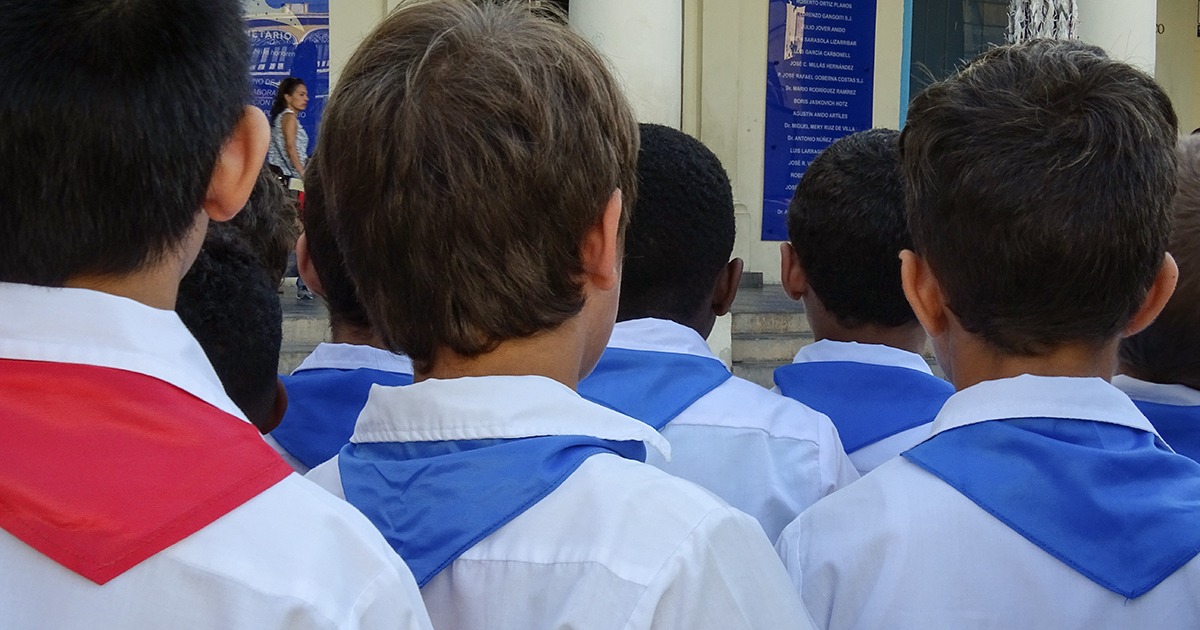
The Cuban sociologist and playwright Esther Suárez Durán published a critical essay on Friday on the site CubaxCuba regarding the start of the 2026-2027 school year, in which she denounces that Cuban institutions have once again resorted to "self-praise": the accolades they sing to themselves about their own educational efforts.
Suárez Durán, a researcher, essayist, and theater critic, argues that "in the indescribable conditions of precarity in which everyday life unfolds, amid [...] absurd contradictions and a complete ignorance of the most basic civic demands, the official information paints a picture [...] that, once again, bets on triumphalism."
For the author, the official discourse is limited to "carrying out the task at all costs" without providing the thorough examination that the circumstances demand. The resumption of educational activities under increasingly harsh economic and social conditions should be seen as a significant challenge, not as a reason for celebration.
The essay identifies major structural issues that the official narrative ignores. The first is the situation of scholarship students, separated from their families and entirely dependent on the institution, a vulnerability that was already concerning during times of relative normalcy.
Another problematic issue is the official bet on digital tools in a country that cannot support them. Suárez Durán warns that "the country does not produce or trade mobile devices that enable this type of communication." It is not a rhetorical question when power outages in some areas of the country frequently exceed 20 hours a day. The state telecommunications company ETECSA has admitted that outages left more than 45% of the country's mobile radio bases out of service.
An equally alarming aspect is transportation. "The current cost of private transportation, which is almost the only option available, is unaffordable when it comes to commuting daily to higher education study and work centers," the author writes.
That reality contrasts with the rhetoric of the regime. Miguel Díaz-Canel celebrated the start as a "conquest of the Revolution". The Communist Party of Cuba described it as "another act of heroism and of strong determination not to give in." Roberto Morales Ojeda, Secretary of Organization of the Central Committee of the PCC, acknowledged that "many things necessary for the educational process will be lacking," but attributed all the problems to the U.S. embargo.
The Cuban education system begins the 2026-2027 school year with a shortage of over 21,000 teachers and a teaching coverage of only 73%, according to figures acknowledged by the Ministry of Education itself. The shortage also extends to school uniforms: national demand is around 3.6 million items, and authorities admit that in primary education, only about 12% of needs have been met.
This is compounded by the food crisis: according to the World Food Program, 48.5% of Cuban schoolchildren between the ages of 6 and 11 do not receive meals or snacks at school. The Minister of Education, Naima Ariatne Trujillo Barreto, who had promised in August that the return would be "a great celebration," had to admit that the school year was starting under "very difficult" conditions.
The citizens' response was emphatic. A Cuban mother announced that she would not send her children to school as long as the blackouts prevented them from sleeping: "I can't ask children to sacrifice themselves for something they have no future in here."
In contrast to official voluntarism, Suárez Durán advocates for in-person education as an irreplaceable value and emphasizes that "nothing replaces personal contact between the teacher and their student; nothing provides the former with more information regarding the quality of the knowledge, experiences, and values transmission process than that interaction."
Related videos:
Filed under: