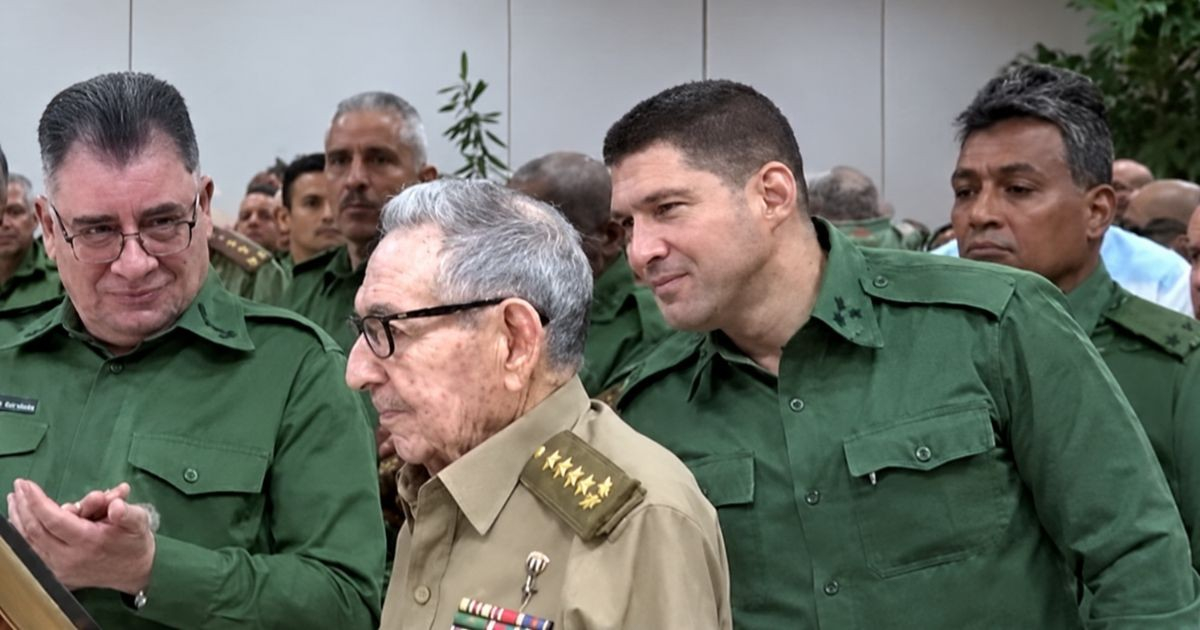
The Cuban jurist Eloy Viera Cañive published an analysis on Facebook this Sunday in which he examines the political implications of the public reappearance of Raúl Castro alongside Miguel Díaz-Canel during the event for the 65th anniversary of the Personal Security Directorate of MININT, held in Havana the day before.
For Viera Cañive, however, alongside the reappearance of the nonagenarian general, the most revealing fact is the growing prominence of his grandson: "It is increasingly evident that there is an effort to publicly elevate the figure of his grandson, Raúl Guillermo Rodríguez Castro, 'el Cangrejo,'" the jurist wrote.
The event commemorated the 65 years since the founding of that MININT agency, created on September 6, 1961, to protect the highest officials of the regime. During the ceremony, the Minister of the Interior, Lázaro Alberto Álvarez Casas, read to those present a letter signed by Raúl Castro addressed to the members of the body, while Castro himself remained seated in the front row without speaking.
That image—the general in silence while another reads his words—is precisely what Viera Cañive considers most significant. “The impression is that they don’t even want to expose the general too much when speaking in public. His voice, expression, and movements are often the elements that most clearly reveal his physical deterioration,” pointed out the jurist, affiliated with the independent outlet El Toque.
For the analyst, the logic of the regime is both contradictory and revealing: “A regime that feels the need to publicly showcase a 95-year-old man every time someone claims he has died is acknowledging, whether it wants to or not, that a significant part of its stability still revolves around that figure.” The reappearance followed a week of rumors regarding the former leader's health, fueled by reports from Miami media citing anonymous sources about an alleged hospitalization.
Viera Cañive also emphasizes the concentration of power that the event highlighted: “Almost the entire leadership of the repressive bodies and a significant part of the Cuban bureaucracy continues to be centered around a man who no longer formally holds any public position and who, at 95 years old, still conveys the impression of being the one who has the final word.”
The analysis of the jurist goes beyond Raúl Castro. It describes El Cangrejo as "a bodyguard who has stopped being merely a shadow behind his grandfather to progressively become a visible figure within the political communication of the regime." The grandson, a colonel of MININT and identified as the chief of personal security for the elderly general, was visibly moved when the official singer Marcos David Fernández Brunet performed a laudatory décima dedicated to his grandfather, an image that was ironically dubbed on social media as "crab tears".
For Viera Cañive, this presence is not a trivial detail: "It is significant that it appears precisely at an event related to Personal Security, the department of the Ministry of the Interior that theoretically it belongs to." He adds that "never before has a member of the escort of Fidel or Raúl Castro had such a prominent semiotic role within official Cuban communication."
The profile of El Cangrejo has grown rapidly in 2026. In July, he gave his first interview to a U.S. media outlet, where he expressed his willingness to negotiate with Donald Trump about the future of Cuba. In August, the New York Times published an investigation linking him—without formal accusation—to a transnational criminal network engaged in smuggling and human trafficking, known as the "Cuban Mafia in Quintana Roo".
The reappearance on Saturday fits into a pattern of controlled absences and appearances: on July 26, Raúl Castro missed for the first time in at least three decades the central event of Moncada, and on August 13 he reappeared at the Karl Marx Theater for the centenary gala of Fidel Castro, accompanied precisely by his grandson.
"In the final shots of the old dictator, the grandson seems to be transitioning from merely a behind-the-scenes figure of power to gradually taking a more visible role in the spotlight," concludes Viera Cañive.
Related videos:
Filed under: