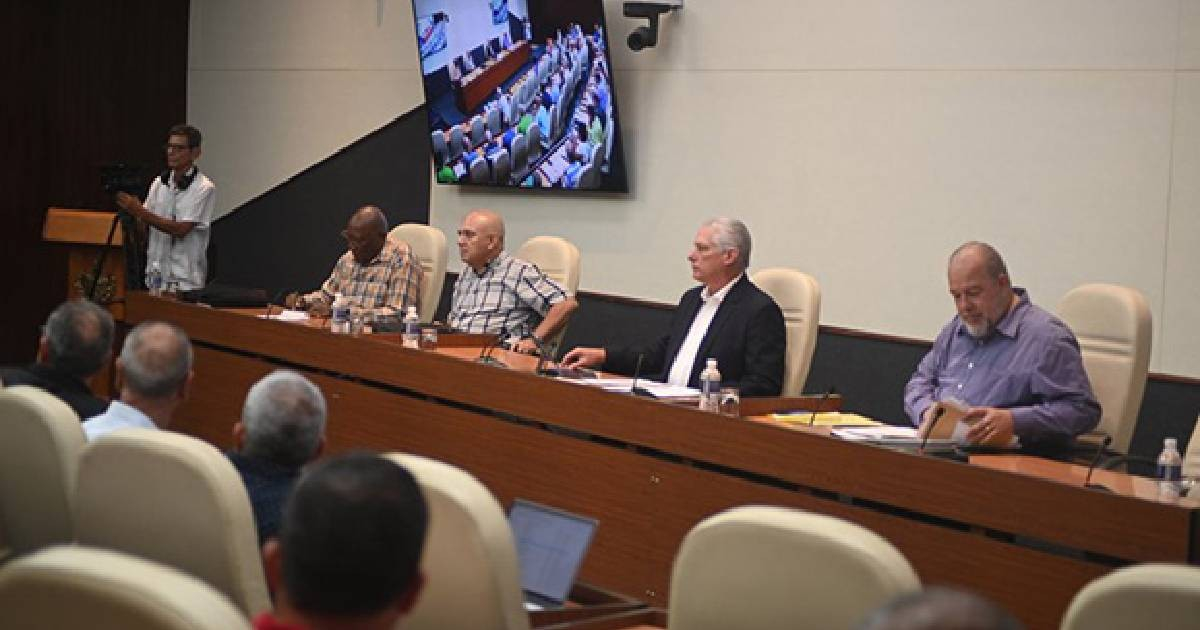
The Cuban ruler Miguel Díaz-Canel met this Tuesday at the Palace of the Revolution with more than thirty executives from Cuban state enterprises to reaffirm his confidence in the state business system and celebrate the progress in the implementation of the 176 Economic and Social Transformations, while Cubans face food prices that multiply more than thirteen times the average salary in the country.
The president stated before business leaders that "the leadership of the Party, the Government, and the State reaffirms its full confidence in the ability of the socialist state business system in Cuba to provide what the country needs," and assured that "we are going to transform ourselves and we will move forward," according to Cubadebate.
The event, moderated by Roberto Ricardo Marrero, president of the National Institute of State Business Assets, also featured the presence of Prime Minister Manuel Marrero Cruz, Vice President Salvador Valdés Mesa, and First Deputy Minister Inés María Chapman Waugh.
Some of the executives present joined in the optimistic tone. Oscar Carvajal Serrano, from the Automotor group of the Ministry of Transport, assured that "this year none of their companies will finish with losses and they will grow in contributions and profits," although he acknowledged that "the difficulties will not be resolved overnight."
Edel Gómez Gómez, director of the electronic industrial company Comandante Camilo Cienfuegos, stated that the transformations "allow us to be on equal footing with the other economic players" and that what they do is "remove obstacles, eliminate barriers, and enable us to move forward more quickly."
The official discourse clashes directly with the data describing daily life on the island. The official year-on-year inflation reached 20.70% in July 2026, according to the National Office of Statistics and Information (ONEI), with food and non-alcoholic beverages accounting for 63.18% of the total increase in the consumer price index that month.
The prices recorded in August illustrate the magnitude of the problem: rice is sold at 330 Cuban pesos per pound, oil at 3,650 pesos per liter, chicken at 6,800 pesos per pack, and breast at 10,500 pesos, while the official average salary closed 2025 at only 6,930 pesos per month, equivalent to between 10 and 15 dollars at the informal exchange rate.
Economists estimate that meeting basic needs requires about 96,000 pesos per month, a figure that exceeds the average salary by more than thirteen times.
The numbers from the state sector itself contradict the optimism of the leadership: net sales of the state enterprise system fell by 29.2% between January and May 2026, pre-tax profits declined by 31.5%, and the number of companies operating at a loss increased from 252 to 363 during that period. CEPAL projects a contraction of the Cuban GDP of 6.5% in 2026, following a decline of 3.8% in 2025.
In this context, the regime approved in June 2026 the 176 Economic and Social Transformations, organized into 23 thematic axes, aimed at granting greater autonomy to state companies for exporting, importing, retaining foreign currency, and setting prices and wages. In July, the regime also eliminated the price cap of 155 pesos per pound on rice through Decree 156, transferring price setting to the Ministry of Finance and Prices, which further worsened the situation for consumers.
Díaz-Canel announced that the upcoming meetings will bring together state-owned, non-state, and cooperative businesses, "so that we can begin to integrate as that unique business system envisioned in our economic and social model." Meanwhile, the gap between the speeches from the Palace of the Revolution and the empty tables of millions of Cubans continues to be the widest it has been in decades.
Related videos:
Filed under: