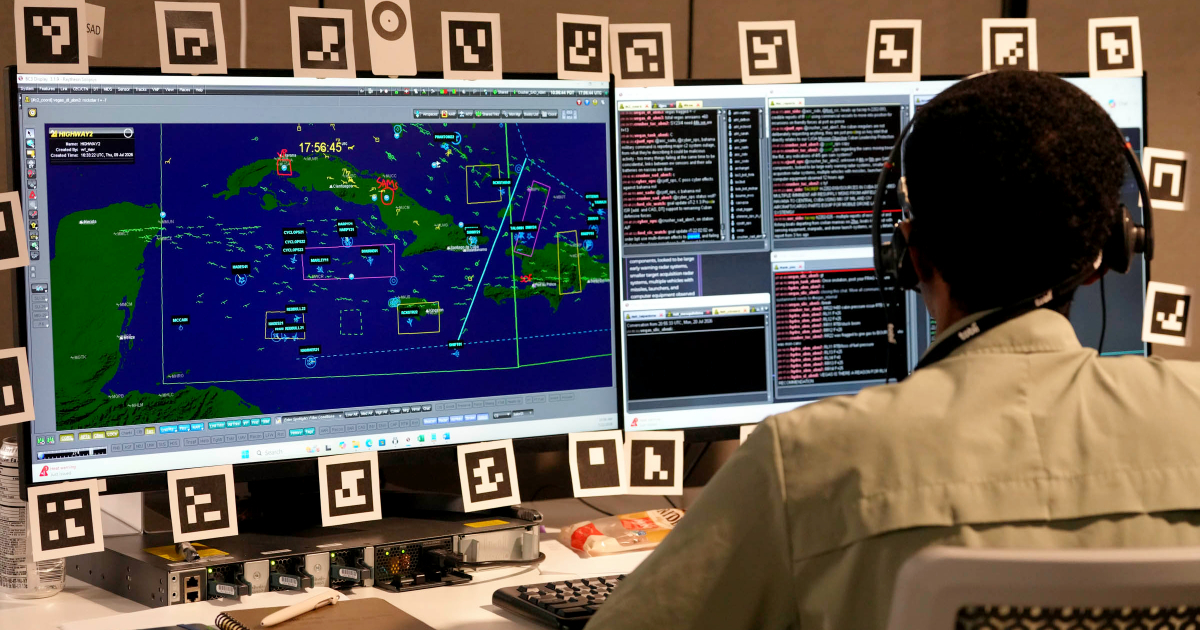
Cuba prominently appears on the screens used during a U.S. military experiment involving artificial intelligence tools and the participation of the Space Force, as shown in several official photographs published on the website of the United States Space Force.
The images correspond to the Decision Advantage Sprint for Human-Machine Teaming (DASH), an experiment led by the United States Air Force, aimed at integrating artificial intelligence into command and control systems to process large amounts of information and accelerate military operators' decision-making.
In several of the photographs taken during the tests conducted in Las Vegas in 2026, Cuba occupies a central position on the monitors' maps. Florida, the Yucatán Peninsula, Hispaniola, and other areas of the Caribbean are also highlighted.
About Cuba and its surroundings, numerous symbols, markers, lines, and defined areas appear that belong to the applications used during the experiment.
This is not an isolated occurrence. Several official photographs show the same geographic setting while different participants engage with the systems or receive explanations about how they work.
Battle management applications ready for classified networks
The captions published by U.S. authorities provide important information about what the screens display.
In one of the images, Colonel John Ohlund, director of the multifunctional team of the Advanced Battle Management System (ABMS), explains to a visitor how a battle management application developed by industry works. In front of them, the map of the Caribbean appears with Cuba in a prominent position.
The Air Force explains that the artificial intelligence tools were tested in an unclassified environment using a modular architecture designed to later transfer them safely to classified combat networks.
Another photograph shows two air battle managers working in front of the systems. The official description notes that the experiment used digital infrastructure owned by the U.S. government, designed to facilitate the transition of validated capabilities to the classified networks used by joint forces.
DASH was led by the multifunctional team of the ABMS from the Air Force Department, in collaboration with the Air Force Research Laboratory (AFRL), the United States Space Force, and the 805th Combat Training Squadron.
Among the participants was Master Erik Murdock from the Space Force, head of the Operations Division of the 57th Aggressor Squadron. Another photograph identifies Chief Master Sergeant Timothey Hodgin from the AFRL, as he receives instructions from an air battle manager about one of the applications.
The presence of members of those units, however, does not allow us to determine what role Cuba played in the scene depicted on the screens.
Artificial intelligence to accelerate the attack chain
The Air Force Department asserts that the experiment demonstrated that the collaboration between humans and machines can significantly accelerate the joint attack chain.
Artificial intelligence would take on some of the intensive data processing to enable operators to identify relevant information and make decisions more quickly.
Our goal is to quickly put the most advanced capabilities in the hands of the joint force, explained Lieutenant Colonel Corey Ellsworth, head of integration for the ABMS multifunctional team.
Ellsworth pointed out that the infrastructure was designed so that the capabilities validated during these experiments can be transferred to classified networks where aviators and members of the Space Force would use them in high-intensity conflict.
The tests took place at the Shadow Operations Center-Nellis of the 805th Combat Training Squadron and also involved software developers from the industry.
Cuba in a very different military context following Maduro's capture
The repeated appearance of Cuba in these maps is particularly significant given the context in which the evidence is produced.
Relations between Washington and Havana entered a stage of intense tension following the U.S. military operation on January 3, which culminated in the capture of Nicolás Maduro and Cilia Flores in Venezuela.
President Donald Trump then stated that Cubans had died while protecting Maduro and directly linked the government of Havana to the security apparatus supporting the Venezuelan leader.
That same day, Trump labeled Cuba a "failed nation", stated that the Cubans had suffered for many years, and predicted that Washington would eventually address the situation on the island.
The Secretary of State, Marco Rubio, presented the Venezuelan operation as a demonstration that when Trump warns he will act against a threat, “he means it.”
Havana responded by escalating its military rhetoric and subsequently established training sessions for defense while increasing American pressure on the Cuban regime.
FLEX2026: AI and autonomous systems 90 miles from Cuba
The DASH experiment is not the first American test of new military technologies conducted this year with Cuba within the immediate geographical environment.
Between April 24 and 30, the Naval Forces of South Command and the Fourth Fleet conducted a training exercise in Key West, Florida, FLEX2026, which incorporated artificial intelligence, long-range drones, unmanned surface vehicles, aerial platforms, helicopters, and the USS Wichita ship.
The maneuvers allowed for testing a chain that encompassed everything from surveillance and target detection to tracking, interdiction, and eventual lethal response. CiberCuba then pointed out that the exercise was taking place just 90 miles from the island, placing Cuba within the immediate operational range of these new capabilities.
In May, the arrival of the USS Nimitz aircraft carrier strike group in the Caribbean, accompanied by other naval units, was added to this situation in order to participate in Southern Seas 2026. Trump denied that the deployment was intended to apply military pressure on Cuba.
Guantánamo regains strategic prominence
The Guantánamo Naval Base has also gained prominence in this new phase.
At the end of May, the head of Southern Command, General Francis L. Donovan, traveled to the facility to inspect its security, force protection, and operational readiness. SOUTHCOM then defined Guantánamo as a "vital operational and logistical center" for U.S. operations in the hemisphere.
During that visit, Donovan also had an unusual meeting with the Cuban General Roberto Legrá Sotolongo, first deputy minister and head of the General Staff of the Revolutionary Armed Forces, officially described as an exchange on operational security issues.
Days later, Defense Secretary Pete Hegseth arrived in Guantanamo during another visit that coincided with the ongoing U.S. military presence in the Caribbean.
Meanwhile, U.S. media reported on Pentagon planning exercises regarding various contingency scenarios related to Cuba, including a possible severe deterioration of the internal situation. Contingency military planning does not, in itself, imply that Washington has decided to carry out an intervention.
Trump left the possibility of acting open
Tensions rose again in July when Trump stated in an interview with Fox News that “many things” could happen in Cuba over the next two months.
When asked specifically about a possible military action similar to that carried out in Venezuela, the leader stated that he did not expect Cuba to follow that exact path, but he also did not rule out Washington's ability to do so.
«We could do that with Cuba. It wouldn't be difficult for us to do it», Trump stated, although he distinguished between the two scenarios due to the scale and strategic resources of Venezuela.
These statements came after U.S. media reported that military leaders had explored various contingency scenarios related to Cuba.
What the photographs say and what they do not say
It is in this context—Maduro's capture, increased pressure on Havana, exercises with AI and autonomous systems near Cuba, naval deployments in the Caribbean, and the renewed strategic importance of Guantánamo—where the recently published photographs related to DASH become particularly relevant.
But images have a clear limit.
The Air Force Department does not explain why Cuba repeatedly appears on the maps, what the symbols displayed over the island represent, or what role the Cuban territory played within the scenario used.
It does not claim that Cuba constituted a military target, that DASH simulated an attack against the island, or that the visible markers corresponded to real targets.
What the official photographs do document is that Cuba and the Caribbean were used as a visible geographic environment in battle management applications during an experiment with artificial intelligence and participation from the Space Force, whose capabilities are designed to later be integrated into classified military networks.
The detail is also revealed when Washington accelerates its military modernization. This week, the Secretary of the Air Force, Troy Meink, publicly acknowledged for the first time that the United States has deployed "space control" weapons in orbit.
There is no information linking those space weapons to DASH or the maps of Cuba shown in the photographs. The relevant coincidence is another: the rapid development of new U.S. capabilities in artificial intelligence, command and control, autonomous systems, and space operations occurs while the Caribbean is once again central to Washington's military strategy.
Related videos:
Filed under: