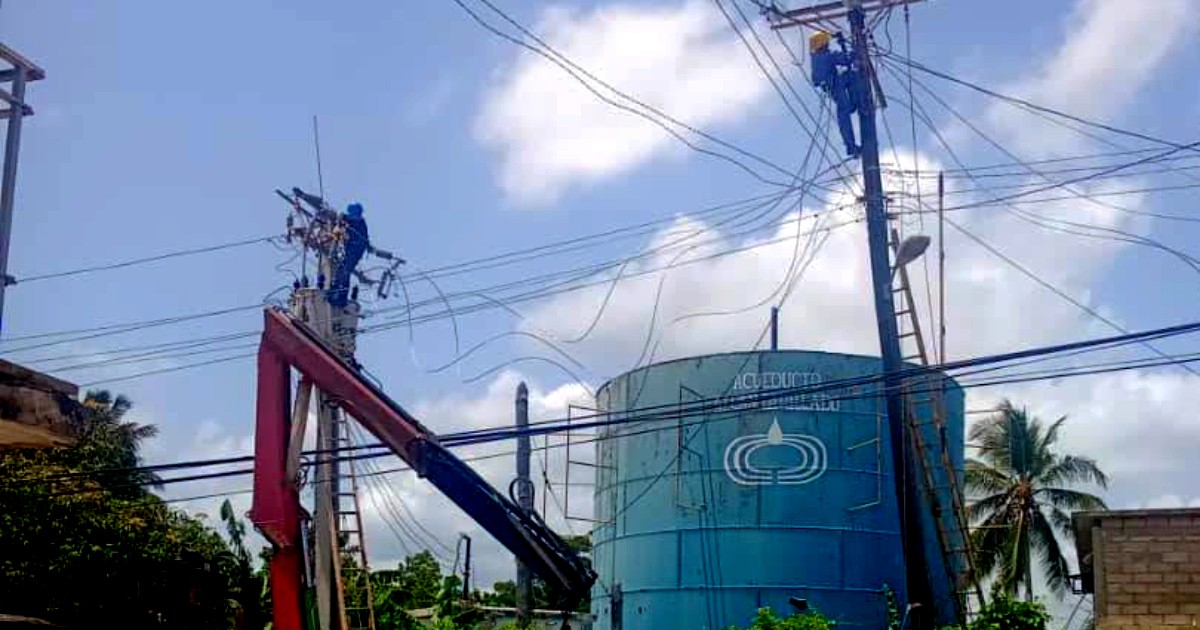
A brigade of linemen from the municipalities of Unión de Reyes and Jagüey Grande has completed the installation of a 13-kilovolt line in the city of Matanzas aimed at ensuring the water pumping for over 36,000 residents in the high and mid areas of the city, as reported by the official journalist José Miguel Solís on social media this weekend.
The figure, presented as an achievement, actually reveals the extent of the disaster: those 36,000 beneficiaries represent only 15% of the more than 240,000 residents of Matanzas who, according to the statistics cited by the official source, face serious difficulties with water supply. In the worst moments of 2026, this number exceeded 300,000 affected in the province.
The project allows the tanks of Pedraja and Hormigón to be supplied even during power outages, benefiting the neighborhoods of Los Mangos, Lozano, El Naranjal, and Kilómetro 101.
According to Liván Morales, the head of the brigade, "initially, work was done on the dual power supply for the Faustino Pérez Provincial Hospital, and from that connection, the line was drawn to the supply centers, with the installation of posts and all the necessary wiring to ensure a completely safe supply."
The link between the energy crisis and the water shortage in Cuba is structural. 87% of the supply system depends on the National Electroenergy System (SEN), as stated by the president of the National Institute of Hydraulic Resources, Antonio Rodríguez Rodríguez, in March 2026.
When the electricity goes out, the pumping stops even if there is water available in the reservoirs. Of 480 essential pumping stations in the country, only 135 are on circuits protected against outages.
The work of the linemen was published precisely on the day that the SEN completed its restoration following the eighth total disconnection of the year, which occurred on September 18, illustrating the extreme fragility of the electrical system upon which access to water in Cuba depends.
The health consequences of this crisis are documented and severe. In February 2025, fecal coliforms were detected in the Bello supply source, which serves areas such as El Naranjal, Matanzas Este, and Versalles.
In March 2026, health authorities once again requested the population to boil and chlorinate water. Between April and May, an outbreak of hepatitis A in the neighborhood of Versalles was confirmed with 18 active cases, and in June, seven new positives and 49 suspected cases were reported in a single week.
The United States Embassy in Havana issued health alerts regarding digestive diseases linked to the deterioration of water and electricity, and the UN estimated in September 2026 that approximately 3.5 million Cubans lack regular access to drinking water.
Given this situation, the official source that disseminated the news about the power lines chose to shift the responsibility to the citizens themselves: "It is now up to the residents of the upper and middle areas of the city of Yumurí to use water wisely,” wrote Solís, ignoring that the crisis is not about consumption but rather about a system that has collapsed due to decades of neglect and dependence on an electrical grid that fails with increasing frequency.
The brigade, which will continue installing switches to protect hospitals and supply centers, faces a task that far exceeds its capabilities: in Matanzas, more than 200,000 people will remain without guaranteed access to drinking water when this intervention ends.
Related videos:
Filed under: