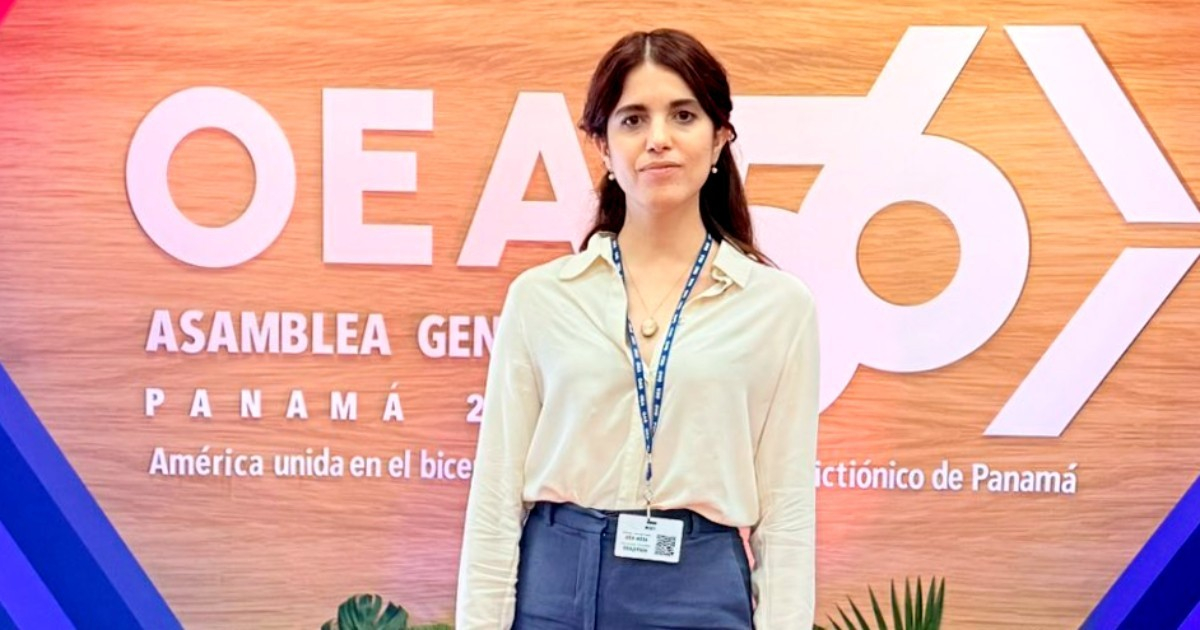
Cuban opposition leader Carolina Barrero warned that the deep economic, energy, demographic, and institutional crisis facing Cuba should not be automatically interpreted as a prelude to a political transition, because an authoritarian regime can prolong its survival even amid significant deterioration of the country.
"Authoritarian regimes can survive for a long time by managing deterioration, selectively distributing repression, and expelling a significant portion of social pressure from the country," Barrero stated in an extensive interview published this Tuesday by the independent magazine El Estornudo.
The activist, recently appointed Ambassador for Freedom by Freedom House, stated that Cuba is experiencing an "extraordinarily deep" crisis that encompasses the economy, demographics, energy, institutions, and the legitimacy of the system.
However, he distinguished between the weakening of the government and the opposition's ability to become a political alternative.
"The depth of the regime's crisis does not automatically equate to the opposition's ability to produce a political alternative. These are two distinct variables," he noted.
For Barrero, it would be a mistake to confuse the permanence of the system with strength, but it is also erroneous to assume that its weakness will inevitably lead to a democratic transition.
His statements come at a time when Cuba is facing a severe economic and social crisis. Freedom House classifies the island as "Not Free," with a score of only 9 out of 100 in its Freedom in the World 2026 report.
The organization points out restrictions on political pluralism, independent media, and civil liberties.
Barrero also identified the fragmentation of the Cuban opposition as one of the problems he considers surmountable.
In their view, for decades there have been numerous initiatives, leaderships, and demonstrations of resistance, but the ability to transform that diversity into a coordinated strategy has been much less.
The opposition figure made a distinction between unity and coordination and defended political plurality. She also pointed out another deficiency: the difficulty in transforming the denunciation of repression into a strategy capable of presenting an organized political alternative in the event of a change scenario.
In that process, Barrero attributed an important role to the Cuban exile community, although he questioned dynamics that, in his view, weaken their political capacity.
"Frustration is understandable; when it turns into intolerance, ideological purism, or constant disqualification, it becomes sterile," he stated.
In their opinion, Cubans inside and outside the island form "a single dispersed Cuban political community across many geographies," even though they face different conditions and responsibilities.
The activist also warned about the risks that would arise from a potential abrupt weakening of state structures without a previously prepared alternative.
According to what he explained, such a scenario could lead to "institutional void, violence, new forms of authoritarianism, or simply the recomposition of the same power under different rhetoric."
Barrero was selected this month as one of the five inaugural members of the Ambassadors for Freedom program by Freedom House, alongside human rights defenders from other countries. The organization explained that the ambassadors will work to highlight threats to freedoms, engage in dialogue with policymakers, and promote the defense of democracy.
In the interview, Barrero stated that one of his priorities in the new position will be to keep the situation of Cuban political prisoners on the international agenda and to expand the number of governments, organizations, and institutions calling for their release.
The leader of Citizenship and Freedom also emphasized that international pressure can help change the conditions under which the Cuban government operates, but ruled out the possibility of a political transformation on the island occurring solely from abroad.
"No UN report, parliamentary resolution, diplomatic meeting, or international campaign will, on its own, bring about a democratic transition in Cuba," he stated. "The democratization of Cuba will fundamentally have to be the work of Cubans."
Freedom House described Barrero as a Cuban political leader, human rights advocate, and political analyst, noting that her activism resulted in repeated arbitrary detentions, constant surveillance, house arrest, and ultimately forced exile in February 2022. The United States government publicly condemned that forced exile at the time.
In August of this year, she arrived in Miami to begin a doctorate in literary studies at the University of Miami.
Related videos:
Filed under: