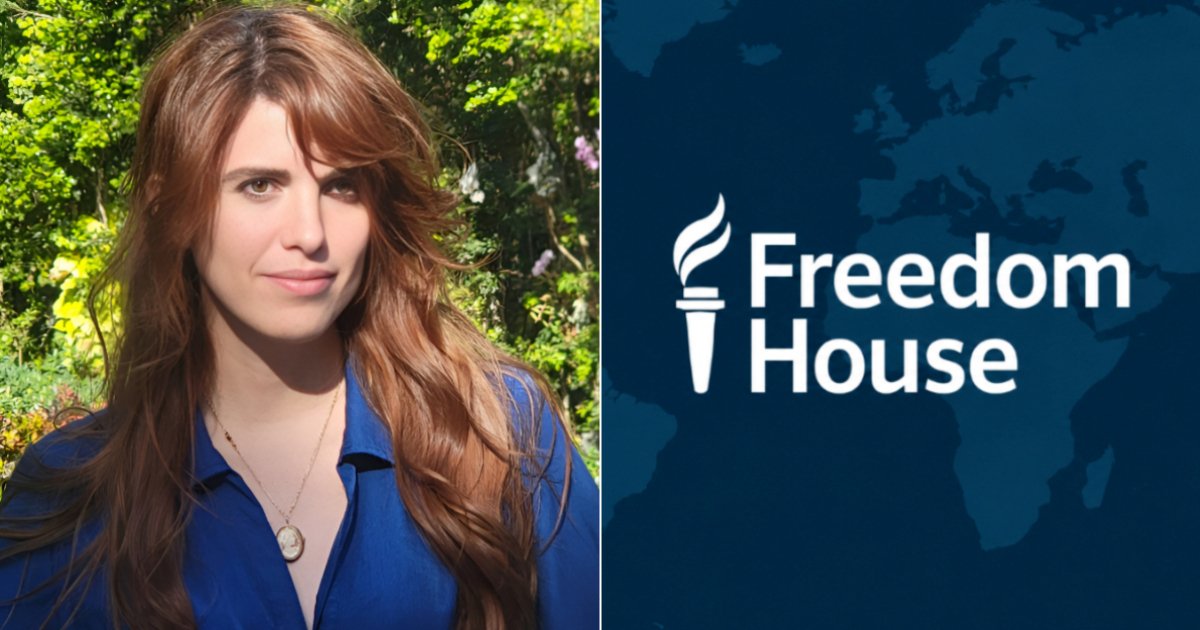
The appointment of Carolina Barrero as one of the five inaugural members of Ambassadors for Freedom (Embajadores de la Libertad in Spanish), the new global program by Freedom House, can be seen as a recognition of her career.
However, in the Cuban context, its potential importance lies elsewhere: the tools it can add to influence Cuba and help prepare the political and institutional conditions for a possible democratic change.
It's not just about gaining greater international visibility. Western organizations focused on human rights and democracy have spent years developing programs that identify and connect activists from authoritarian societies with experts, organizations, parliaments, governments, and multilateral bodies.
Behind titles like ambassadors, fellows, or advocates lies a common logic: to enhance the ability of these actors to transform a local complaint into political impact.
Freedom House explicitly states it for its new program: ambassadors must highlight threats to freedom, engage with policymakers and the public, and promote the defense of democracy.
From denouncing repression to contemplating what comes next
Barrero's journey allows us to observe that transformation.
Her public emergence was linked to the 27N in 2020. During 2021 she faced detentions, surveillance, and house arrests while participating in actions related to freedom of expression and, after 11J, concerning the situation of political prisoners.
Her departure from Cuba to Spain in February 2022, which she denounced as a forced exile, necessarily changed the tools of her activism.
In the following years, she brought the Cuban situation to European officials and other international forums, was selected in 2024 for the Sájarov Fellowship of the European Parliament, and ultimately transformed part of that activism into institutional work through Citizenship and Freedom, an organization that she currently presides over and directs.
The evolution is significant: from protesting against decisions made by the Cuban government to studying and promoting the necessary conditions for a different system to exist.
That second job is less visible than a protest, but it can be crucial in a changing scenario.
A transition requires more than just the end of the regime
A potential democratization of Cuba would not result in the disappearance of the current power structures. One of its most complex challenges would begin there.
After decades without effective political pluralism, it would be necessary to rebuild freedoms of association and expression, develop independent organizations, establish electoral guarantees, strengthen the rule of law, and create conditions for movements and parties to organize and compete freely.
It would also be necessary to cultivate leadership, articulate different social interests, and rebuild a civil society that has operated for decades under restrictions, surveillance, and repression.
Precisely in that area is where part of Barrero's recent work has been focused.
Citizenship and Freedom has addressed political participation, the strengthening of independent civil society, and democratic institutions. In 2025, it also published a study on the right to association that examined the legal mechanisms used by the Cuban regime to prevent autonomous organizations.
The question then shifts from how to confront the existing power to include another inquiry: what institutions, organizations, and capabilities does Cuban society need to replace an authoritarian system with a pluralistic one.
The value of international networks
Here, the incorporation into Freedom House becomes significant.
The comparative experience of programs developed by democratic organizations and institutions shows that their main added value is not usually the title granted to the activist, but the network that is built around them.
Access to specialists in democratic transitions, human rights organizations, legislators, diplomats, academics, and other activists can provide insights and connections that are difficult to develop from a closed society.
Barrero had already begun that journey prior to her new appointment.
The Sájarov Prize from the European Parliament, for which she was selected in 2024, is specifically designed to strengthen the capacities of human rights defenders and connect them with European institutions. Subsequently, her activities have included the United Nations, Washington, and various political dialogue forums in Europe and the United States.
Freedom House now adds another platform to that network.
From Denunciation to Incidence
There is also a difference between gaining international attention and attempting to change specific policies.
Barrero has defended for the past few years a review of the European Union's relationship with Havana and, particularly, of the Political Dialogue and Cooperation Agreement.
In April 2026, she took that position to Brussels and the European Parliament alongside Amelia Calzadilla. A month later, the High Representative of the European Union, Kaja Kallas, confirmed that the agreement was under review.
It would not be accurate to attribute that decision to Barrero. The review is a response to European institutions and was preceded by years of pressure from various organizations and actors of Cuban civil society.
However, the episode does allow for the observation of a specific mechanism of influence: a sustained demand by Cuban actors manages to reach the spaces where European policy towards Havana is discussed and decided.
This capacity may gain even greater importance if Cuba enters a scenario of political transformation.
The connection between inside and outside of Cuba
There is, however, a fundamental limit.
International legitimacy does not replace legitimacy within the country. Nor can a network of foreign organizations create from the outside the parties, social movements, and consensus that it will be up to Cubans to build.
External influence will be significant to the extent that it can strengthen internal capacities and connect civil society on the island with knowledge, institutional resources, and democratic experiences, without intending to replace it.
This challenge is particularly complex in Cuba due to the fragmentation caused by decades of repression and exile. A significant portion of activists and opponents are currently outside the country, while those who remain within face severe restrictions on organizing.
Barrero precisely embodies that tension. His activism originated within Cuba, but a significant part of his current capacity for dialogue has been built from exile.
Her recent move to Miami, while maintaining work connections with Europe, also expands a focus that could be significant for the Cuban opposition and civil society: linking actors within the island to Miami, Washington, Madrid, Brussels, and other capitals where decisions affecting Cuba are made.
Prepare for the day after as well
The greater significance of Barrero's designation may therefore lie less in the recognition of what has been accomplished and more in the possibilities it opens for what she aims to achieve.
Freedom House presents her as a Cuban leader committed to strengthening independent civil society, political participation, and democratic institutions.
It is a definition that places their work beyond merely denouncing human rights violations.
If for years a priority of Cuban activism has been to demonstrate the repressive nature of the regime, a future stage of transformation will require answering different questions: how to organize pluralism, how to ensure competitive elections, how to build independent parties and organizations, how to recover institutions that have been subjugated to political power for decades, and how to incorporate a society divided between the island and the exile.
No activist, organization, or international program can resolve those issues on their own.
But democratic transitions are not improvised either.
The incorporation of Barrero into Freedom House is particularly relevant at this point: it increases the networks and tools available for a Cuban activist whose journey has evolved from resisting the regime on the streets of Havana to also working on the institutions and capabilities necessary to build an alternative.
The question that remains open is no longer just how much Carolina Barrero can denounce the Cuban regime from an international platform, but how much she will be able to turn that external influence into the ability to help Cubans organize for the day after.
Related videos:
Filed under: