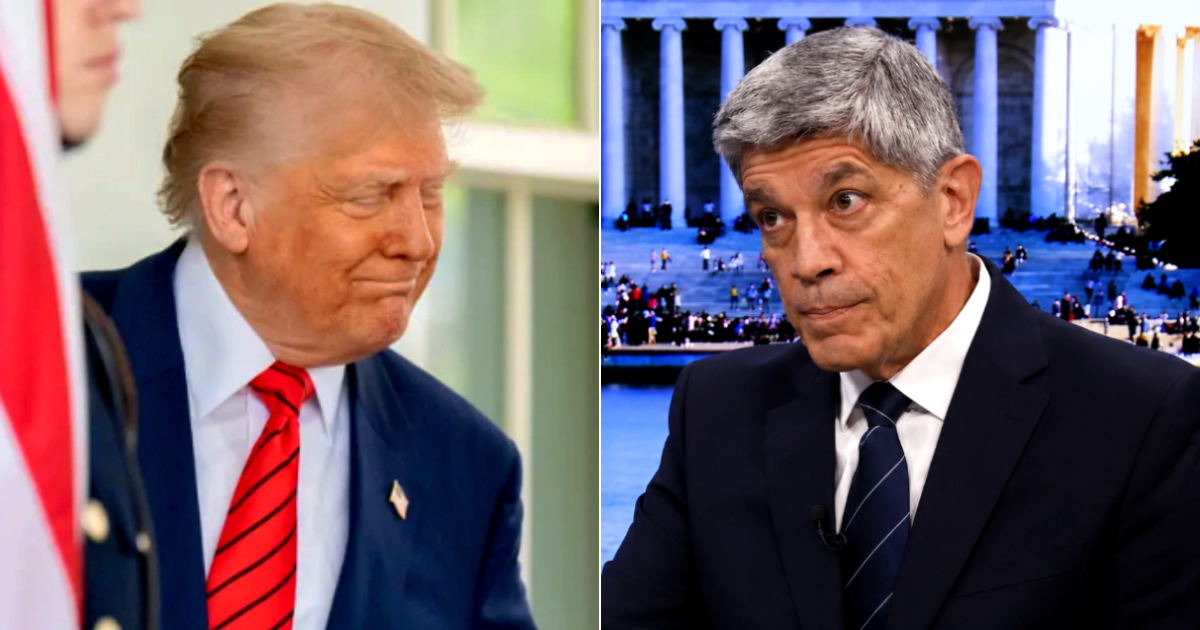
The Deputy Minister of Foreign Affairs of Cuba, Carlos Fernández de Cossío, responded to the statements made by President Donald Trump before the UN General Assembly and dismissed any progress in the contacts between Havana and Washington.
It is evident that there are no advances, declared the diplomat to the official agency Prensa Latina on the sidelines of the High-Level Segment of the 81st session of the body, held in New York.
The reaction comes shortly after Trump stated in that same forum that Cuba is an "absolutely failed state" and pointed out Secretary of State Marco Rubio as the person responsible for exchanges with the regime of the island.
Marco Rubio is leading a negotiation. He is deeply involved in the talks with Cuba. We'll see what happens," said the president in his speech.
The Cuban delegation left the plenary during Trump's speech, in a protest that the Foreign Minister Bruno Rodríguez Parrilla described as a response to “falsehoods and slanders.”
Fernández de Cossío argued that it is not possible to identify progress "when the U.S. government frequently imposes new punitive coercive measures on the Cuban people every week or every two weeks and continues to reinforce the brutal economic war."
The official acknowledged the existence of contacts but framed them within the context of ordinary diplomatic relations: "We have formal diplomatic relations with the United States and therefore an official channel of communication." He added that the matter "is handled with discretion, as has been our practice."
This statement is the final link in a long chain of denials, clarifications, and confirmations that began in January 2026. “There is no dialogue table, although we are open to talking,” Fernández de Cossío himself assured at the beginning of February.
After repeatedly denying any political contact or conversation, the regime began to give ground: in March, Díaz-Canel confirmed that Cuban officials were engaged in discussions with representatives from Washington to "seek solutions through dialogue," and acknowledged that Raúl Castro was leading that process.
In April, the regime confirmed that it held a meeting with a delegation from the United States in Havana. In statements to the official newspaper Granma, the deputy director general for the United States at the Ministry of Foreign Affairs (MINREX), Alejandro García del Toro, acknowledged that the meeting took place with high-level representatives from both governments.
In this context, the Guantanamo Naval Base was also the scene of high-level movements. On May 29, the head of the U.S. Southern Command, General Francis L. Donovan, met at the facility's perimeter with the Cuban General Roberto Legrá Sotolongo, first vice minister and head of the General Staff of the FAR, in a meeting that Havana rated as "positive" and that SOUTHCOM described as an exchange on operational security.
Days later, on June 10, the Secretary of War, Pete Hegseth, visited the base, where he asserted that the Department of War was “prepared and positioned for any possible eventuality” related to Cuba and warned Havana against acquiring weaponry capable of threatening the installation or U.S. territory.
The most visible milestone of these contacts was the visit of the CIA Director, John Ratcliffe, to Havana on May 14, where he met with high-ranking Cuban officials, including Raúl Castro's grandson, Raúl Guillermo Rodríguez Castro, known as "El Cangrejo," and the Minister of the Interior, Army Corps General Lázaro Alberto Álvarez Casas.
In July, Prime Minister Manuel Marrero Cruz confirmed that a negotiating team was operating with the approval of Raúl Castro and Díaz-Canel. By the end of that same month, Fernández de Cossío himself admitted that Cuba accepted a "communication channel" proposed by Washington, although he specified: “We do not use the word negotiations.”
On September 8, Rodríguez Parrilla admitted that conversations were taking place but “do not show any progress” and denied that there were “negotiations, agreements, or roadmaps.” Fernández de Cossío's statement this week almost mirrors that position.
Rubio, for his part, left the door open to working with figures from the regime who do not have "blood-stained hands," and sent a direct message to Havana: "You have an opportunity to begin putting your country on an irreversible path towards progress and a better future. This involves both political and economic freedom, without a doubt."
While the regime insists that there are no advancements, John Kavulich, president of the U.S.-Cuba Trade and Economic Council, stated that contacts between both governments occur daily through private actors and that American companies already have investment agreements "in progress" in Cuba.
"Perhaps there isn't much traditional diplomacy right now, but there is still a form of dialogue every day," he stated.
Related videos:
Filed under: