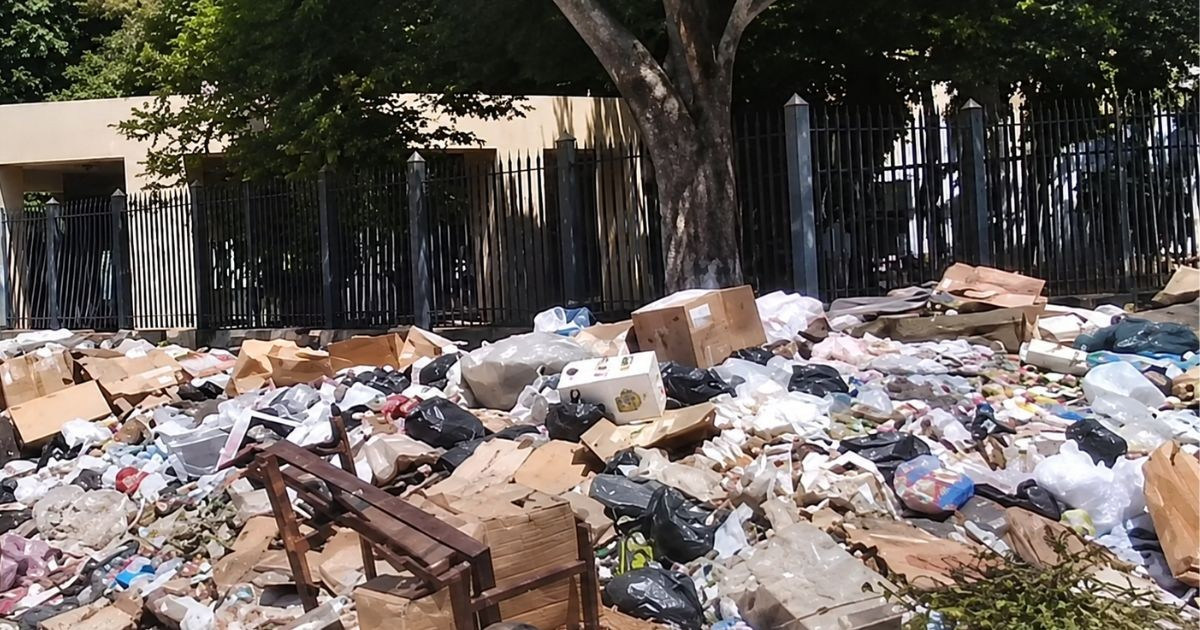
The Holguín writer José Poveda Cruz published a text entitled "The Great Stench" this Friday on his Facebook profile, an ironic and morally demanding reflection on the accumulation of waste in the streets of Cuba and the collective resignation that has normalized it.
"I have spent these days contemplating the dumpsters of the city, an activity not recommended for those who still hold any hope in the human species," writes Poveda Cruz, who in July warned that " even the most basic needs seem like luxury items in the country."
The trash bins he describes are not exceptions: they're on the sidewalks, at the corners, next to the trees, in front of the houses. "You take one step and a trash bin appears. You take another step and another one shows up. You turn the corner and there's the third one, as if the city had decided to replace its monuments with heaps of waste," the author points out.
What troubles him the most is not the dirt itself, but the indifference that surrounds it: “Trash has reached that sublime moment of social acceptance where it stops being seen as a problem and becomes part of the landscape.”
To frame his complaint, Poveda Cruz refers to a specific historical example: the Great Stink of London in 1858, when the River Thames, turned into a sewage system, emitted such an intense odor that it reached the British Parliament. The response was to build a vast sewer network designed by engineer Joseph Bazalgette. The contrast with Cuba is the crux of the argument: “The English, faced with such a plague, did not organize a campaign to explain to the population that they should get used to the smell. […] They built sewers.”
The Cuban solution has been different: "And we, in the meantime, have discovered a much more economical solution: to get used to it. Because habit is the sewer of the poor." Under that logic, the garbage dump ends up acquiring a permanent status: "It has its corner, its hours, its neighbors, and even a certain job stability: each day it receives new contributions."
The deeper argument of the text points to a moral degradation: "That may be the true Great Stench. Not the one that comes from a mountain of waste, but the one that begins when the moral sense becomes accustomed." It adds: "A society does not start to decline when the first dumps appear. It begins to decline when someone walks past them, looks at them, shrugs, and keeps walking. And after a while, they don’t even look at them anymore."
The text arrives at a moment when the solid waste crisis in Cuba has reached critical levels. In Havana, in February 2026, only 44 out of the 106 collection trucks were operational —around 41.5% of the fleet— while the capital generates between 24,000 and 30,000 cubic meters of waste each day. In light of the collapse, Prime Minister Manuel Marrero called for a massive cleanup effort that month, after admitting in late 2025 the failure of institutions to resolve the crisis.
Holguín, the hometown of the writer, has a particular symbolic weight: it was historically recognized as one of the cleanest cities in Cuba, a distinction it has completely lost. Throughout 2026, there have been reports of burning trash dumps in its neighborhoods, roads blocked by waste, and rivers turned into landfills. This Wednesday, an enormous trash dump next to the train tracks in Las Tunas sparked outrage on social media.
The text joins other voices that in 2026 have raised concerns about urban degradation and the dangers posed by dumpsters on public roads as breeding grounds for disease. In August, poet Juan Carlos García Guridi stated that Cuba had become "a country of trash."
Poveda Cruz concludes his text with a statement that serves both as personal resistance and a collective call: "For now, at least, I still have that small luxury. The luxury of being outraged."
Related videos:
Filed under: