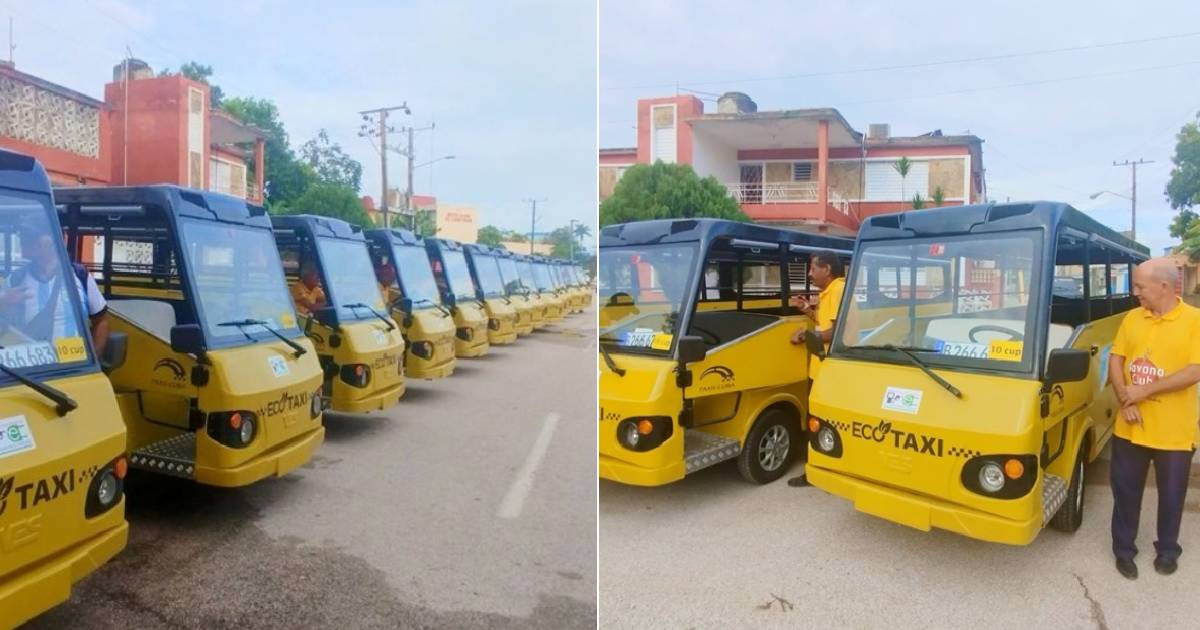
The authorities in Sancti Spíritus delivered 13 new Ecomóvil electric vehicles to drivers from the company TaxisCuba in the municipalities of Jatibonico, Taguasco, Fomento, and Cabaiguán, amidst the worst mobility crisis Cuba has faced in decades.
With this addition, the province increases its total fleet to 61 units of this type, confirmed José Lorenzo García, director of the Transportation Directorate of the People's Power Administration in the territory, as reported this Saturday by the official newspaper Escambray.
"Throughout the remainder of the year, it is expected that the eight municipalities of Sancti Spíritus will have these means, which will bring the provincial total to 73," García specified, referring to the governmental strategy related to territorial mobility.
The event was attended by the Vice President of the Council of Ministers Jorge Luis Tapia Fonseca, the First Secretary of the Communist Party in the province, Deivy Pérez Martín, and the Governor Alexis Lorente Jiménez.
The Ecomobiles are electric minibuses assembled at the Military-Industrial Company Colonel Francisco Aguiar Rodríguez, funded by the Public Transport Development Fund of the Ministry of Transport and the Energy Transition Project, which also involves the José Martí University of Sancti Spíritus.
Each unit has a capacity for 11 passengers and operates with a fare of 10 Cuban pesos on high-demand urban routes. Its main advantage over conventional transportation is that it runs on electricity and does not require diesel or gasoline.
The program launched in April 2023 with the first prototype. The first five vehicles began operating in June 2024, and by September 2025, 28 units were already on the road in the provincial capital and five in Trinidad.
In June, Sancti Spíritus resumed manufacturing with the aim of producing another 50 units. Despite official efforts, the scale of the program is still inadequate in light of the extent of the mobility crisis facing the population.
The delivery occurs in the context of a collapse of public transport. The Ministry of Transport has implemented drastic cuts to buses, trains, and ferries; interprovincial bus trips from Havana have been limited to three departures per week, train services to one every two weeks, and the ferry to Isla de la Juventud operates only on Saturdays.
Meanwhile, the government relaxed the requirements for operating private electric transportation. By the end of July, around 1,900 people with electric vehicles had been authorized to transport passengers and cargo, and the country had more than 10,000 self-employed workers in that sector.
Related videos:
Filed under: