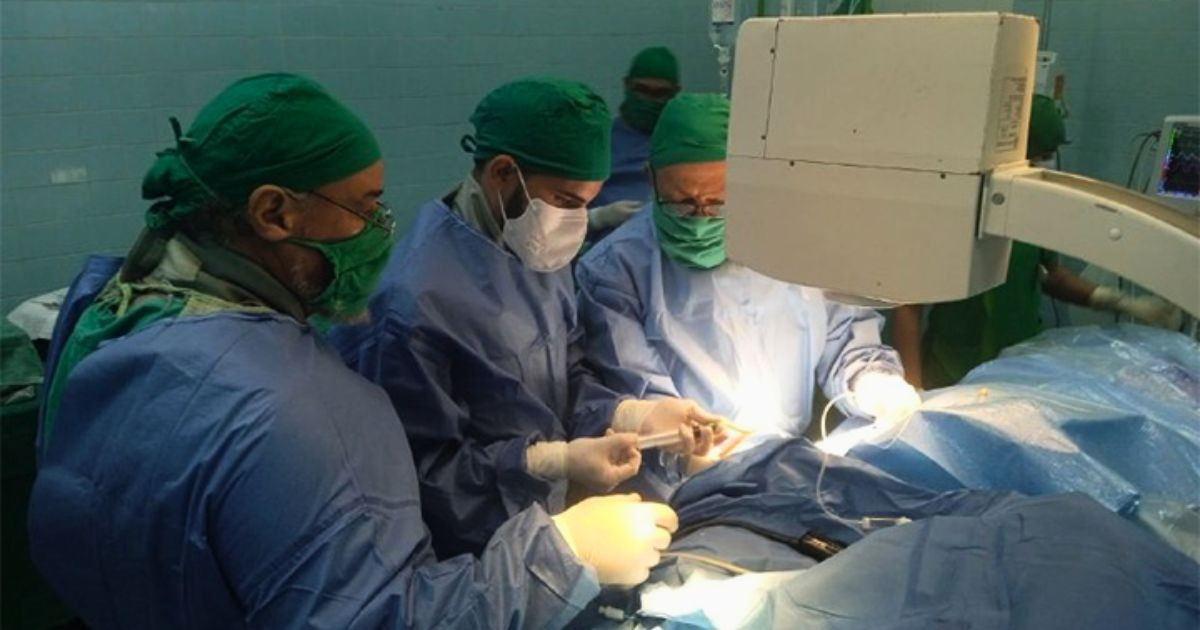
A multidisciplinary team of Urology specialists from Pinar del Río performed, for the first time on Friday, a percutaneous nephrolithotomy at the Pepe Portilla pediatric hospital, a minimally invasive procedure to remove kidney stones that had not previously been performed at this pediatric care center.
The patient was Adrián Rodríguez Vélez, a 16-year-old young man from the main municipality, who suffers from a metabolic disease associated with a disturbance of calcium, phosphate, and magnesium, according to the Cuban News Agency (ACN).
The minor had a coraliform lithiasis—a type of stone that occupies a large part of the renal collecting system—with frequent crises, especially septic ones, which had been previously treated in various ways, including open surgery, the source specified
Roberto Caveda Carrasco, a first-degree specialist in Urology at Pepe Portilla and head of the provincial Urology service, led the intervention and described it as a landmark of institutional collaboration: “In this way, we established a connection with the minimally invasive department of Abel Santamaría Cuadrado hospital, as the equipment belongs to that facility; and we can ensure that the pediatric unit can resolve this type of surgery, with minimal approaches and great relevance for the preservation of renal function.” The specialist also emphasized that “it was a complex surgery that lasted three hours; and it was successful,” reported the outlet.
The procedure was supported by Tadeo Miguel Ferreiro Valdés, a second-degree specialist in Urology at the Abel Santamaría Cuadrado hospital —the largest hospital in the province— who emphasized that the endoscopic technique, by incorporating an endocamera, provides greater visibility and a more accessible surgical field than conventional surgery.
In that regard, the surgery served as a formative experience for Misael Hernández, a recently graduated specialist in Urology, and for Jonathan Cuba, a fourth-year resident on a Pediatrics rotation
The pediatric anesthesiology team was also crucial to the outcome. Jackson Castillo Pozo, head of the Anesthesia service, emphasized teamwork as a key factor in the success. The procedure was performed under general endotracheal anesthesia.
The achievement takes on special significance in the context of the severe health crisis facing Pinar del Río and the country, which has tens of thousands of pending surgeries. Since at least February of that year, blackouts and shortages had forced the postponement of elective surgeries in the westernmost Cuban province, prioritizing only urgent cases, pregnant women, oncology patients, and those on hemodialysis.
Percutaneous nephrolithotomy is a technique with decades of development in Cuba: endourological procedures of this type began to be developed at the Hermanos Ameijeiras Hospital in Havana since the second half of the 1980s and later spread to other areas.
Its use is also listed among the alternatives for the treatment of pediatric urolithiasis, although the widespread adoption of minimally invasive techniques in children has been hindered for years by the availability of equipment and instruments.
In this context, the pediatric nephrolithotomy performed this Friday marks a significant advancement for the problem-solving capacity of Pepe Portilla, the main children's healthcare center in Pinar del Río, at a time when the precariousness of the Cuban healthcare system is particularly affecting the provinces.
Related videos:
Filed under: