The Cuban poet and improviser Juan Carlos García Guridi published on Saturday on his Facebook profile the sonnet titled "LUCHA", fourteen verses that capture in a classical form the daily anguish of millions of Cubans trapped in a crisis with no visible way out.
The lyrical piece, structured in two quatrains and two tercets, opens with an image of unyielding resistance: "The ordinary Cuban fights daily, / he does not pause in search of sustenance; / every step he takes resonates in my soul / as if it were an unnecessary scream."
The second quartet deepens the existential precariousness: "It is a destiny sometimes so precarious / that it seems driven by the wind / and life, soulless and breathless, / clings to the fasting of Calvary." The reference to Calvary equates the suffering of the common Cuban with a martyrdom that repeats without redemption.
The first tercet encapsulates a powerful essence of the poem: "God does not listen to the everyday Cuban: / What He commands cannot be the struggle, / much less the Judas of the government." The characterization of the regime as "the Judas of the government" is the most direct accusation of the composition, positioning political power as an accomplice in this abandonment.
And for the conclusion, an image of resistance without reward is preserved: "I admire him because he never bends / and under the sun, the rain, or winter / he fights for a future that does not come." That last line serves almost as a chronicle of what hard data confirms about the reality of the island.
García Guridi, born in Batabanó, Mayabeque, in 1968, is an active researcher and cultivator of the décima and Cuban popular poetry, with more than a dozen published books. "LUCHA" is the most recent installment in a sustained series of protest poems published throughout this year: "Catarsis", where he wrote "Silence is not worthy of a medal"; "PREGUNTO", about the loss of dignity and freedom; and a décima in which he denounced that Cuba has become "a country of garbage".
The verses arrive at a time of the greatest documented deterioration of the island in decades. The Cuban Observatory of Human Rights estimated in August, based on 1,318 interviews in 79 municipalities, that 94% of the population lives in extreme poverty and that eight out of ten Cubans had skipped breakfast, lunch, or dinner at least once in the past six months due to lack of money or food.
This reality is compounded by blackouts lasting between 20 and over 30 hours daily in several areas, an informal exchange rate where the dollar is valued at over 700 Cuban pesos, and hundreds of essential medications out of stock in state pharmacies.
The response from readers to the poem "PREGUNTO," published in July, anticipated the resonance that compositions like "LUCHA" evoke among those living that reality. One internet user wrote: "The most brutal torture that can be inflicted on a human being is being applied in our country; we have nothing left." Another commented: "Oh God, how much suffering in those verses! [...] But no one has an answer; only uncertainty remains in our lives."
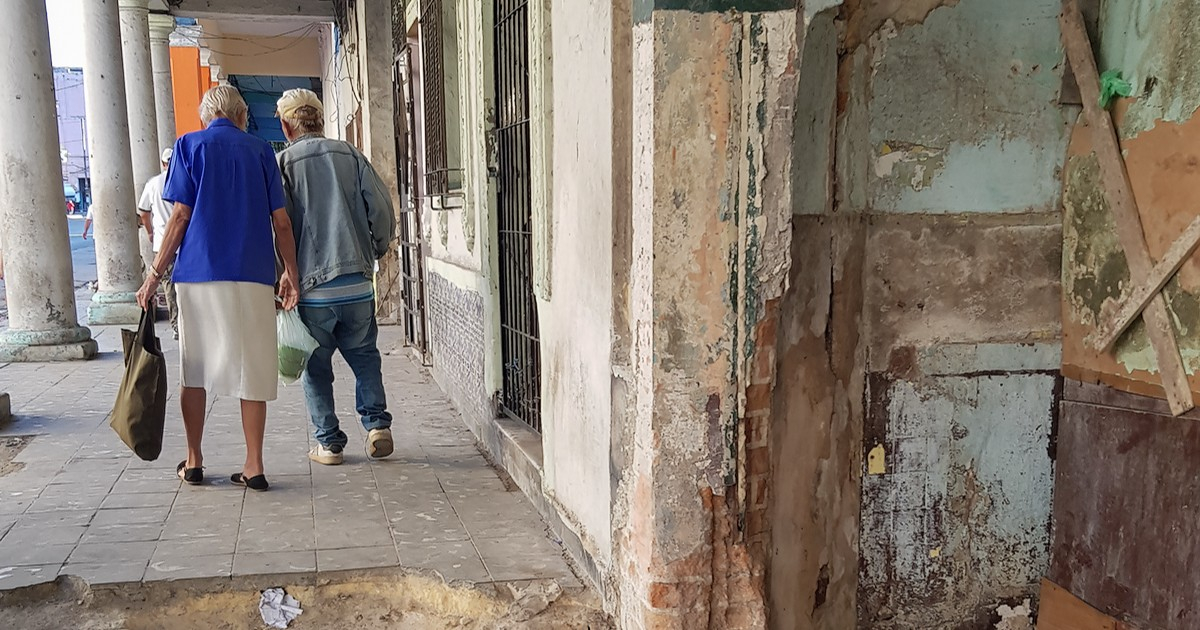
In that context, the closing of the sonnet takes on a dimension that transcends the literary: the Cuban who “under the sun, rain, or winter / fights for a future that does not arrive” is also the one pushing a rickety cart through worn streets, the one who skips meals, the one who watches his children emigrate.
Related videos:
Filed under: