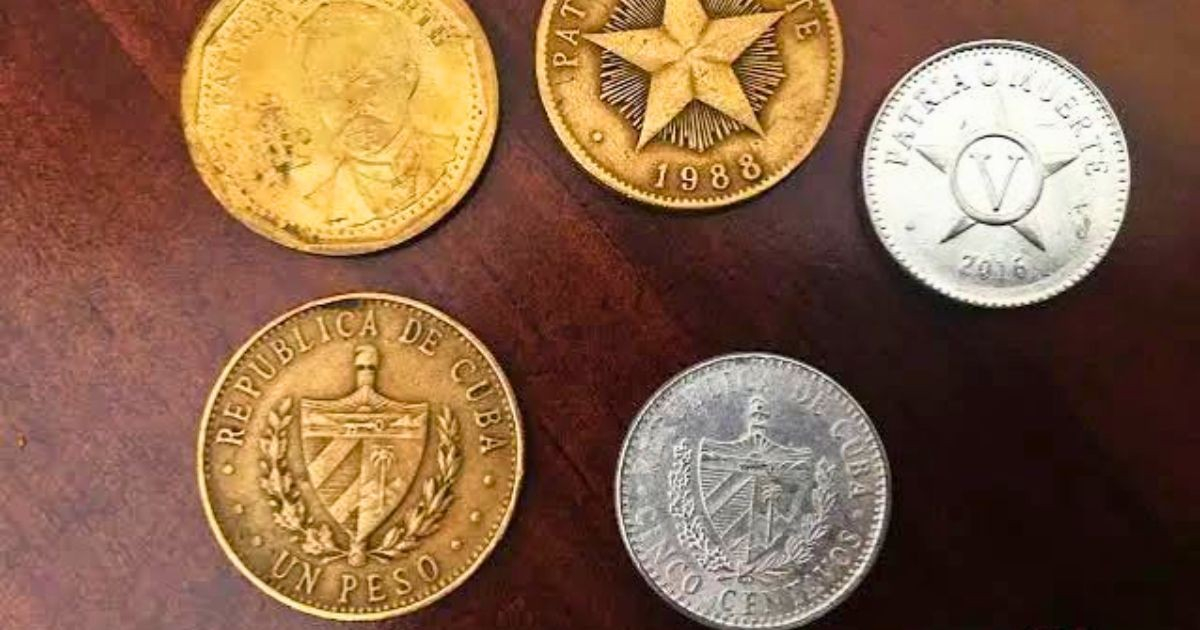
A list of nine words published this Sunday on Facebook by Camagüey writer and journalist María Antonia Borroto Trujillo summarizes, with linguistic precision and implicit humor, the collapse of the purchasing power of the Cuban peso: "Menudo (as a noun), Calderilla, Peseta, Medio (as a noun), Peso macho, Moneda, Kilo, Kilo prieto… Cheap."
The post, accompanied by a photograph of Cuban coins, immediately resonated with Cubans, who recognized in that list the exact portrait of an economy where those words have lost all real reference.
Each term is rooted in the monetary and linguistic history of the island. The "peseta" was the traditional name for 20 centavos, a denomination inherited from the old Spanish monetary vocabulary and which survived in Cuba. The "medio," equivalent to five centavos, preserved the memory of the medio real from the old monetary system. "Calderilla," a term with a long Spanish tradition and now almost archaic in Cuba, generically referred to small coins or coins of low value.
The "kilo" or "quilo" became a synonym for centavo in Cuban colloquial speech, while "kilo prieto" originally referred to the copper cent that circulated on the island and colloquially ended up associated with an insignificant amount of money. Lastly, "peso macho" was the popular name given to Cuban one-peso coins minted since the early years of the republican monetary system.
All that terminology became obsolete as inflation eroded the value of peso fractions, a process that dramatically accelerated with the so-called Tarea Ordenamiento, which began on January 1, 2021. This effort eliminated the CUC and left the CUP as the only legal currency, unleashing an inflationary spiral that has reached historic levels by 2026.
According to the Center for Cuban Economy Studies (CEEC) at the University of Havana, the year-on-year inflation in Cuba reached 25.19% in August 2026, with food and non-alcoholic beverages increasing by 36.01% during the same period. Independent economists estimate that the real inflation —including the informal market— is much higher.
The Central Bank of Cuba issued on September 16 10,000 and 20,000 peso bills, the highest denominations in the country's history, while the dollar in the informal market surpassed 700 pesos. Economist Pedro Monreal warned that this issuance reflects "chronic inflation, monetary duality, or a dollarized circuit, not a payment system anchored in work."
The extent of the deterioration is evident in everyday prices: a pound of chicken is sold for 800 pesos in Havana's MiPYMES, a bag of milk has reached a cost of 6,500 pesos in Matanzas, and a bottle of oil ranges between 3,800 and 4,000 pesos, with peaks around 7,000.
In light of this, the minimum wage remains at 3,210 pesos per month, and the cost of living for a small family in Havana, according to estimates from a local resident, exceeds 205,000 pesos per month. In this context, referring to "pesetas," "medios," or "change" concerns such insignificant amounts that they have vanished from everyday conversation.
Borroto Trujillo, a Doctor in Communication Sciences and a member of the Union of Writers and Artists of Cuba (UNEAC), has become a recurring voice on Cuban social media throughout 2026. On July 31, she published an ironic “basic manual” for calling the Electric Company without having a heart attack, and in August, she recounted the effects of seven days without electricity with the same blend of literary irony and direct denunciation that characterizes her writing.
The climax of his list —the word "cheap"— is perhaps the most striking blow: it is not just an outdated monetary term, but a summary of a reality that Cubans no longer recognize.
Related videos:
Filed under: