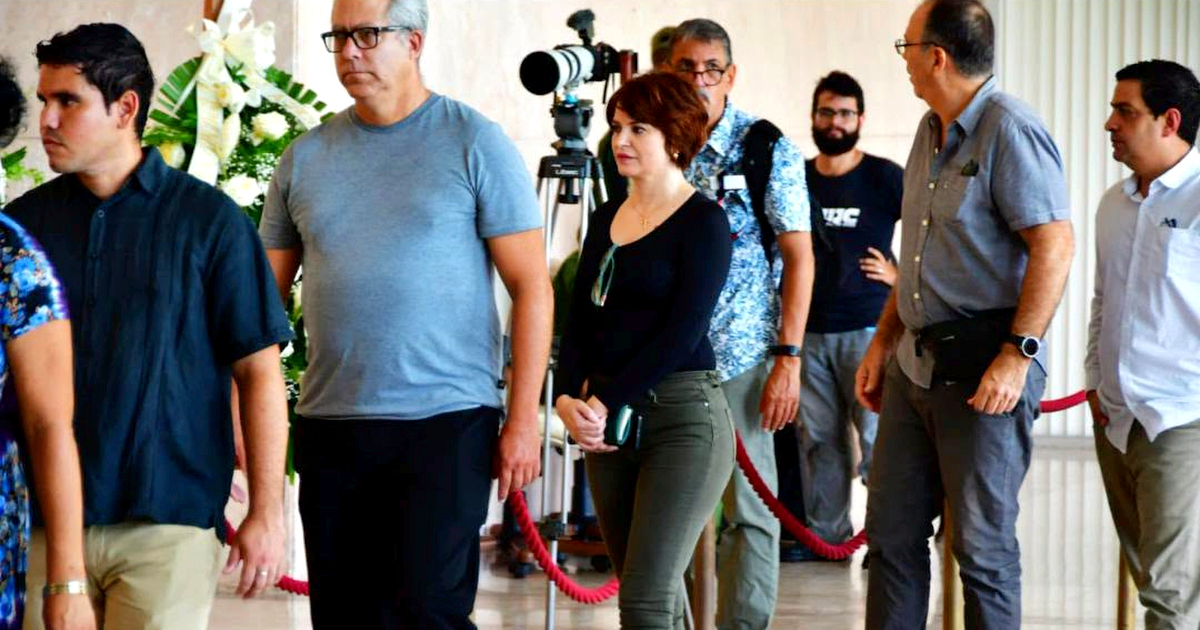
Ana Hurtado wants to present the recent leak from CBS News regarding U.S. military preparations related to Cuba as just a simple "psychological warfare" operation. However, a photo posted by her on Facebook helps to better understand the perspective from which the Spanish propagandist speaks.
On June 27, Hurtado shared an image of the funeral tribute to Ramiro Valdés with the message: "Always grateful to the lens of Roberto Garaycoa Martínez. Paying tribute to Ramiro."
It was not just any event. Ramiro Valdés was a historical figure at the core of the Castro regime's security: a commander of the so-called "revolution," founder of the Ministry of the Interior, and one of the men closely associated for decades with the intelligence, counterintelligence, and internal control structures of the Cuban system.
The image is significant due to the context and the people surrounding Hurtado. According to the identification provided about the scene, her husband, Senén Casas Más; Alejandro Castro Espín, son of Raúl Castro; and Humberto López, one of the main media spokesmen for the Cuban regime, are present in the environment.
That triangle—military family, intelligence, and propaganda—allows for a different interpretation of Hurtado's message regarding the alleged "psychological war" of Washington.
The wife of an operator implicated in the Castro Espín environment
Hurtado is not an external observer who comments from a distance. Investigative reports identify her as the wife of Senén Casas Más, designated as an operator within Alejandro Castro Espín's close circle.
CiberCuba, citing research from Martí Noticias and Mario J. Pentón, reported that Casas Más may have had access to diplomatic passports from the Ministry of the Interior and participated in over 40 missions abroad alongside Castro Espín, in countries such as Russia, China, Panama, and France.
The information is relevant because places Hurtado in a network that goes far beyond ideological activism. Her husband is portrayed in these investigations as a low-profile figure, but connected to a power circle where state security, discreet diplomacy, and the Cuban military apparatus intersect.
For this reason, his reaction to the CBS report should not be interpreted solely as a militant phrase against "the empire." It can also be understood as part of a defensive narrative of an environment that needs to minimize signs of external pressure and convey the idea that everything is under control.
Castro Espín: Intelligence, the United States, and Power in the Shadows
The figure of Alejandro Castro Espín is central to understanding that environment. Son of Raúl Castro and Vilma Espín, he was for many years one of the least visible yet most influential names in Cuban power.
El País described him as an "organic intellectual of the regime, but in uniform": he wrote articles for official media, presented himself as a political scientist and master's degree holder in International Relations, and published books on international politics such as Empire of Terror and United States: The Price of Power, focused on a hostile interpretation of U.S. policy towards Cuba.
But Castro Espín was not only an author of anti-American books. According to El País, following the announcement of the thaw between Barack Obama and Raúl Castro, he emerged as the architect of the rapprochement with Washington, a facilitator of secret talks, advisor to his father, a member of the National Security Commission, and head of intelligence and counterintelligence for State Security.
Yucabyte also reports that Ben Rhodes and Ricardo Zúñiga negotiated with Castro Espín during the secret contacts that led to the restoration of diplomatic relations between Cuba and the United States. According to that report, Alejandro was then leading the Commission on Defense and National Security, although the American negotiators suspected that his real role was even greater within the Cuban leadership.
That is to say, when discussing the circle around Castro Espín, it is not about a symbolic group. It refers to a realm where, for years, the relationships with Washington, Cuban counterintelligence, the security of the Castro family, and the management of sensitive crises have intersected.
The ghost of the Havana Syndrome
The trajectory of Castro Espín was also marked by the so-called Havana Syndrome. Diario de Cuba recalled that a report from The New Yorker linked Castro Espín—until a few months prior the head of the National Defense and Security Commission and advisor to his father—with the context of the alleged acoustic attacks that affected American and Canadian diplomats in Havana.
That same report indicated that the department of MININT that Castro Espín led has reportedly been dismantled around March 2018, amid speculations regarding his loss of influence. The information does not publicly prove a direct responsibility of Castro Espín in those incidents, but it does show that his name became associated with one of the most sensitive episodes in the recent relationship between Cuba and the United States.
El Estornudo, when reviewing the case, recalled that The New Yorker paid special attention to Castro Espín as the figure leading Cuban counterintelligence, and noted that Ben Rhodes and he held direct conversations during the thawing process.
This background is important: Hurtado's proximity to the environment of Casas Más and Castro Espín links his public messages to a space that has historically been involved in interpreting, managing, and responding to signals from Washington.
Humberto López and the propaganda machine
The presence of Humberto López in that context, according to the image's identification, adds another element. López is not just a television presenter. In recent years, he has served as one of the most visible faces of the Cuban official discourse against opponents, exiles, sanctions, and international accusations.
CiberCuba has documented how López has defended on television the thesis that in Cuba, political opponents are not persecuted, but rather individuals accused of crimes against state security or common offenses, a narrative that contrasts with reports from activists and human rights organizations regarding surveillance, harassment, and political imprisonments.
CiberCuba also analyzed the role of Razones de Cuba and La Bitácora Nocturna, spaces led by López, as instruments of political defense for the Cuban government on sensitive issues.
That detail helps to understand the logic of the ecosystem. Cuban official propaganda does not function as a separate apparatus from the security system. In sensitive matters—internal opposition, judicial accusations, the United States, sanctions, intelligence—it typically operates as a narrative arm of a larger political control machinery.
That is why a scene where Hurtado, the circle around Casas Más and Castro Espín, and a figure like Humberto López converge holds journalistic value. It does not by itself prove a specific coordination behind Hurtado's post, but it does illustrate the political landscape in which he operates.
Mockery as Defense
Hurtado's post about CBS should be read within that context. The American network reported that the Army Reserve is evaluating whether it can provide Southern Command with military police units, medical personnel, engineers, and logistical support within 90 to 120 days.
CBS clarified that there is no public deployment order and that the internal document does not directly mention Cuba, although U.S. officials linked those preparations to planning concerning the island.
Hurtado responded with mockery: “What the United States doesn’t want to leak, doesn’t leak.” The statement aims to instill a simple idea: Washington is just playing at being frightening.
But that interpretation overlooks the context. Since January, the United States has amassed public signals directed at Cuba: sanctions, energy pressure, aerial surveillance in the Caribbean, military movements in Puerto Rico and Guantánamo, strategic documents regarding the Western Hemisphere, and statements from Donald Trump about "taking Cuba" or sending an aircraft carrier.
In the face of a statement like this, reducing everything to a "psychological war" doesn’t seem like an analysis. It appears to be a slogan.
Real tranquility or a message for the membership?
The underlying question is not whether Ana Hurtado truly believes that everything is a theater. The question is whether the apparatus she seems so close to needs to convince its base that there is nothing worth taking seriously.
Propaganda serves an emotional function: it reduces anxiety, ridicules the opponent, reinforces the idea of control, and prevents external signals from being interpreted as internal vulnerability.
In that sense, Hurtado’s message can be interpreted less as a strategic assessment and more as a calming operation directed at the pro-government audience: nothing is happening, it’s all manipulation, the enemy just wants to scare us.
The problem is that the recent experience of Venezuela provided another lesson. Before the capture of Nicolás Maduro, there were also warnings, sanctions, leaks, rewards, deployments, and public messages that the Chavismo chose to downplay. Not all threats are fulfilled, but some cease to be threats when the adversary miscalculates.
Hurtado may call what was published by CBS "psychological warfare." However, his own image at the tribute to Ramiro Valdés, his marriage to a figure implicated in the circle of Castro Espín, and the presence of spokespersons like Humberto López reveal that his message originates in a setting where propaganda, security, and intelligence are not separate realms.
The question, therefore, is not just what Ana Hurtado meant to say.
The question is whether the Cuban government is truly at ease, or if public mockery and minimization are the chosen methods to conceal their concern.
Related videos:
Filed under: