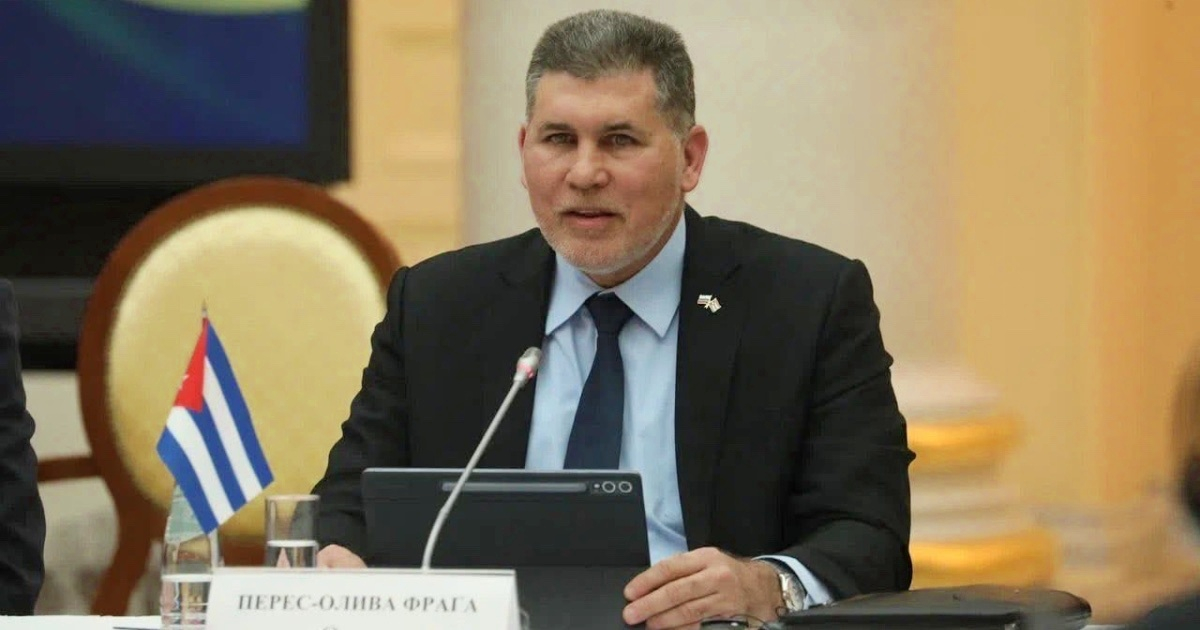
The great-nephew of Fidel and Raúl Castro, Oscar Pérez-Oliva Fraga, dismissed any aspirations of coming to power in Cuba during an extensive interview given to Reuters from his office in Havana.
“I have no aspirations in that regard,” said Pérez-Oliva.
"I am simply a public servant and I will work wherever I am needed, without aspiring to any particular position", he added.
The 55-year-old official, who serves as the vice prime minister and minister of Foreign Trade of Cuba, responded to speculation about his potential role as a successor within the Cuban regime during a time of intense diplomatic pressure from the Trump administration.
"I have no aspirations in that regard."
When Reuters directly asked him about his potential role in a political transition scenario, Pérez-Oliva was categorical: “I have no aspirations in that regard.”
The statement takes on particular significance in light of what was published by The New York Times in August. According to the newspaper, the Trump administration sought to identify figures within the Cuban regime capable of taking on government responsibilities in a possible transition process, using Delcy Rodríguez's role in Venezuela following the capture of Nicolás Maduro as a reference.
The New York newspaper noted that the regime itself appeared to be positioning Pérez-Oliva as a possible successor, although it indicated that Washington would consider him “almost certainly unacceptable”.
The New York Times also mentioned possible interlocutors including Raúl Guillermo Rodríguez Castro, the grandson of Raúl Castro known as "El Cangrejo," and the Minister of the Interior, Lázaro Alberto Álvarez Casas.
A rapid rise within the regime
Pérez-Oliva is the son of Mirsa Fraga Castro and the grandson of Ángela Castro Ruz, the elder sister of Fidel and Raúl, who passed away in 2013, making him the great-nephew of the two historical leaders of the Cuban Revolution.
An electronics engineer graduated from the Technological University of Havana, he accumulated over 15 years of experience in foreign trade before his political rise.
He worked as the Business Evaluation Director in the Mariel Special Development Zone, under the supervision of General Luis Alberto Rodríguez López-Calleja, known as the "czar of GAESA" and former son-in-law of Raúl Castro.
In May 2024, he was appointed as Minister of Foreign Trade replacing Ricardo Cabrisas Ruiz.
Just a year later, in October 2025, he was promoted to vice prime minister, while simultaneously retaining his position as head of the ministry, marking a rapid rise within the structure of the Cuban government.
His public visibility has also increased: he appears more frequently on state television and has given interviews to international media such as CNN and Reuters.
The Ministry of Foreign Affairs highlighted in November 2025 as the only figure in a session of the National Defense Council chaired by Díaz-Canel, omitting the rest of the leaders.
Denies contacts with companies linked to Trump
In the interview published this Tuesday, Pérez-Oliva also denied reports suggesting that companies linked to President Donald Trump had traveled to Cuba this year to explore business opportunities.
“I have no knowledge of any company directly linked to President Trump that has made contact with Cuba,” he stated, and assured that neither he nor any other Cuban official had met with representatives of those companies.
The Cuban government once again blames the embargo
The official took the opportunity during the interview to defend the package of 176 market reforms approved by the National Assembly in June 2026 and to identify the U.S. embargo as the primary obstacle to their implementation.
“It is not Cuba's policy to prohibit U.S. companies from investing in Cuba, trading with Cuba, or conducting any kind of business with Cuba,” stated Pérez-Oliva.
"What prevents this possibility is the existence of the trade embargo," he added.
Pérez-Oliva also blamed the measures taken by Washington in January of this year for the significant reduction in Cuba's fuel imports from Mexico, Venezuela, and other traditional suppliers to the island.
The regime claimed on Monday that it has already implemented 89% of that reform package, which includes opening up to foreign direct investment in the private sector, private banking, removing the limit of 100 employees for small and medium-sized enterprises, and private currency exchange houses.
A context of high diplomatic tension
The interview takes place amid signs of rapprochement and tension between Washington and Havana.
Last Friday, Trump predicted that the U.S. and Cuba "will reach an agreement" and ruled out military action against the island.
At the beginning of last week, before the UN General Assembly, the U.S. president stated that Marco Rubio "is handling a negotiation" with Cuba.
On his part, the Cuban Foreign Minister Bruno Rodríguez stated before the UN that the island is open to dialogue with the U.S., but on the basis of sovereign equality and without preconditions.
In that context, Pérez-Oliva's statement — "I have no aspirations in that regard" — represents a public rejection of the possibility of taking on a leadership role in a potential transition.
However, his rapid rise within the regime's structure and the attention he has received from both the international press and Cuban institutions keep interest in his political future alive.
Related videos:
Filed under: