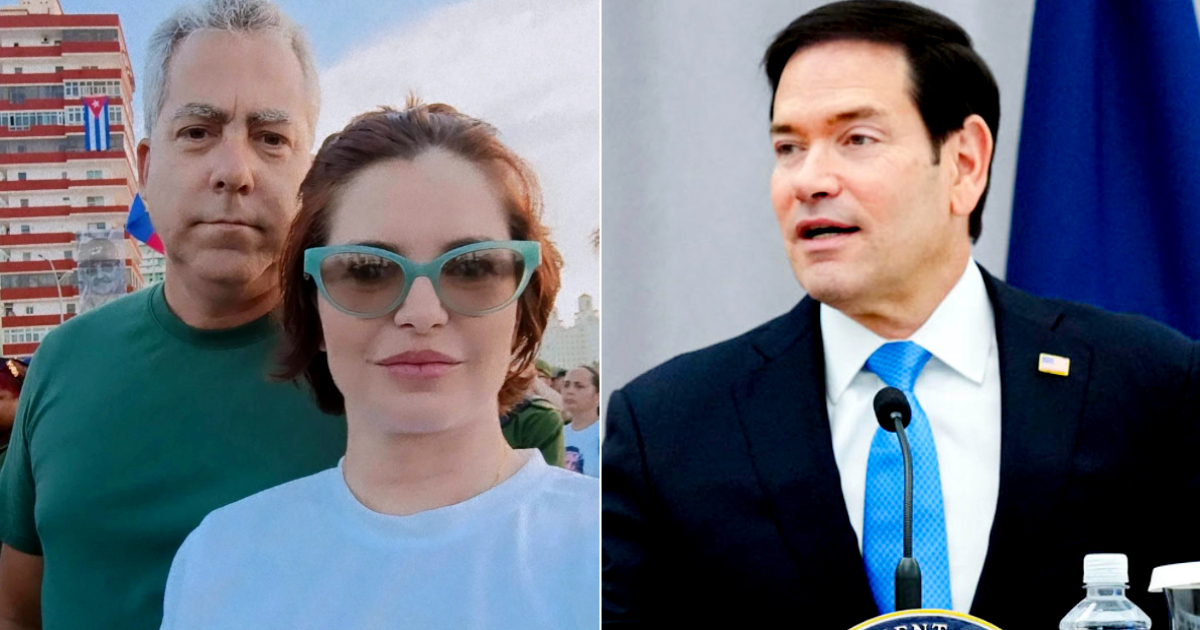
Ana Hurtado went from mocking the leaks regarding U.S. military preparations to warning that an action against Cuba could turn into a new Iraq in just a few days.
The Spanish propagandist, a frequent defender of the Cuban regime, published a text titled "The Living Will Envy the Dead," accompanied by an image of coffins of U.S. soldiers who died in Iraq. The political recipient of the message is clear: Marco Rubio, whom she refers to as "Blondie." For Donald Trump, she has another nickname: "carrot top."
The text aims to respond to the growing pressure from Washington on Havana. Hurtado quotes Rubio's phrase about leaving Cuba on an "irreversible path towards a very different future" and intends to interpret that caution as weakness. According to her, if Rubio were confident that he could bring down the Cuban regime, he would say so openly.
But the argument is weak. In pressure politics, ambiguity also plays a role. Rubio does not need to announce an intervention to uphold the threat. It is enough for him to keep the possibility open, while Washington accumulates sanctions, energy pressure, aerial surveillance, military movements in the region, and leaks such as the one from CBS regarding support units for Southern Command.
What stands out is not only what Hurtado says, but also the change in tone. A few days ago, his thesis was that it was all a "psychological war" waged by the United States. Now, he no longer limits himself to ridiculing the threat: he attempts to respond with a bluff. If the U.S. intervenes, he warns, they won't know how to exit.
From mockery, it shifted to the ghost of Iraq. From "nothing is happening" to "the living will envy the dead," as if a U.S. military action were doomed in Cuba to a "hell on earth" for its troops.
This shift reveals more concern than calm. If the CBS leak were just a meaningless maneuver, there would be no need to invoke coffins, protracted war, moral defeat, and dead American soldiers. Propaganda first reassures its own; when that doesn't suffice, it threatens the opponent.
What does not appear in Hurtado's text is a realistic analysis of the conflict. It does not ask why Cuba has reached this point. It does not examine the cost of remaining entrenched in power. It does not mention the economic deterioration, energy pressure, international isolation, or the risk that the lives of Cubans could sink even further due to the regime's refusal to open a political exit.
It also does not consider the option that any responsible government should contemplate before driving its country into a spiral of confrontation: a transparent consultation, with international observers, free elections, a referendum, or some verifiable mechanism to truly understand what the Cuban people want.
That debate doesn't fit into their propaganda. To include it, they would have to admit that the dilemma is not between Cuba and the United States, but between the closed power of an elite and the right of Cubans to decide their future.
Hurtado also does not question Havana's role in the Venezuelan case. In his previous post, he spoke of the "kidnapping of Maduro / Cilia" and the "murder of the 32 Cuban heroes." The phrase makes the deaths of Cubans linked to the protection of Chavismo seem epic, but it sidesteps the fundamental questions: What were they doing there? Who sent them? Why do Cubans continue to pay with human lives for the sick and criminal will of a minority elite to remain in power?
Propaganda does not question. It canonizes, ridicules, or threatens, as it sees fit.
Now, the message to Rubio aims to convey strength: Cuba would be a trap for Washington, a war difficult to end, an unbearable political cost. But it also reveals that the government continues to improvise a narrative of resistance in a scenario that can no longer be dismissed merely as noise.
Nothing proves an imminent intervention against Cuba. But it cannot be denied that Washington has been sending increasingly visible signals for months.
The appeal to Iraq does not strengthen his argument; it exposes it. If Washington were just trying to frighten him, it would be enough to ridicule it. But Hurtado is no longer satisfied with that: now he needs to promise Rubio an unbearable cost.
Related videos:
Filed under: