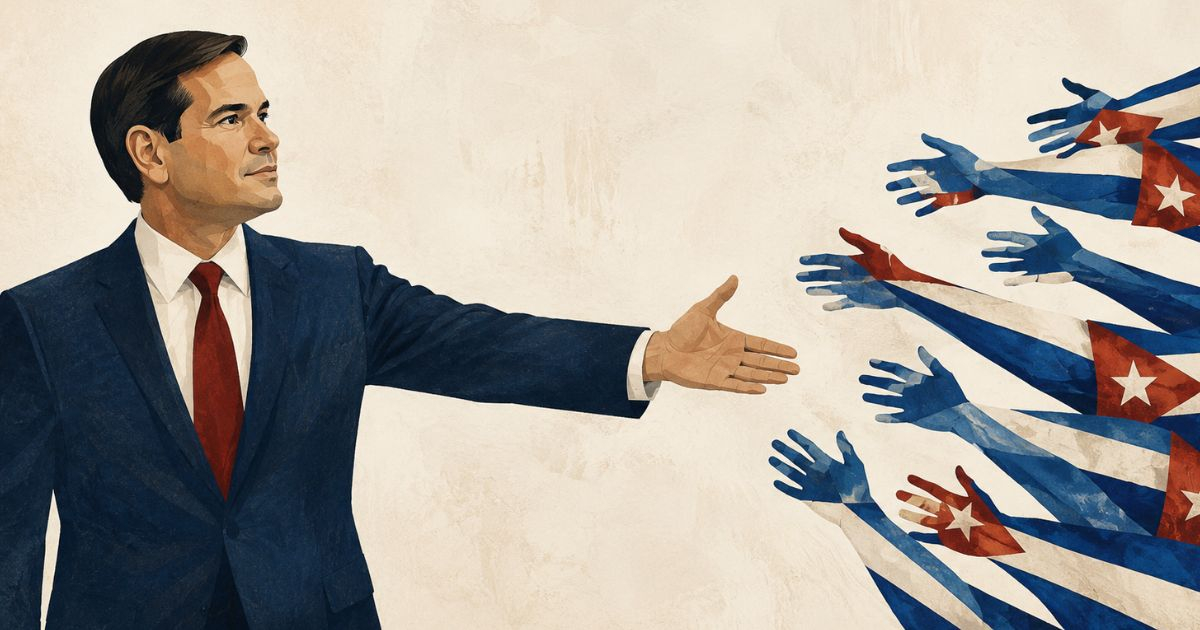
The Secretary of State Marco Rubio set a specific goal this Friday for the Trump administration's maximum pressure policy against Cuba: by the end of the term, the island should be on what he described as an "irreversible trajectory towards a different future."
The statement is part of an exclusive interview granted to Axios in which the official revealed the internal details of an unprecedented campaign against the Cuban regime.
"What we are trying to teach them is that there are no escape hatches," Rubio told the U.S. media, summarizing the logic of the entire strategy in one phrase.
Since January 2026, the administration has carried out more than two dozen separate actions against Cuba, including sanctions on 40 entities —ranging from foreign companies operating on the island to state-owned conglomerates in fuel, banking, and mining— as well as measures against at least 38 individuals, which include visa restrictions and residency revocations.
The most devastating blow to the Cuban economy, according to Rubio, was the capture of Nicolás Maduro by U.S. forces on January 3, 2026, which cut off the Venezuelan supply of up to 100,000 barrels of oil per day that Cuba had been receiving at no cost.
"For the first time in Cuba's history, Cuba lacks two things it has always relied on: an external sponsor and the lack of attention from the U.S. as a top priority," stated the Secretary of State.
The loss of that energy flow has exacerbated chronic blackouts on the island. In contrast, U.S. fuel exports to Cuba reached nearly 96 million dollars in the first half of the year, with almost half concentrated in June alone.
John Kavulich, president of the U.S.-Cuba Trade and Economic Council, was emphatic in evaluating the campaign: "Trump and Rubio have initiated the most effective sanctions program against a target country than any of their predecessors. We have been doing this since 1994 and we have never seen anything like it."
Prime Minister Manuel Marrero recently announced historic reforms to open up the private sector— the largest since the 1959 Revolution— but Rubio dismissed them as maneuvers to buy time.
"Every time they create a new mechanism to get out of the knot, we tighten it. They certainly can't wait for us. This is not going to disappear in the next 2.5 years," he warned.
Axios also revealed that Rubio is in talks with Raúl Guillermo Rodríguez Castro, the grandson of the former leader Raúl Castro, to explore scenarios for political transition.
However, an anonymous U.S. official cited by the outlet acknowledged the uncertainty regarding the true weight of that interlocutor: "When Raúl is no longer around, what is his status? Who protects him?"
Rubio, however, showed no signs of moderation and emphasized that the administration is acting with a long-term perspective: "One of the things we have lost in U.S. foreign policy is the concept of patience and persistence." His stated goal is that, by the time the Trump era concludes, Cuba will have crossed a threshold from which there is no turning back.
The day before the interview was published, the U.S. imposed a new round of sanctions against five Cuban military entities and eight officials, including the Minister of the Revolutionary Armed Forces Álvaro López Miera, due to links with arms purchases from Russia and China.
Unlike previous rounds, these sanctions specifically target the network that allows MINFAR to acquire weapons, equipment, and military technology in international markets, an aspect that had not been addressed as directly by Washington until now.
Related videos:
Filed under: