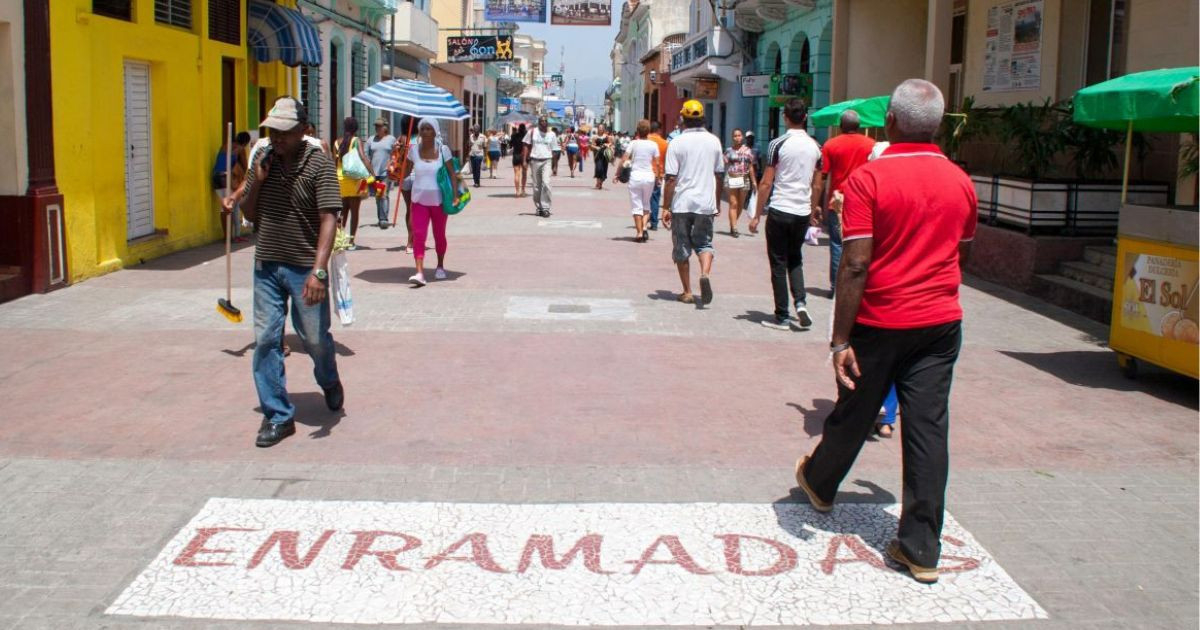
The government of Santiago de Cuba acknowledges that scarcity necessitates the selection of who receives food assistance, in a process that places the responsibility on the local councils to determine monthly which individuals qualify as vulnerable.
The official newspaper Sierra Maestra published this Saturday the explanations of Diamaris Perdomo Hechavarría, the main specialist in Prevention and Social Work of the Provincial Directorate of Labor, regarding the criteria used to identify those who may access state food assistance planned until December.
The official herself summarized the logic of the mechanism by explaining that, in the face of the need to "share the little among many," resources must be directed towards those who do not have enough support.
He stated that the economic situation does not automatically make a person vulnerable, and each case must be assessed individually.
The profiles considered include individuals already assisted by the Employment Directorate, pregnant women, the elderly, children from zero to five years old, minors with oncological diseases or weight and height issues, as well as single mothers with three or more children under the age of 17.
The relationship also includes homeless individuals, families of inmates, and university students whose financial circumstances prevent them from pursuing their studies.
Regarding these last ones, Perdomo emphasized that the State has the responsibility to ensure they do not end up helpless when their families' financial situation is insufficient.
The classification, however, is neither automatic nor permanent. "It is true that conditions are difficult, but not everyone is vulnerable," stated the official, who explained that a person may remain in that condition for three to six months or exit it if their economic circumstances change.
The evaluation is the responsibility of the popular councils. There, groups of Social Policies made up of representatives from the ministries of Education, Health, Labor, Culture, the National Institute of Sports, Physical Education and Recreation (Inder), and social workers analyze each case, provide their opinions, and approve the list of individuals who will receive assistance through a consensus.
The relationship must be updated monthly, so that a family deemed vulnerable may stop receiving assistance if their economic situation improves, while another may join if their conditions worsen.
The official also made it clear that having an elderly person within the family unit does not guarantee access to assistance. Social workers must determine if there are relatives, including children, who are able to provide for their support. "Not everyone qualifies. We must also emphasize the responsibility of families," she pointed out.
The Commerce Directorate of Santiago de Cuba reported that individuals included in these profiles would have some food guarantees, including rice and sugar, until December.
This process is part of a redefinition of the social protection model approved by the National Assembly in June, as part of a package of 176 economic and social measures.
At the end of July, Prime Minister Manuel Marrero Cruz announced that 876,522 individuals had been identified as being in a particularly vulnerable situation across the country.
In the province of Holguín, the third most populated in Cuba, authorities recently acknowledged that one in every 10 inhabitants, -90,148 people- falls into that category.
Critical voices warn that the true magnitude of the problem far exceeds official figures. According to a research study by the Cuban Observatory of Human Rights published in August, extreme poverty affects 94% of the Cuban population.
The jurist René Fidel González García, residing in Santiago de Cuba, rejected the notion that the official figure is an abstract data. In his view, 876,522 people "are not a cold number, they are living persons, people enduring conditions that are simply unacceptable."
The historian Ivette García González was even more direct: "The vulnerable in Cuba are no longer segments, they are not a minority. It is the majority of the people, the ordinary citizen."
Related videos:
Filed under: