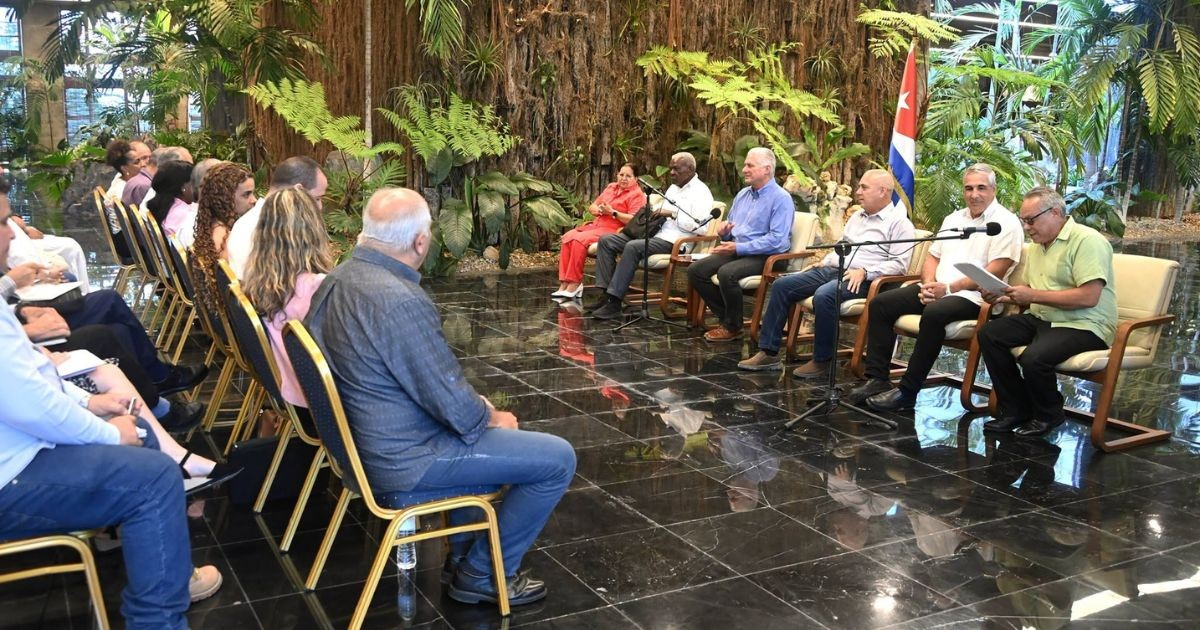
Roberto Morales Ojeda, Secretary of Organization of the Central Committee of the Communist Party of Cuba, published a message on his Facebook account on Friday reaffirming the official discourse on popular participation, social justice, and inclusion, referencing the meeting that President Miguel Díaz-Canel held on Thursday, October 1 with representatives of agencies, organizations, and institutions linked to the so-called 176 Economic and Social Transformations.
In his post on the social network, the official, a member of the Political Bureau, declared that “in Cuba, popular participation is and will be the strongest pillar of unity and a guarantee of sovereignty” and echoed Díaz-Canel's assertion that “social justice is not defended with speeches; it is defended with institutions that work towards social justice.”
Morales Ojeda also stated that, "despite the blockade and the energy siege, Cuba continues to work for a more just, inclusive, and supportive society."
In the meeting, moderated by the Minister of Labor and Social Security, Jesús Otamendiz Campos, participants also included Esteban Lazo Hernández, president of the National Assembly, Vice Prime Minister Eduardo Martínez Díaz, and Morales Ojeda himself. Díaz-Canel emphasized that the 176 transformations —approved by the National Assembly in June 2026— prioritize social justice as a guiding principle, and that economic growth only makes sense if it impacts social development.
The problem is that the Cuban reality of 2026 seems determined to contradict each of those statements. CEPAL projects a 10.3% decline in Cuba's GDP this year, the worst in all of Latin America. Year-on-year inflation reached 25.19% in August, and the dollar exceeded 700 Cuban pesos in the informal market, while the average monthly salary hovers around 7,000 pesos on the island, which is less than 11 dollars.
Extreme poverty now affects 94% of Cubans, while eight out of ten people have had to skip a meal due to lack of money or food, according to data from a recent report prepared by the Cuban Observatory of Human Rights (OCDH) and the Cuba Social Rights Observatory.
This economic photograph is compounded by the energy crisis: generation deficits that have repeatedly exceeded 2,000 MW and frequent outages lasting more than 20 hours a day in many areas of the country. Cuba has experienced eight national blackouts so far this year, and about 2.7 million people have total or partial access issues to drinking water.
Among the responses to Morales Ojeda's post, there were numerous criticisms and sarcastic comments. One user wrote: "No one believes in you anymore, who are you going to move forward with? It's 67 years of promises and lies." Another sarcastically asked, "What is social justice when those of us on the ground are getting poorer while our leaders become richer and fatter? For us, it's just creative resistance." A third was even more direct: "Participation without the right to make decisions, hehehe."
Some questioned the very semantics of the official discourse. "For you, Robertico, what is popular participation? If no one knows anything about what you do," wrote another user. And yet another pointed out the structural contradiction of the system: "With just one party?!"
Another internet user invited Morales Ojeda to visit a Family Care System (SAF) in San Agustín, La Lisa, where they denounced the poor conditions in which vulnerable individuals are cared for. "It's not about speeches and nice words. It's about facing reality," they stated.
Related videos:
Filed under: