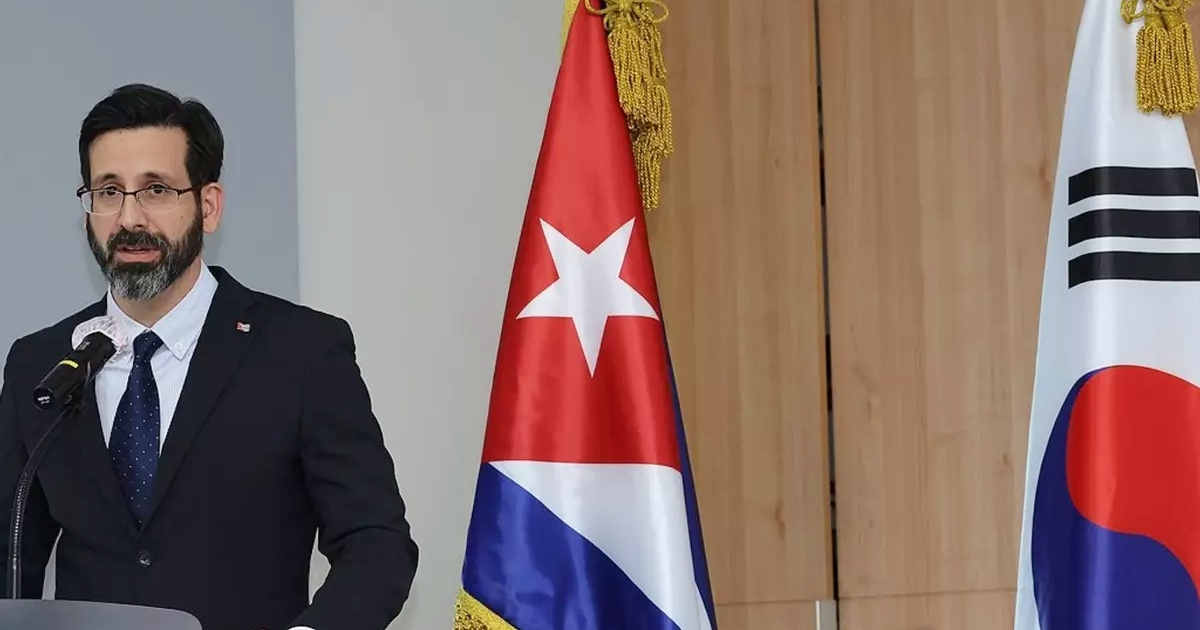
The South Korean economic newspaper Seoul Economic Daily revealed in an exclusive report that half of the Cuban diplomatic staff in Seoul returned to Cuba on direct orders from Havana, without an ordinary rotation taking place or a specific explanation being provided to the South Korean authorities.
Two of the four diplomats assigned to the mission left their positions abruptly.
The only Cuban officials remaining in Seoul are Ambassador Claudio Raúl Monzón Baeza and Counselor Patricia Flechilla Prometa.
The South Korean Foreign Ministry confirmed that it did not receive any specific explanation from the Cuban side regarding the two departures.
An embassy that was barely a year old
The Cuban diplomatic mission in Seoul opened its doors on June 10, 2025, a year and four months after the resumption of relations between the two countries, announced on February 14, 2024, after more than six decades without formal ties.
The opening of the embassies in Havana and Seoul ended a long diplomatic rift that dates back to 1959, when Fidel Castro's government severed its relations with South Korea and strengthened its ties with North Korea.
For decades, both countries maintained very limited contact; however, starting in 2015, some initiatives began in economic, technological, energy, and cultural areas, in parallel with the thawing relations between Washington and Havana.
That approach carried a significant symbolic weight: Cuba had maintained relations with North Korea since August 1960 and had never formally recognized Seoul.
The South Korean government interpreted the restoration of relations as a diplomatic success against Pyongyang, which responded by remaining silent and reducing public references to Cuba in its state media, as documented by the Korea Economic Institute of America.
For months, the North Korean press unusually reduced its references to the island. Even the state agency KCNA omitted the usual mentions of the "brotherly" nature of relations between Cuba and North Korea in some official messages.
At the inauguration of the embassy, the Director General of Asian and Oceanic Affairs of the Cuban Ministry of Foreign Relations, Ariel Lorenzo Rodríguez, declared that "our two countries are entering a new stage in which we will promote our common interests and strengthen our relations."
The official silence and the unconfirmed hypotheses
In response to questions from the Seoul Economic Daily, the Cuban embassy replied in writing that “all administrative decisions of the embassy are of an internal nature and have no political significance or connection with bilateral relations.”
Diplomatic sources cited by the South Korean newspaper consider two unconfirmed hypotheses: that the cut could represent a "tacit protest" towards Seoul due to some undisclosed friction, or that it responds to personnel adjustments abroad that the regime is implementing amid the serious economic crisis facing the island.
The potential deterioration of relations is particularly noteworthy because Seoul has made a sustained effort in recent years to approach countries traditionally linked to North Korea, including Cuba.
South Korea, for its part, maintains five officials at its embassy in Havana and does not plan any changes to its representation.
The Mirage of Economic Cooperation
Just three months before the cut, in June 2026, the Cuban embassy in Seoul organized a forum to attract South Korean investors and the ambassador Monzón Baeza himself proclaimed to Korean businessmen that “Cuba remains a land of opportunities and possibilities.”
On June 15, the Chamber of Commerce of Cuba and the Korea Importers Association (KOIMA) signed a commercial collaboration agreement in sectors such as agri-food, renewable energies, and biopharmaceuticals.
The economic ties, however, remain modest.
In 2022, South Korea exported goods to Cuba worth around 14 million dollars and imported Cuban products valued at approximately 7 million dollars.
In 2023, bilateral trade amounted to 43 million dollars, with a clear surplus in favor of South Korea.
Among the main products shipped from South Korea are technology, vehicles, heavy machinery, and plastic products, while Cuba exports tobacco, alcoholic beverages, scrap metal, and biotechnological products.
The relationship also has a consular dimension. Before the pandemic, around 14,000 South Korean citizens traveled annually to Cuba, and approximately a thousand descendants of Koreans who arrived in the Caribbean during the Japanese occupation of the peninsula resided on the island.
The South Korean Foreign Ministry itself had stressed the need to provide stable consular assistance to its citizens residing or visiting Cuba, one of the arguments used to justify the opening of its embassy in Havana.
However, representatives from the South Korean state agency KOTRA themselves warned that “Cuba is not a market where companies can simply apply the standards they use for regular trade with other countries.”
South Korean representatives have also recommended that their companies evaluate each operation individually due to U.S. sanctions and the financial risks associated with doing business with Cuban entities.
A pattern of diplomatic withdrawal
The incident in Seoul is not an isolated event. In August 2026, the Dominican Republic expelled nine Cuban diplomats accused of intelligence activities.
Costa Rica closed its embassy in Havana in March 2026, and Ecuador expelled Cuban diplomatic staff that same month.
On September 3rd, Chancellor Bruno Rodríguez Parrilla chaired a virtual meeting with heads of missions to emphasize that the regime's diplomacy remains active, signaling that Havana is aware of the deterioration of its external network.
Related videos:
Filed under: