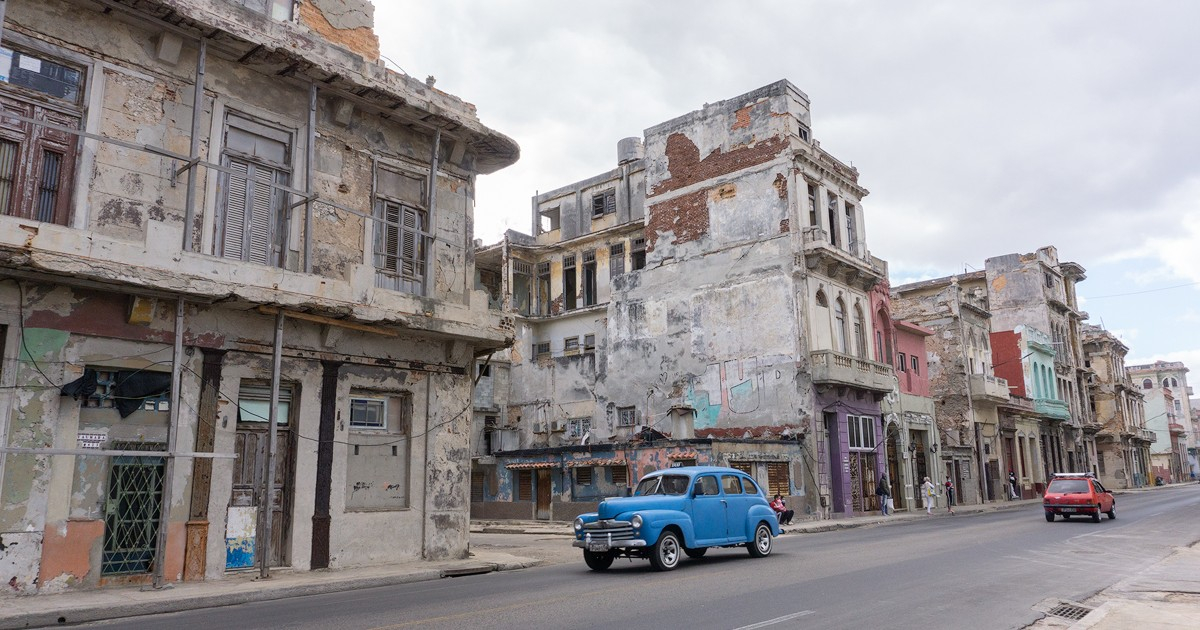
The new Housing Law approved in Cuba opens possibilities for recovering properties, expanding holdings, and attracting new economic actors, but it raises a crucial question: Who will provide the funds to transform the urban landscape of the capital?
Havana has been accumulating deteriorated buildings for decades, with propped-up homes, facades that are peeling, and constructions that survive thanks to makeshift repairs. The , approved on July 30, 2026, aims to update a legal framework that for decades has influenced the construction, conservation, and buying and selling of properties in the country.
Its scope goes beyond real estate procedures. Some of its provisions could directly influence the appearance of Havana, from the rooftops of the city center to the multi-family buildings in Vedado and the deteriorated housing in other neighborhoods.
However, legally permitting rehabilitation does not mean that there are resources to implement it. Where will the investments that could transform the city come from?
Ruined buildings: an opportunity to recover housing
One of the most significant changes in the new policies affects properties declared as in ruin. According to the official explanation of the law published by Granma, property owners will be able to make arrangements for other individuals or companies to take over dilapidated properties and restore their use, under certain urban planning conditions.
The measure could help some abandoned buildings find buyers or new caretakers willing to rehabilitate them. It also raises a sensitive question: What happens when the owner lacks the resources to repair their property?
The legislative project included judicial procedures to recover homes that had fallen into a state of ruin due to abandonment. Marvelis Velázquez Reyes, director of Legal Affairs for Housing at the Ministry of Construction, explained that these situations should be assessed by the courts and that actions would not be taken arbitrarily.
For Havana, where old buildings in need of costly interventions are plentiful, the difference between recovering a property and losing it may depend on the financial capacity of its owners.
Rooftops and multifamily buildings: Will Havana's skyline change?
The new legislation also changes the possibilities for utilizing existing spaces. The Minister of Construction, René Mesa Villafaña, announced the removal of certain administrative authorizations to grant rights over rooftops intended for building or expanding homes.
According to the official, the municipal authorization to transfer a house or rights over its rooftop for construction or expansion purposes has been removed. This could facilitate new works on existing properties, although the applicable technical and urban requirements will still be necessary.
In a city where numerous families share limited spaces, rooftops represent an opportunity for rapid growth, but building on aging buildings also requires checking their structural capacity. Not to mention, there are urban planning regulations in the country that must be adhered to.
The minister also mentioned an update that includes horizontal property and housing cooperatives, two mechanisms that could change residential management and construction.
Another change affects the management of collective properties. The establishment of management boards and contributions from owners was anticipated to cover common expenses.
Façades, stairs, roofs, and other installations could benefit from more organized management. The challenge will be in financing those repairs when residents do not have sufficient income.
Foreign investment or the diaspora: Where will the capital come from?
The reconstruction of Havana requires investments that can hardly be resolved through individual contributions from its residents, especially in the context of the current economic crisis affecting the country.
The official explanation of the new law announces the removal of restrictions so that certain foreign individuals and entities can buy or rent housing, although the practical scope of these operations will depend on the applicable regulatory framework.
At the same time, the Cuban government claims to have made changes to facilitate the economic participation of residents abroad.
In May, CiberCuba reported on the creation of the migratory status of "Investors and Businesses", aimed at emigrated Cubans interested in engaging in economic activities on the island. None of these measures guarantee that the capital will end up financing housing for the population, which is the major issue in Cuba today.
A real estate investment intended for tourism, for example, can enhance a specific building without addressing the housing needs of its neighbors.
The potential protagonists of the reconstruction would be the owners with their own resources, Cubans living abroad, and private investors who find profitable opportunities in the real estate market, always within the limits established by the legislation.
However, it is still unclear how many will be willing to invest, what guarantees they will have, or what portion of that capital would be allocated to recovering housing for the population, rather than properties aimed at tourism or high-net-worth buyers.
Gentrification: the risk of an increasingly unequal Havana
The entrance of new investors could also accelerate a process of gentrification in the most desirable neighborhoods of Havana, especially in Vedado, Miramar, Kohly, certain areas of Old Havana, El Cerro, or Centro Habana.
Gentrification occurs when the influx of capital and buyers with higher purchasing power increases property prices and alters the use of buildings, making it difficult for lower-income residents to remain in their neighborhoods.
In Cuba, there are already signs of a significant disparity between real estate prices and the income of the population. In 2025, CiberCuba reported on the sale of a penthouse in Vedado for $200,000. It also documented a mansion in Kohly for over $300,000.
These housing prices announced do not necessarily represent the value of all houses in these neighborhoods, but they reflect the existence of a real estate segment aimed at buyers with access to significant amounts of foreign currency.
If the new investment opportunities focus on high-value properties, they could promote the rehabilitation of certain areas while others remain dilapidated.
The risk is not limited to Havana. Attractive sectors for tourism and investment in cities like Trinidad, Santiago de Cuba, or Cienfuegos could also experience similar pressures if the commercial and tourist uses of their housing increase.
Urban renewal could ultimately benefit primarily those who already own valuable properties or have capital, while lower-income families find it increasingly difficult to access suitable housing.
There is not enough evidence to assert that the new law will cause resident displacement, but the lack of effective affordable housing mechanisms would turn that possibility into an issue that deserves monitoring.
The obstacles that a law cannot eliminate
The extent of the construction deterioration in the capital is the main challenge. According to official data collected by CiberCuba, 35% of the housing stock in Cuba is in fair or poor condition.
This problem is exacerbated by the shortage of materials, difficulties in financing restorations, economic inflation in the country, a lack of skilled labor, and limitations within the construction industry.
The government's history does not provide reasons to trust in a quick recovery. Thestate housing construction planshad not been fulfilled for over five years.
In 2025, of the 10,795 homes planned, authorities reported only 2,382 completed within the plan, achieving a compliance rate of 22%, according to official figures.
There are also questions regarding the guarantees offered to those who decide to invest. The Cuban economist Pedro Monreal warned in September that the modifications to the foreign investment legislation simplify procedures, but do not address essential aspects of legal protection.
"The revised regulation relaxes banking services, utilities, and contracting, but does not redesign the procedural safeguards for investors," he noted.
After decades of deterioration in the housing stock and failures to meet state housing construction plans, the government is expanding rehabilitation options through private homeowners and investors. Many families living in these buildings lack the funds to fix a roof, reinforce a structure, or restore a façade.
The government provides subsidy programs for those without resources, but these aids have not succeeded in reversing the accumulated deterioration of the housing stock and do not guarantee that they will do so in the future.
The reform may facilitate those with capital to restore their properties, while those without it continue living in increasingly precarious housing. The effort to preserve the architectural heritage and the urban landscape of Havana could fall on a population that does not have the means to take it on.
A renewed Havana or a city of two faces?
The reforms could open up different paths for the urban future of the capital. Some homeowners might expand their residences, certain buildings could be revitalized through private investments, and certain neighborhoods could undergo noticeable renewal.
However, there is also the possibility that interventions will focus on properties capable of generating profit, while the buildings inhabited by low-income families continue to deteriorate until they collapse.
The main question regarding the future of this law is not what it will allow, but rather who will be able to take advantage of those possibilities, what role the state will play in preserving urban heritage and protecting owners who cannot afford to restore their homes.
Havana runs the risk that its reconstruction will primarily benefit those with capital. The city could become even more fragmented, with increasingly stark contrasts between its neighborhoods. In the central or more commercially attractive areas, some families may find themselves pressured to leave the homes they have lived in for decades.
Related videos:
Filed under: