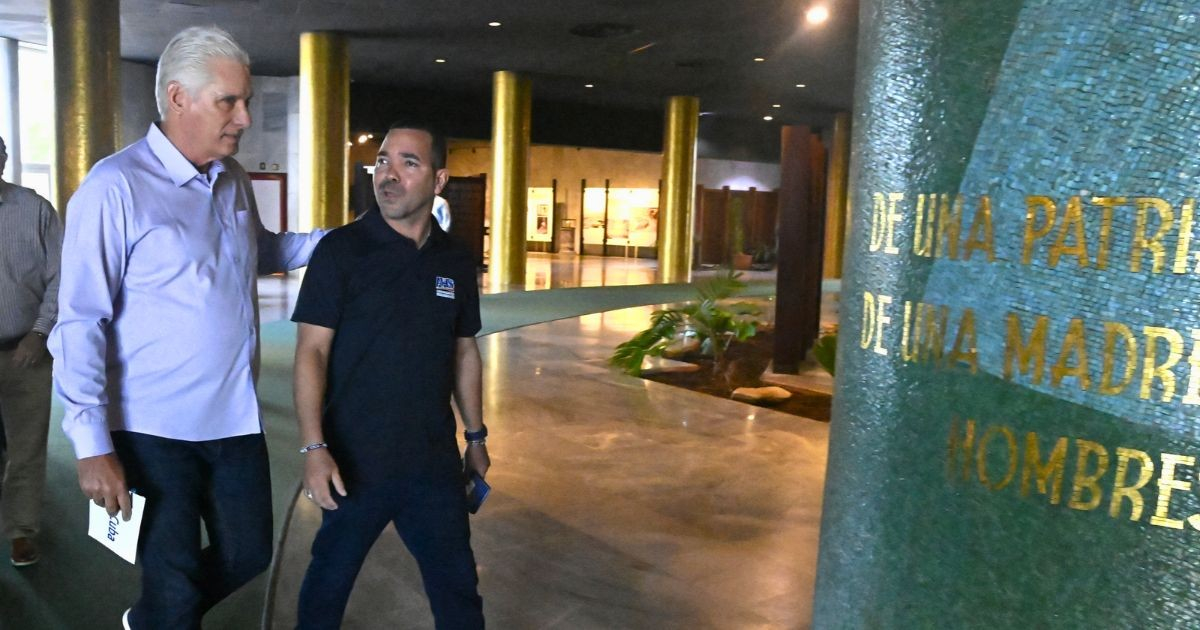
While Cuba was facing an electricity generation deficit of 2,042 MW on Saturday —with circuits in several provinces shut down for 30, 40, and more consecutive hours— Miguel Díaz-Canel was meeting at the José Martí Memorial with more than fifty young artists to celebrate the 40th anniversary of the Hermanos Saíz Association and to speak with them about dreams, beauty, and socialist construction.
The leader opened the meeting— which lasted nearly two hours— with a statement that, in any other context, could be considered “poetry”: “Socialist construction [...] is also a struggle for meaning, for feelings, for beauty, for spirituality, and for the symbols that create a society as just and inclusive as ours.”
A society where the official inflation rate exceeded 25% year-on-year in August 2026 and where 94% of the population, according to independent studies, lives below the extreme poverty line.
Díaz-Canel urged creators to "continue fostering that committed creation without renouncing aesthetic experimentation or complexity" and called on them to resist what he described as an attempt to "colonize culture" by "hegemonic powers." The fact that the Cuban people have been unable to sleep for years due to blackouts was, in the official discourse, a notable absence.
Cubans on social media did not miss the irony. "How can you dream in a country where you can't sleep?" wrote one user. Another was more direct: "Please wake the president up… let him stop dreaming if he can, because the country he leads is falling apart." A third commented: "You might dream that you can sleep, since you don't experience blackouts like the people do."
Even a participant in the event, the journalist and poet Yeilén Delgado Calvo, inadvertently described the magnitude of the disaster when she recounted how "the blackout nights become hours of learning and solace for the little ones" from the doorsteps of her neighborhood.
The event included the presentation of the Youth Master Award to nearly twenty personalities: Marilyn Bobes, Mirtha Ibarra Collado, Jorge Fornet, and Liuba María Hevia, among others. The only foreign recipient was the Brazilian theologian Frei Betto, an advisor to the regime for the Food Sovereignty Program, whose extensive experience in culinary advice for Cuba deserves a separate chapter.
In December 2021, he published in Granma that in Cuba "there is no hunger," although Cubans "have a big appetite." In March 2022, he recommended on Mesa Redonda to fry potato peels as a snack: "Potato peels [...] are great for snacking while having a drink. Fried, they are excellent." In June 2024, he invited Cubans to plant "even in the windows" of their homes.
The distinction awarded to Betto had been presented before the official ceremony on Thursday, the 15th, by the president of the AHS, Yasel Toledo Garnache, who described the organization as an entity that aims to be "useful, much beyond culture." Useful, indeed, even if it is to reward someone who tells a starving people that what they have is merely appetite.
Cuba has experienced eight total failures of the National Electroenergetic System during 2026, and it is estimated that more than 1.6 million Cubans have left the island since 2020. One internet user summed it up with the precision that is often lacking in official speeches: “Not everything is commemoration; there are many towns and municipalities with more than 48 hours of blackout [...] The situation for Cubans is extremely critical.”
Díaz-Canel concluded his speech convinced that the members of the AHS demonstrate "that no matter how tough the times are, we as a people have the ability, with our own talent, our own work, our own effort, and our culture, to move forward." Meanwhile, the Cuban people continue to wait for someone to bring back the light.
Related videos:
Filed under: