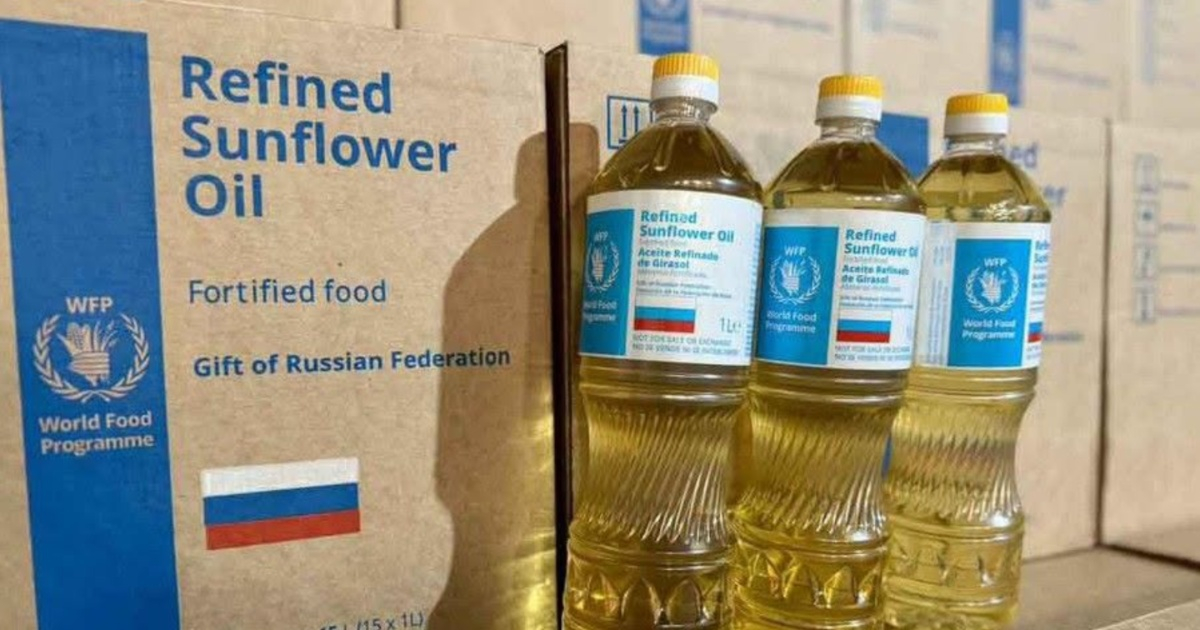
The Russian Deputy Foreign Minister, Alexander Alimov, acknowledged this Saturday in an interview with the state-run newspaper Izvestia that Russia is facing logistical problems and delays in the shipment of humanitarian aid to Cuba through the UN World Food Program (WFP), and that since June, only two shipments of sunflower oil have arrived on the island, totaling just over 750 tons.
The statement, also reported by Kremlin-affiliated media Lenta.ru and RIA Novosti, has not been confirmed by any independent source.
"This time we truly encountered logistical difficulties, there were delays in the delivery of aid to Cuba through the UN's WFP, but Russia fulfilled its humanitarian duty to the friendly people," stated Alimov, who promised that Moscow would "without fail" continue to support Havana through the same channel.
The admission comes at a politically sensitive time: the UN General Assembly is set to vote on the annual resolution calling for the end of the U.S. embargo against Cuba on October 28, and both Moscow and Havana are looking to maximize international support before that date.
The 750 tons of oil represent a minimal fraction compared to the actual needs of the Cuban population.
Independent surveys from 2026 indicate that 33.9% of Cuban households reported that at least one member went to bed hungry.
The Russian acknowledgment of the difficulties contrasts with the announcements of investments exceeding 1,000 million dollars made by Moscow and Havana in April 2026.
The Russian embassy in Havana told Izvestia that the joint projects already underway are still in operation, but warned that Russian entrepreneurs must "carefully study" the new conditions for doing business in Cuba, a cautionary signal that does not align with the rhetoric of strategic partnership.
In the energy sector, the outlook is equally bleak. The Cuban ambassador in Moscow, Enrique Orta González, acknowledged a few days ago that the tanker Anatoli Kolodkin was the only Russian ship carrying oil that arrived in Cuba throughout 2026, and that its cargo of 100,000 tons of Urals crude barely alleviated the power outages for about two weeks.
A second shipment of crude announced by Russia also did not materialize: the tanker Universal changed course toward the South Atlantic in May 2026, and its arrival at the island was never confirmed.
In addition to the oil, Russia donated three ambulances and a Lada Iskra car to Cuba for medical centers in Havana, Matanzas, and Santiago de Cuba, which are part of the maternal and child care program.
The contrast with Chinese aid is striking: Beijing provided emergency assistance of 80 million dollars in 2026, at least 60,000 tons of rice, and several batches of photovoltaic solar systems, including a 200-megawatt project.
In this context, Russia's promise to continue support "without fail" sounds more like a diplomatic statement ahead of the UN vote than a commitment backed by real logistical capability.
In 2025, the resolution on the embargo received 165 votes in favor, compared to 187 in 2024, reflecting a decline in international support that both Moscow and Havana are trying to curb with gestures of solidarity that, according to Russian data itself, are arriving late and in insufficient amounts.
Related videos:
Filed under: