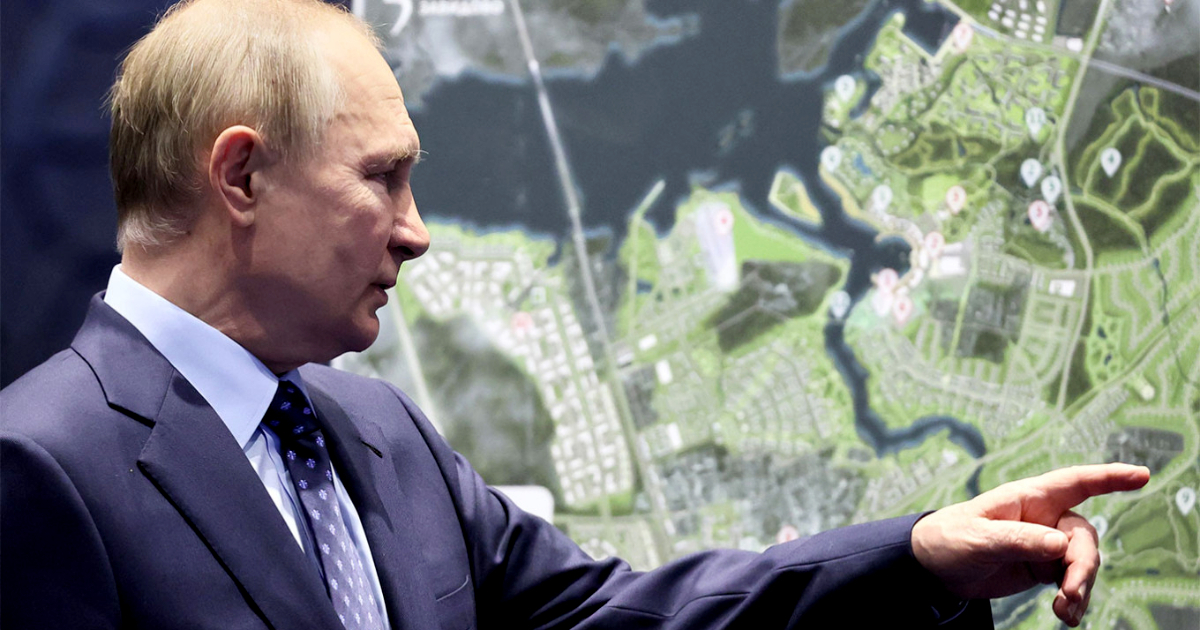
Vladimir Putin made it clear during a phone call with the leaders of Finland and Norway that Russia is not willing to give up on its goal of conquering the entirety of the Ukrainian region of Donbas, thus ruling out any possibility of territorial compromise in peace negotiations, according to a source close to the Kremlin cited by Reuters.
The conversation, which lasted about 90 minutes on Tuesday, brought together Finnish President Alexander Stubb and Norwegian Prime Minister Jonas Gahr Støre with the Russian leader in an unusual gesture: Most Western European leaders have avoided direct contact with the Kremlin since the beginning of the large-scale invasion of Ukraine in February 2022.
The source consulted by Reuters explained that when Putin spoke about ending the war “taking into account the realities on the ground,” that phrase was equivalent to a definitive refusal to give up the ambition of controlling the entire Donbas.
The official statement from the Kremlin left no room for ambiguity: “Achieving a just and lasting peace is only possible if the legitimate interests of the Russian Federation are fully and unconditionally taken into account,” the text noted, which also accused the countries of the European Union and NATO of contributing to the prolongation of the conflict.
Putin's stance fits into a neo-imperial vision that he has been articulating for years. In 2005, he described the dissolution of the USSR as "the greatest geopolitical catastrophe of the 20th century".
In July 2021, he published an essay in which he argued that Russians and Ukrainians form "one single people" and that the political separation between the two countries was a historical anomaly. On September 30, 2022, he proclaimed the formal annexation of Donetsk, Lugansk, Kherson, and Zaporizhia, despite not having full military control over those territories.
The Russian Foreign Minister Serguéi Lavrov was even more direct: he dismissed the idea that the call had brought anything new to the conflict and stated that European countries are simply seeking a role in the negotiation process.
Stubb and Støre linked their initiative to the peace talks scheduled between Russia, Ukraine, and the United States in Abu Dhabi in November, the first since February. Both leaders also spoke with Ukrainian President Volodymyr Zelensky after their call with Putin, and coordinated their contact with Kyiv in advance.
"The discussion with Putin was frank and substantive. We are neighboring countries to Russia. The outcome of this war will have a direct impact on our security and European security in general. Ending the war requires direct negotiations," Stubb stated.
The Nordic initiative generated mixed reactions in Europe. Danish Prime Minister Mette Frederiksen stated that she does not see signs of Russia wanting peace: "I believe Europe should stay united rather than acting alone."
The Swedish Prime Minister Ulf Kristersson noted that other European leaders were not informed and expressed having "rather low expectations" for this type of conversation. The Polish Prime Minister Donald Tusk warned that "absolute caution and vigilance are necessary in such contacts."
Ukrainian Foreign Minister Andrii Sybiha took an opposing stance, describing the call as “the right approach,” celebrating it as support for Kiev's diplomatic efforts. Zelenski, for his part, has reiterated in recent interviews that Ukraine will never recognize the occupied territories as Russian and that freezing the conflict at the current front line does not equate to conceding territory.
The U.S. Secretary of State Marco Rubio recently acknowledged that the Donbas is "the main sticking point" in the negotiations, describing the conflict as a dispute over approximately 11% of Ukrainian territory that Russia wants to control but has been unable to conquer militarily, in a context where Russian forces recorded virtually no net territorial gains during 2026 and suffered more than 40,000 monthly casualties since July.
The trilateral negotiations between Russia, Ukraine, and the United States are set to take place in Abu Dhabi in November, following the agreement by Putin to resume talks reached after the U.S. envoy Steve Witkoff traveled to St. Petersburg to meet with the Russian leader.
Related videos:
Filed under: