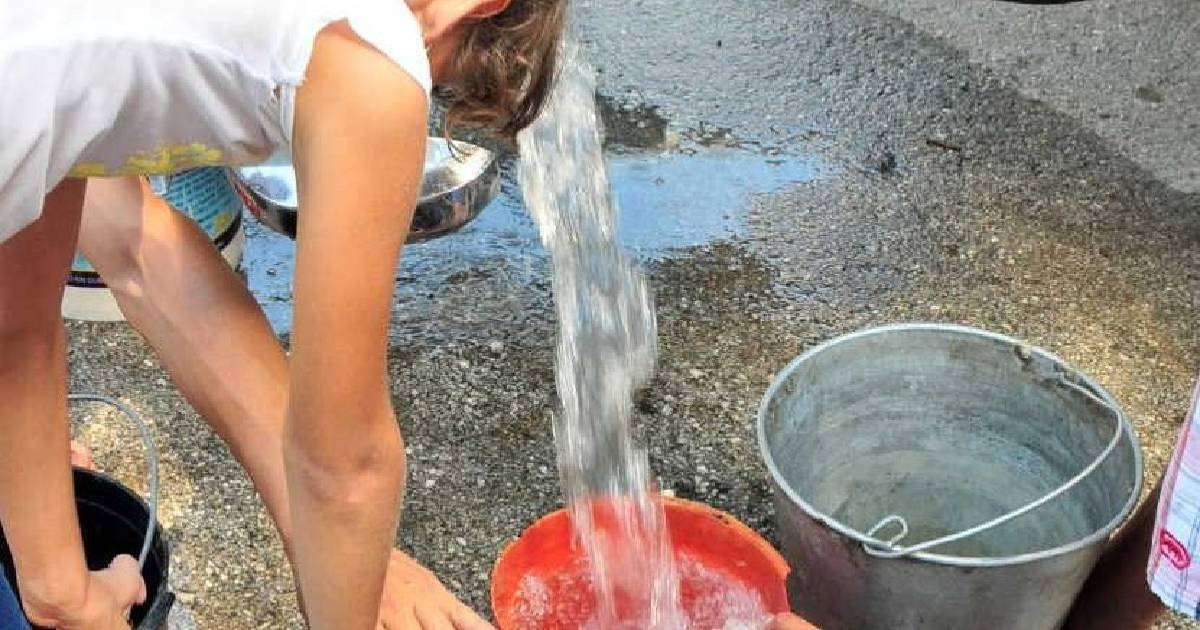
More than 57,800 residents of the province of Sancti Spíritus face issues with access to drinking water, while authorities acknowledge that electrical outages and equipment failures hinder the stability of the service.
According to a report published this Friday by the provincial newspaper Escambray, based on data from the Provincial Water Supply and Sewerage Company, approximately 19,600 individuals are experiencing issues directly related to equipment failures at the Vanguardia and Guasimal pumping stations.
Trinidad faces the greatest challenges in the province. Roberto Nápoles Darias, director of the provincial company, explained that all the pumping stations in the municipality are connected to different electrical circuits, which hinders the maintenance of supply stability when interruptions occur in the network.
"Due to electrical issues, Trinidad is the municipality facing the greatest challenges in securing water supply," acknowledged the official.
In the provincial capital, the situation does not ensure a continuous service either. According to Nápoles, the pumping occurs twice a day, a frequency that does not mean that water reaches all homes regularly.
As an alternative, the pumping station at La Boca, in Trinidad, now has solar panels. The installation allows for service almost 24 hours a day and fills the tank that supplies the Ancón peninsula and the lower area of the city.
At the provincial level, the company has installed 99 pumps through energy matrix changes, although these benefit only small populations of about 800 inhabitants.
The larger-scale project is still pending. The installation of 15 pumping units with solar panels at stations that exceed 15 liters per second, which could benefit more than 2,000 people per station, is still dependent on the importation of the technology.
Nápoles stated that the investment will allow for the needs of populations in all municipalities to be addressed and will reach the most critical areas that depend solely on electricity. However, he did not provide a specific date for its implementation.
Although Sancti Spíritus is not among the territories with the highest levels of impact, the national situation reflects a much more widespread crisis. In provinces such as Santiago de Cuba, Mayabeque, Holguín, and Havana, distribution cycles can reach 30 days or more.
In Santiago de Cuba, a break in a 900-millimeter pipeline left more than 93,000 residents in 13 neighborhoods without water, it was reported this Thursday.
In Pinar del Río, around 170,000 people lack regular access to the service, while blackouts exceed 16 hours daily at the pumping stations. Matanzas also faces supply issues for 265,000 residents.
Nationwide, the National Institute of Hydraulic Resources reported at the end of October that more than 2.6 million people had their access to water affected either totally or partially. At the beginning of the month, that figure reached 2.7 million affected Cubans, which is equivalent to 35% of the population supplied by networks.
The lack of electricity and equipment failures accounted for nearly 88% of the reported incidents, according to the agency.
Related videos:
Filed under: