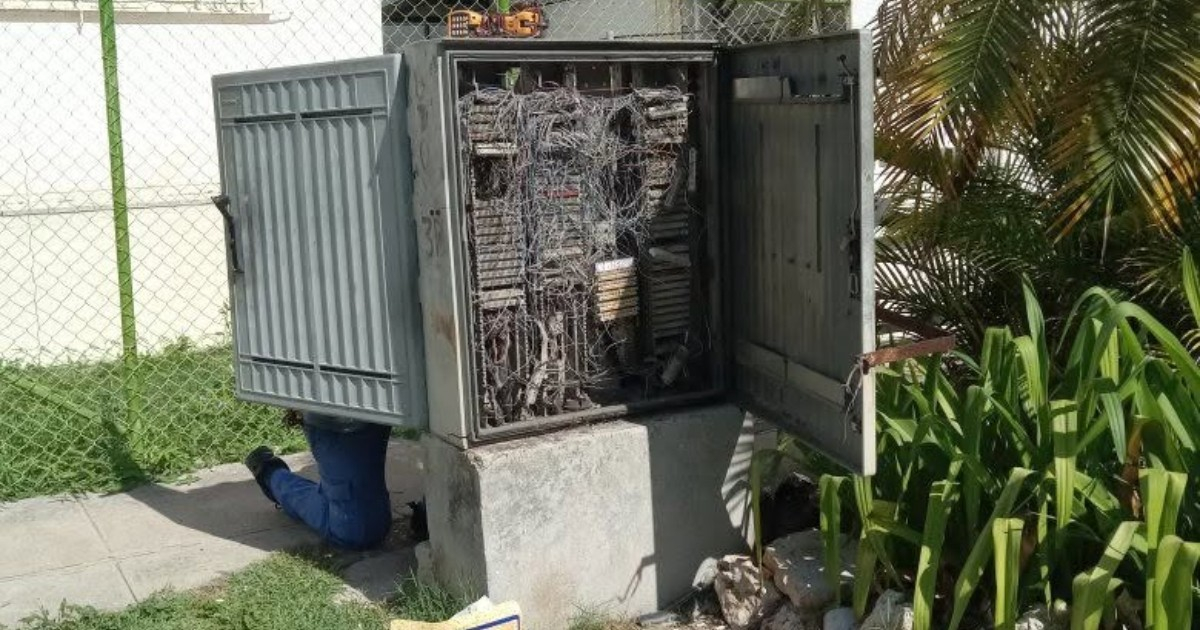
Alejandro Delgado Cabrera, the only son of the beloved Cuban actress Gina Cabrera, reported this Monday on Facebook that he has been without landline or Nauta Hogar for more than two months, and that the ETECSA technicians left the repair pending due to a lack of cable, a material that, according to what he was told, is neither available nor will be.
"It's hours of waiting in lines and dealing with matters that lead nowhere. Meetings with officials who are only there to show their faces and justify themselves, without providing any solutions," Delgado wrote.
This weekend, he believed the situation would change. "I finally felt lucky after more than two months without fixed-line phone service and Nauta Hogar when I saw a repair truck arrive at the building where I live on Saturday," he recounted. Two technicians arrived, then three, but the most experienced one left before finishing.
After inspecting the external installation, the workers informed him that the line was live at the pole, but the connection cable to his home was damaged. "They ultimately summarized that they had found my live line at the pole in front of the building, but the simple cable that leads to the connection at my home is damaged," explained Delgado Cabrera. The conclusion was devastating: “They stated that the cable was still pending and that there is none, nor will there be.”
As an electrical engineer, Delgado questioned the assessment that had been conducted. He pointed out that the technicians did not properly clean the contacts before measuring the continuity of the cable, a basic step that, in his view, could have saved the line. He also described the state of the distribution cabinet as "a complete disaster of connections, with no order whatsoever, mistreated a thousand times by the same technicians again and again."
He also highlighted the working conditions of the repair technicians, who, as he reported, work without lunch, snacks, or transportation and receive a monthly salary of 21,000 pesos, despite the risks associated with their jobs. Delgado pointed out that the technicians were tired and demotivated, although he questioned why they had not carried out the necessary checks to try to restore the connection.
"That same day, during the move, they left one of our neighbors without service. The opposite had happened months earlier with him and us. It's a never-ending story," he lamented.
Delgado Cabrera accompanied his complaint with photographs of the cabinet—filled with tangled cables—and of an institutional poster from ETECSA with the slogan “Values that Unite Us.” His conclusion was straightforward: “Service culture, professionalism, cohesion, transparency, and sense of belonging... cable, spare parts, experience, interest, all that and more, ABSENT!”
In the comments on the post, other Cubans confirmed experiencing similar situations. "Being reliant on cable is the most common; this is terrible, my friend, what price are we paying!"; "ETECSA is mocking its customers; nobody cares," and "I thought it was only happening to me. Now I see it's widespread."
The problems with the state monopoly on telecommunications are recurring throughout Cuba.
Executives of ETECSA in Camagüey recognized this week that over 2,000 meters of drop cable were missing. In the same report, a worker explained that the fiber optic cable used for repairs is primarily recovered from deactivated services, as it is neither manufactured in Cuba nor entering the country. In September, the company admitted to accumulating around 77,000 reports of interrupted fixed services nationwide. And in October, neighbors of Casino Deportivo in Havana reported being disconnected for nearly a month for the same reason: ETECSA had no cables to repair the damage from a fire.
It is not the first time that Delgado Cabrera has raised his voice about the situation in Cuba. In August 2026, he published the heart-wrenching testimony "The Cuban Hell", in three parts, describing decades of shortages, repression, and indoctrination. In September, he paid tribute to his mother Gina Cabrera, whom he defined as "a Cuban who did not know how to lie," denouncing the institutional abandonment she suffered in her later years.
Related videos:
Filed under: