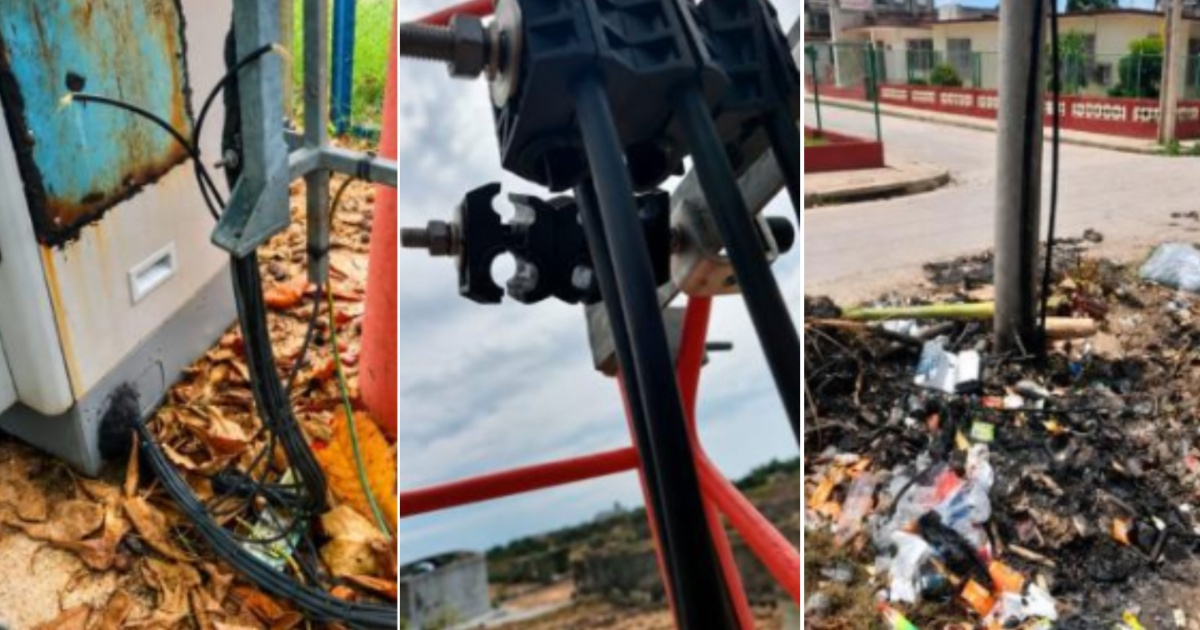
The Telecommunications Company of Cuba (ETECSA) in Camagüey reported an increase in acts of vandalism against its infrastructure, which has left entire neighborhoods without telephone and mobile data services, according to a report by the official newspaper Granma published this Sunday.
The most revealing information came from Yoan Álvarez Fonseca, Operations Chief of the Network: “More than 2,000 meters of downspouts that we do not have. They are stealing the downspouts from us and they are stealing the power cables.”
The affected municipalities include the city of Camagüey, Esmeralda, Florida, and Vertientes, as specified by Edel Mendoza Valdivia, head of the Wireless Network of the Territorial Direction.
The pattern of the attacks is repeating: cutting of fiber optic cables that feed data transmission equipment, theft of electrical power cables, and stealing of breakers and breaker boxes. What concerns the executives the most is that in several cases, the cut materials are left abandoned at the site, without the perpetrators taking them.
"There are resources that are not utilized in the practical life of the population, and places where they are introduced and then left there. In other words, it is an act intended to cause harm because they are not removed," noted Mendoza Valdivia, who also warned that some locations have been vandalized up to three times and that in certain cases, restoring the service took more than two months.
The impact on families is direct. The neighbor Nereisy Gutiérrez Labrada was without a landline for three months after the theft of the downpipe that connected her home to the network. "Behind an incident like this, there are affected families. There is also an economic loss for everyone; for the State and Etecsa as a company," she stated.
Another illustrative case was that of a dumpster set on fire next to a distribution cabinet. Iván Casalís Milanés, the cable brigade leader, explained that the situation left over 300 services affected and required more than a week of work: "It's practically like providing full service to the area again."
The scarcity of materials worsens the problem. Luel García Lorenzo, territorial director of ETECSA in Camagüey, acknowledged that the necessary equipment for repairs is not available in local warehouses: “We don’t have them in our warehouses, and every time this type of breakdown occurs, we have to ‘make do’ to find solutions.”
The worker Juan Menéndez Barroso, with 48 years in the company, confirmed that the fiber optic cable used in repairs is mainly recovered from services that are no longer provided, because "this cable is not manufactured here and it is not coming in." The company attributes this shortage to the U.S. embargo, although the structural crisis of the Cuban telecommunications industry is also a result of decades of underinvestment.
Each repair diverts planned resources intended for expanding coverage towards replacing what was destroyed. "This has led to a deficit in resources that could have been allocated to other investments, and we have had to take them for repairs," detailed Mendoza Valdivia.
This phenomenon is not exclusive to Camagüey. In Holguín, 27 acts of vandalism against ETECSA facilities were reported during 2025, resulting in losses exceeding 529,000 Cuban pesos, while in Santiago de Cuba the company resorted to neighborhood surveillance to protect its infrastructure after multiple thefts of solar panels and batteries.
In Camagüey, the local residents have begun to organize themselves: on Nereisy's block, they installed LED lights and remain vigilant against suspicious individuals near the infrastructure. The company, for its part, designed a "community debate" program to raise awareness among residents about the necessity of protecting telecommunications resources, in a context where the province has already accumulated over a hundred radio bases that could be out of service simultaneously during blackouts.
Related videos:
Filed under: