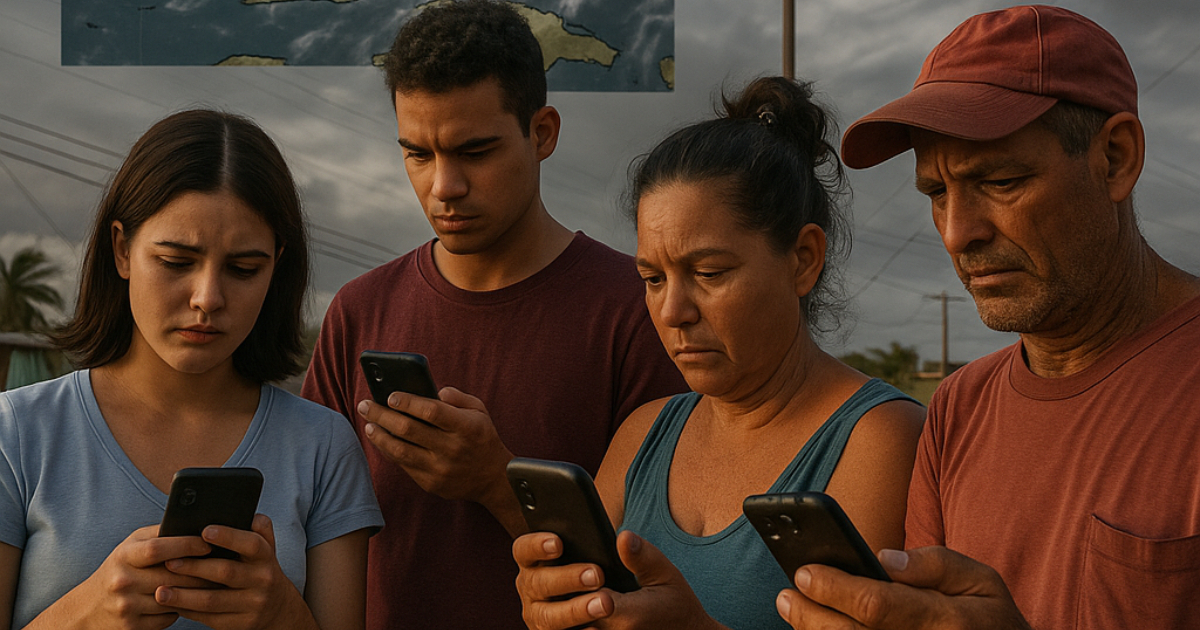
ETECSA took to explaining to its users this Sunday why their cell phones displayed a time different from the official one, after Cuba decided not to set the clocks back on November 1, as was customary at the end of daylight saving time.
If your phone displays a different time and you want to check if it is set correctly, you can consult and verify the current time before changing the device settings.
The background of the measure is the severe energy crisis facing the island. On October 24, the Ministry of Energy and Mines (MINEM) and the Ministry of Labor and Social Security (MTSS) jointly announced that Cuba would maintain daylight saving time (UTC−4) continuously until November 7, 2027, arguing that it would prevent an estimated increase of 126 MW in electrical demand during peak hours: 76 MW due to reduced use of artificial lighting and 50 MW from better utilization of solar photovoltaic generation.
As a complementary measure, the Ministry of Education adjusted the entry to schools and workplaces, delaying it by 30 minutes between November 1, 2026, and March 14, 2027, to account for the later sunrise during winter with the current daylight saving time.
The immediate consequence was that Cuba is now one hour ahead of Miami, since Florida did switch back to standard time (UTC−5) this Sunday.
In that context, ETECSA released a statement on its social media, assuring that the telecommunications network was adjusted smoothly. "The equipment that makes up the telecommunications network is configured for automatic time change, so in recent days, efforts have been made to create the conditions for this Sunday to maintain the operation of these systems without change, which was successfully achieved," stated the state-owned company.
However, he acknowledged that the issue was on the users' side: "Many users might perceive that their mobile devices have indeed adjusted to the new time, and this is because the operating systems of these devices are already programmed with Cuba's time zone, which they often use as the default."
To resolve this, the company provided a five-step guide: go to Settings/System, access Date and Time, turn off the automatic time option, set the clock forward by one hour, and check that the time is correct.
The reaction of Cubans on social media combined sarcasm with disbelief. While ETECSA proclaimed the success of the adjustment, the comments told a different story. "Do they really say in the text that they achieved it satisfactorily? I haven't met anyone whose schedule hasn't returned to normal. Every day we wake up with something to keep us entertained," wrote a user.
Another reported an additional problem: "My phone changed the time automatically, and when I tried to connect, not even mobile data would activate. It was only when I changed the time that the data was activated. I'm at a loss for words." A third tried to follow ETECSA's steps without success: "I did that, and it still changed." Many, half joking and half serious, were asking what the actual time was.
Black humor soon emerged. "It doesn't matter, in Cuba time stopped in '59," declared one internet user. Another summarized the situation with a sharply pointed remark: "They are pretending to move forward while actually going backward..." There were those who highlighted the situation with more bluntness: "Cuba as always... Pissing against the current."
The episode takes on a particular dimension when considering that the Cuban electrical crisis causes outages that usually exceed 20 hours a day in Havana and can extend for consecutive days in the provinces.
The very infrastructure of ETECSA is suffering from the consequences of the energy crisis: during the national blackout on September 18, 2026, more than 80% of the base station sites were out of service, and internet traffic recorded a drop of up to 58% compared to similar periods, as acknowledged by the state-owned company.
Of the approximately 2,520 existing radio bases in the country, only about half have some form of backup energy system, according to figures gathered by the Cuban press.
The next scheduled time change in Cuba will be on November 7, 2027, when clocks will need to be set back one hour to return to standard time UTC−5, unless the regime decides to extend the measure once more.
Related videos:
Filed under: