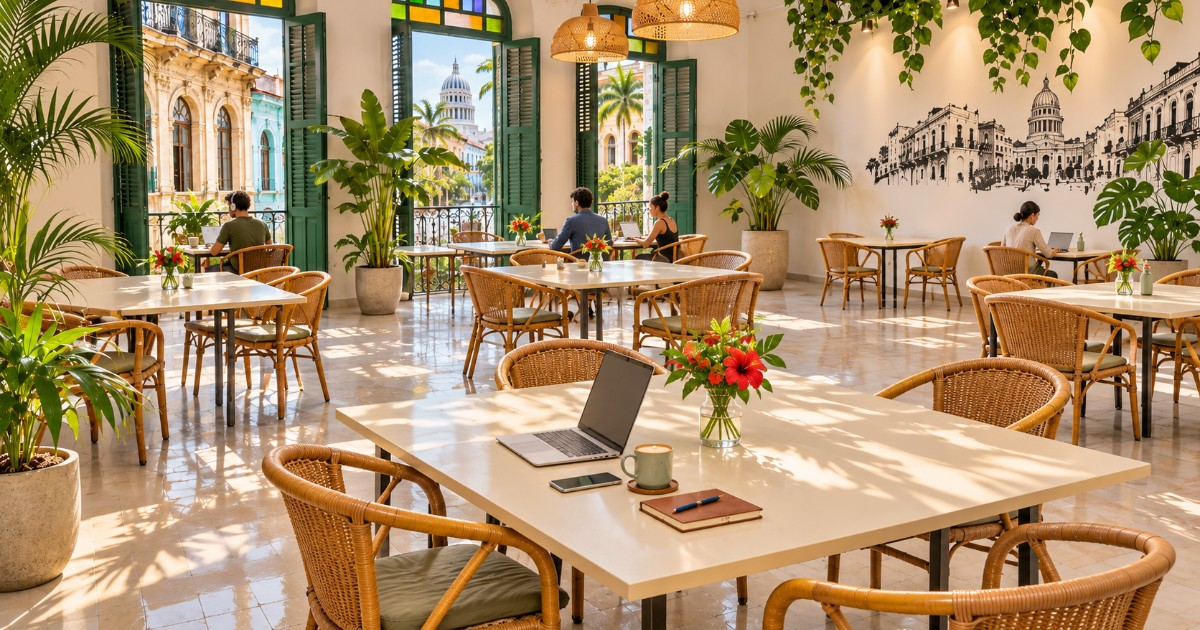
Cafés, hostels, and private businesses in Havana have become emergency offices for many Cuban professionals who cannot work from home because the regime does not guarantee them electricity or internet access, according to a report by IPS Cuba.
The phenomenon is not a trend in entrepreneurship, but rather a response to the electrical collapse. The clientele of these spaces mainly consists of social media managers, programmers, designers, journalists, and freelancers who provide services to foreign companies and are paid in foreign currency.
Elizabeth Cuesta, a social media manager, summarizes the daily paradox: "It would be better if I didn't always have to leave my house to work, because there I have no connection or my battery dies. It's an obstacle, even though it's profitable, because I don't live nearby."
The prices of these spaces reveal who can afford them and who cannot.
The Albero Dulce Residence, founded by Claudia Terry, charges 700 CUP per hour and offers monthly plans of up to 80,000 CUP. With a state average salary of 7,354 CUP per month —equivalent to about nine dollars at the informal exchange rate—, just one hour at this hostel consumes nearly 10% of a state worker's monthly salary. The monthly plan is almost 11 times that amount.
The hostel Kerida Habana sets its price at one euro per hour, which, based on the informal exchange rate this Sunday, is approximately 1,010 CUP. The state micro, small, and medium-sized enterprise La Quinta SURL began trials of this service in August at the Botanical Garden La Quinta de los Molinos with a fee of 500 CUP per hour and support from renewable energy sources.
They also operate the Grados Restaurant, which hosts a space driven by the community project Vive el Vedado, and the Avenida Italia Coworking Café, inaugurated by the Italian Agency for Development Cooperation with different levels of membership.
"In our search for what to do with the business, we noticed that such spaces exist in other parts of the world. There are some in Europe, and there's a connection there," Terry explained. The influx of customers for their business began to surge in February 2026, when the energy crisis escalated.
The collapse of tourism —only 450,000 visitors between January and August, a 64.4% decrease compared to the same period in 2025—forced many hostels to adapt in order to survive.
The new Labor Code (Law 189), in effect since September 2026, expands the regulations on telecommuting, a modality that was already included in Resolution 71/2021.
However, power outages and difficulties accessing the internet continue to force many professionals to seek alternatives outside of their homes in order to work.
Ernesto Asen, founder of the Vive el Vedado project, describes the aspiration behind these spaces: "to create a circular economy with local talent, where everything is reinvested (...) forming a small ecosystem."
The rates for these spaces represent an economic barrier for those who rely on a state salary. The average Cuban continues to work in the dark and without internet access in the 21st century.
Related videos:
Filed under: