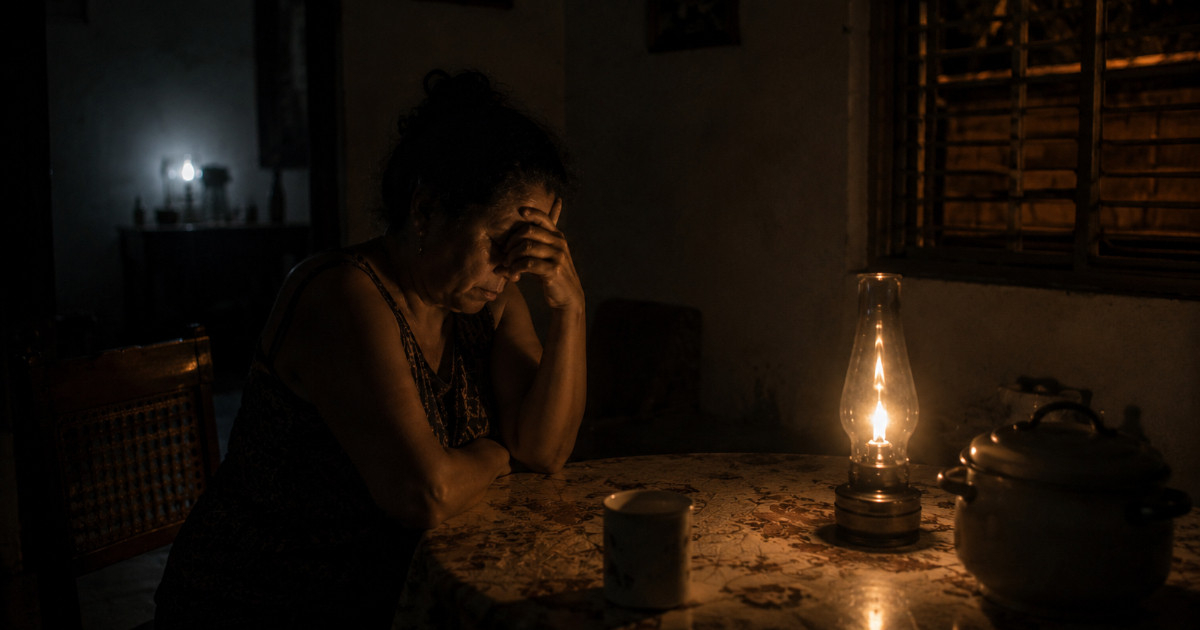
A report by the American public radio NPR described Havana this Saturday as plunged into darkness, with deserted streets and citizens worn out by the energy crisis, fuel shortages, and the deterioration of their living conditions.
The correspondent Eyder Peralta walked through Old Havana and described a scene that he compared to the day after a hurricane. "Life in Cuba these days is increasingly defined by darkness," he stated at the beginning of his segment on the program All Things Considered.
The journalist reported finding completely dark streets, residents walking with flashlights, and the Capitol building without any lighting. "It's a bit surprising how much life light brings to a city, and this feels like a zombie movie," he commented. He then summarized his impression with a powerful statement: "This is, by far, the worst I have seen in Havana."
Peralta also explained the difficulties he faces during his stay in the capital. He is working from an Airbnb accommodation equipped with a battery to keep the fans running, while U.S. restrictions prevent citizens from staying at certain large hotels, many of which are closed, that have electric generators.
Beyond the darkness, the correspondent found a population increasingly frustrated with the situation in the country, attributing responsibilities to both the U.S. embargo and the Cuban authorities.
A man in his 60s, interviewed in a park, described the embargo as "inhumane," but also called for political changes on the Island. "You have to join the world. You can't keep thinking that you can do things your way and survive in this world," he stated. Additionally, he called for the release of political prisoners, elections, and the lifting of U.S. sanctions.
According to Peralta, one of the phrases he heard most during his journey was a direct request to the Cuban authorities: "Please, Cuban government, just do what the United States tells you so this can end."
The journalist conveyed that demand to a Cuban deputy foreign minister, whose identity was not disclosed. The official responded that Washington aims for a change in the Cuban political system and dismissed that possibility. "That is a red line for us and it will never happen," she asserted.
Peralta also observed a change in citizens' willingness to express their discontent. "Frustration at this moment means that people are much more willing to cross a red line that they previously wouldn't have," he noted.
One of the episodes he reported during his journey illustrates the daily economic precariousness. In a building in Old Havana, a woman sold five blouses on the street and with the money she earned, she was able to buy a carton of eggs. "Cubans continue to tell you: I live day by day," the correspondent summarized.
The journalist announced that he will publish a series of reports on Cuba for NPR over the next few weeks, continuing the international coverage of the crisis on the Island.
His work comes amid a new escalation of pressure from Washington on the regime in Havana. Two days earlier, U.S. Secretary of State Marco Rubio announced sanctions against eight entities and two individuals linked to the Cuban maritime and oil network, as well as restrictions on five vessels.
The energy crisis has worsened since January, when the United States implemented measures to restrict fuel supply to Cuba. This Saturday, the Electric Union forecasted a mere availability of 1,070 MW against a demand of 2,830 MW, while some circuits in Havana had accumulated over 52 consecutive hours without electricity.
The report from NPR adds to other international coverage that has highlighted the deterioration of living conditions on the Island. The Italian newspaper Domani titled one of its pieces from Havana "Now this looks like hell", while the Russian state newspaper Rossiyskaya Gazeta described in October blackouts lasting over 20 hours and gasoline prices in the informal market nearing three dollars per liter.
Related videos:
Filed under: