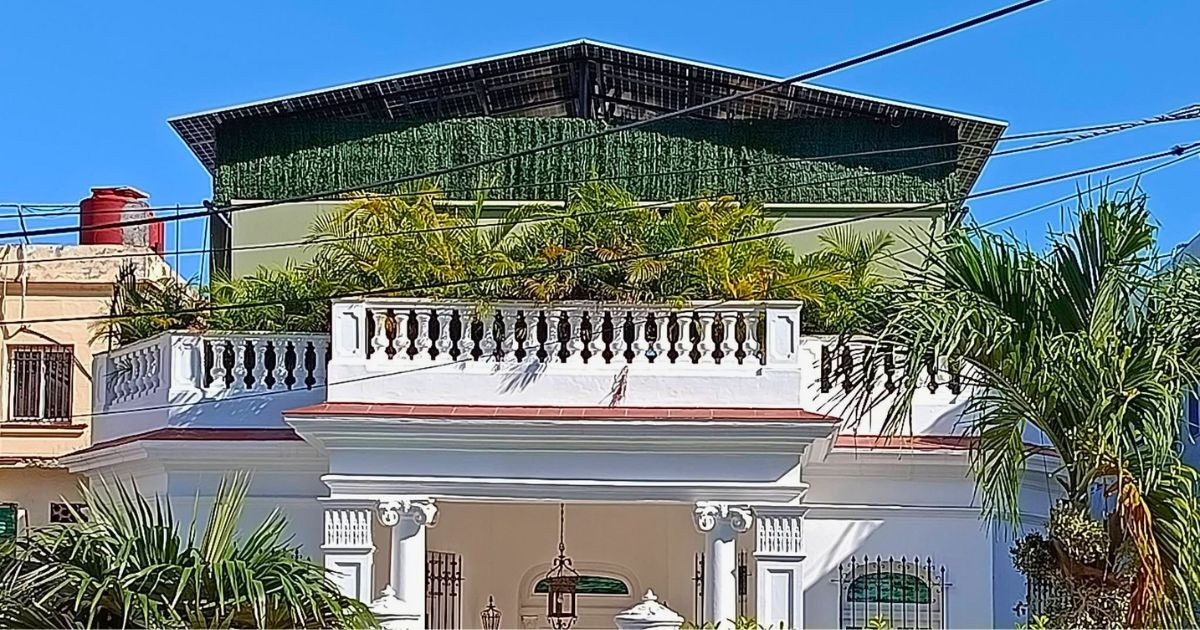
An article by independent journalist Boris González Arenas, published on November 11 in Diario de Cuba, depicts what the Cuban home has become in 2026: a unit of forced self-sufficiency where what was once emergency reserve—water, fuel, candles, food—has turned into the main source of supplies for many families.
González Arenas recounts his visit to a friend’s house in a Havana neighborhood built during the Republican era, well-preserved and inhabited by a hardworking family. What he finds is an inventory of survival: a solar panel on the terrace connected to a portable power station, improvised water pumps, electric pots for cooking in the absence of gas, and a small homemade business to generate income.
The cost of this minimum energy system —the power station, the panel, and the ten-meter cable— was approximately 1,120 dollars, equivalent to more than 1 million Cuban pesos at the . This figure takes on its true significance when compared to the minimum wage effective from July 2026: 3,210 pesos per month. According to González Arenas, someone earning that income would need decades to save up that amount.
But electricity is just one of the shortages. «Not only is there a lack of electricity, but also water, gas, food, and medicine», writes the journalist. The friend who receives him shares that recently «the water was unavailable for 28 days», and at the time of the visit, they had endured 36 hours of blackout. To siphon the scant flow from the water supply, the father-in-law has to bring a pump to the curb, a task made possible only because the family has their own electricity.
This dependence between the electricity crisis and the water crisis is no coincidence: over 80% of Cuban aqueducts require electricity to pump water. According to the National Institute of Hydraulic Resources, at the beginning of November, around 2.6 million Cubans were suffering from supply interruptions, with over 60% of those outages directly attributed to blackouts. In Havana alone, the number of people affected by the water crisis exceeded 536,000, and in some areas, households went as long as 40 days without receiving water.
Gas completes the picture. The state distribution of liquefied gas in Cuba is undergoing a prolonged supply crisis, with documented suspensions since early 2026 in the eastern provinces and supply difficulties in other regions. The shortage has led to the closure of sales points, prolonged waiting times for consumers, and an increasing reliance on alternatives for cooking.
Many families have returned to cooking with charcoal or firewood —a bag can cost up to 5,000 pesos in the informal market— although González Arenas' friend has been able to avoid this thanks to his electric pots.
The food crisis completes the picture. A study from June 2026 estimated that an individual needs around 96,000 pesos per month to cover their basic needs, almost thirty times the official minimum wage. The Food Monitor Program reported that 96.91% of Cubans had inadequate access to food that year, and a survey conducted in 2025 revealed that 33.9% of households had at least one member who went to bed hungry.
González Arenas also describes the social dimension of this forced self-sufficiency: during his visit, the friend stored food in his freezer for a neighbor, cooked spaghetti for an elderly woman, and charged the phone of another acquaintance. They talked, he writes, about "the need to help those in need and the impossibility of doing so on the scale that overwhelming poverty requires, as well as the dangers added by the increase in scams and violent assaults".
The journalist, who has systematically suffered abuses and harassment from the regime, has reflected on the challenges of independent journalism in Cuba in a context of systemic collapse.
The article concludes with an image that encapsulates decades of decline: "From the home of yesteryear, a place of rest for the citizen, we have transitioned to this sort of bunker inhabited by a figure caught between seeking refuge and gathering strength for the next battle."
Related videos:
Filed under: