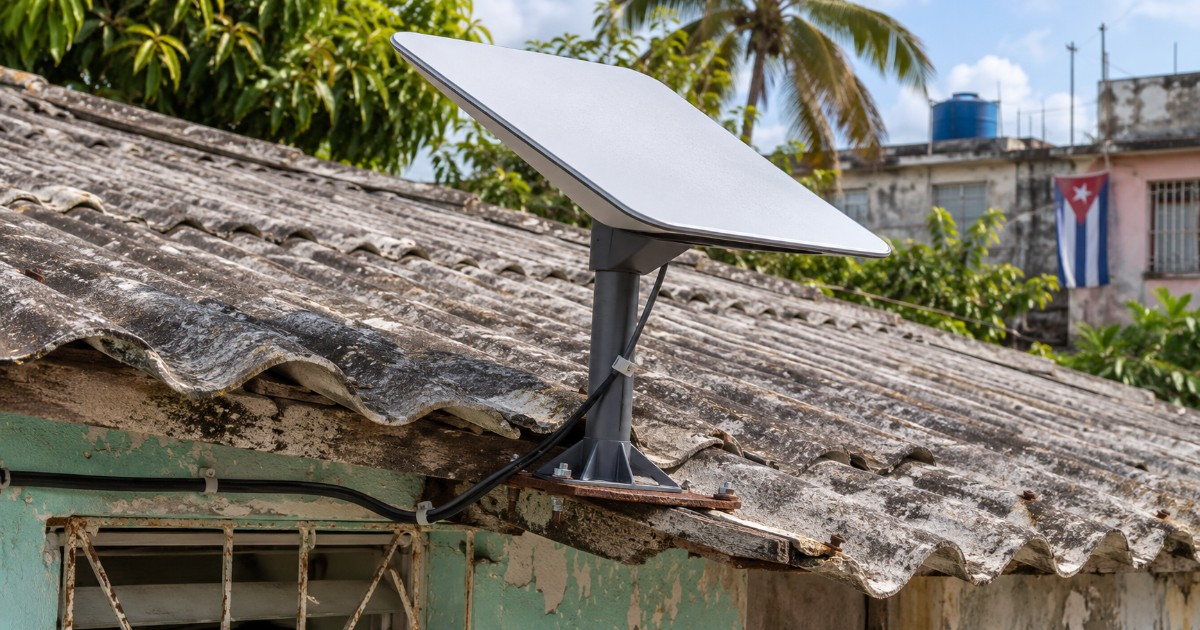
The Cuban police conducted searches in homes in the municipality of Placetas, in Villa Clara, and Starlink satellite internet antennas, according to an official statement released this Tuesday.
The operation confirms police actions against these devices amid reports of a campaign to identify those who use internet connections outside of the state infrastructure.
The officialist profile Fuerza Pueblo, which shares information aligned with the Ministry of the Interior (MININT), announced this Tuesday the seizure of the three devices as part of what the authorities call "confrontation with illegal activities."
“Officers from the Placetas territory police conducted searches in homes, uncovering 3 Starlink satellite antennas,” the post stated, which deemed the possession of these devices and their entry into the country without authorization as illegal.
The message also warned that the importation and possession of Starlink terminals without the appropriate permits constitutes a violation of Cuban customs regulations.
The publication did not specify how many homes were registered during this new campaign by the regime, whether there were any arrests or fines issued, or what happened to the antenna owners.
The announcement comes just hours after reports emerged regarding preparations to locate the homes where Starlink antennas are operating.
In information published this Monday, testimonies shared by the independent newspaper 14ymedio were gathered regarding an alleged operation to identify, block by block, the owners of these devices.
One of the testimonies came from the Los Sitios neighborhood in Central Havana, where a resident claimed to have received information about a supposed uprising involving participation from structures linked to the Committees for the Defense of the Revolution (CDR).
The warning led some users to remove their antennas or consider hiding them out of fear of raids, seizures, and penalties.
Until that moment, there was no official confirmation of a nationwide operation. The seizure now announced in Placetas demonstrates that searches against these devices are being conducted in that locality of Villa Clara.
Restrictions against Starlink have recently extended to diplomatic missions as well. A week ago, the Ministry of Foreign Affairs notified embassies and international organizations accredited in Havana that they were also prohibited from importing or using terminals of that brand.
The Foreign Ministry recalled a provision from January 2025 that prohibits the use of those devices in Cuban territory, a measure justified by the Government with arguments related to sovereignty over the radio spectrum and national security.
The offensive against these services did not begin this week. In October, another pro-government profile reported on supposed sentences of four to five years in prison for several Cubans involved in the marketing of Starlink antennas in Santa Clara.
That publication stated that during the raids, 37 devices were seized and that some buyers received fines of 100,000 Cuban pesos (CUP).
Starlink, developed by SpaceX, the company founded by Elon Musk, allows users to connect to the internet through a network of satellites without relying directly on the terrestrial infrastructure of ETECSA, the state telecommunications monopoly in Cuba.
Although the service is not officially marketed on the island, some Cubans have managed to use it through devices brought in from abroad and connections contracted outside the country.
In March 2026, Musk confirmed that the technology works in Cuba, although it cannot be sold officially there.
The use of these antennas has increased as an alternative to ETECSA's connectivity issues, exacerbated by power outages, the deterioration of infrastructure, and limitations on internet access.
For the Cuban authorities, however, satellite connections that operate outside of state networks represent a control issue over communications.
Officials from the Ministry of Communications have warned that Starlink allows for the transmission of information through foreign infrastructure without the State being able to directly oversee those communications.
Related videos:
Filed under: